
Bio Essence Corp’s Shift to Outsourced OEM Services Amid Legal and Liquidity Challenges
Bio Essence has transitioned from subsidiary manufacturing to outsourced OEM services, driving revenue growth but facing significant legal and financial headwinds.
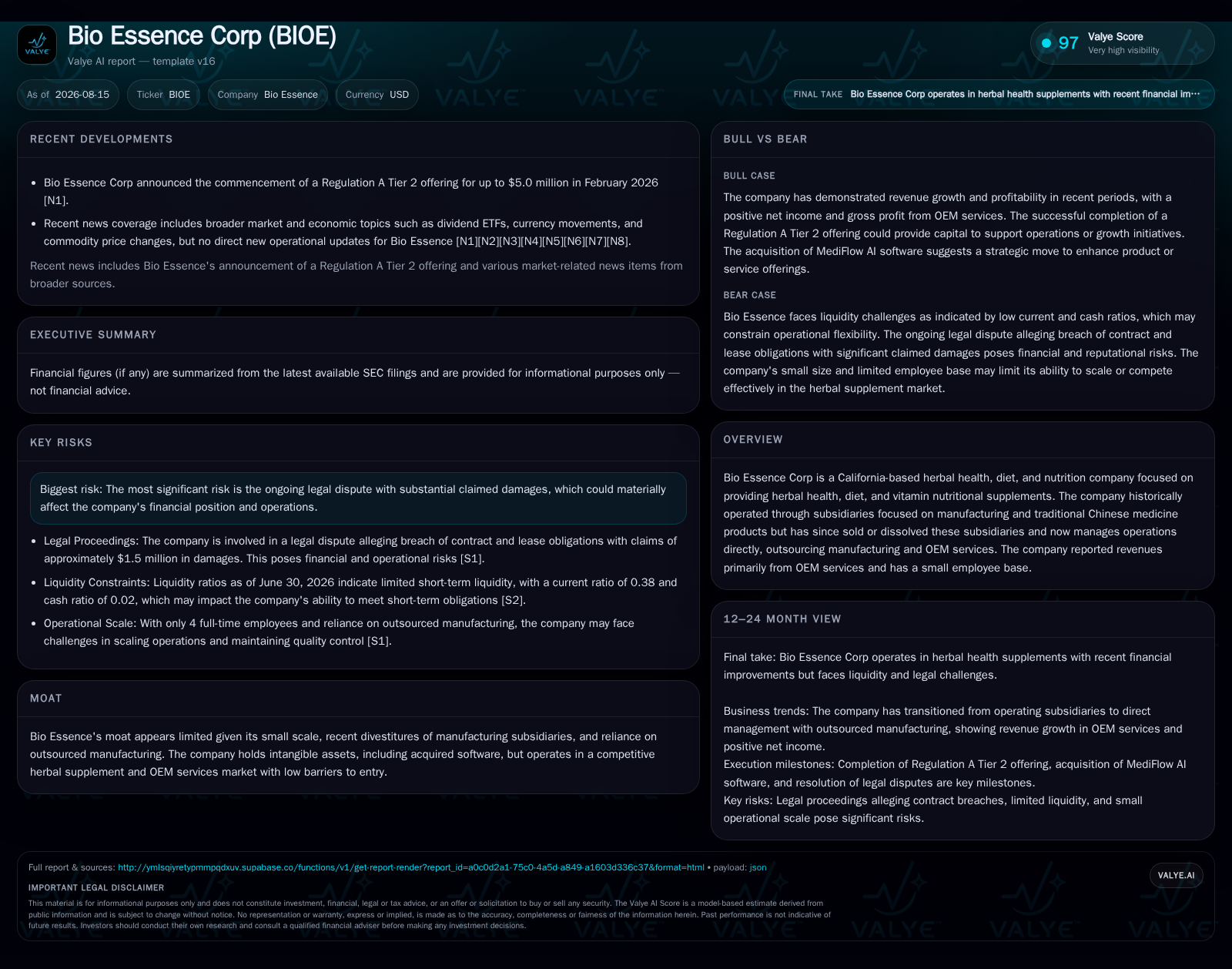
Bio Essence Corp, a California-based herbal health supplement company, reported substantial revenue growth driven by increased OEM manufacturing orders and new customers in its latest quarter. The company has divested its manufacturing subsidiaries, now managing operations directly and outsourcing production. However, it is contending with a significant legal dispute alleging breach of contract with potential damages exceeding $1.5 million, alongside ongoing liquidity constraints reflected by a working capital deficit and low current ratio. Despite operational improvements, these risks create material uncertainty around Bio Essence's financial stability and future growth trajectory.
Recent Operating Update
Bio Essence attributes this growth to a strategic pivot emphasizing OEM service revenue rather than direct product sales—consistent with its transition away from subsidiary-operated manufacturing facilities toward full outsourcing post-December 2023 [S1], [S8]. This shift liberated capital from owning physical plant but increased dependence on external contract manufacturers.
Business Model Analysis
Originally structured as a holding company for multiple subsidiaries specialized in manufacturing (BEP) and traditional Chinese medicine distribution (BEH), Bio Essence divested these in late 2023 and early 2024 via equity sales totaling approximately $700K. McBE Pharma Inc., focused on pharmaceutical R&D, was dissolved subsequently without meaningful operations [S1]. The parent company now manages product formulation, marketing, sales, and business relationships directly while engaging third-party Original Equipment Manufacturers (OEMs) to produce its health supplements and nutraceutical products under contract.
Revenue generation depends primarily on OEM service agreements where Bio Essence offers formulation expertise and brand stewardship but outsources physical production. Its customer base concentrates heavily—the company disclosed two major vendors accounted for over 65% of total manufacturing services recently—and few large customers dominate sales aggregation [S4]. This high vendor and customer concentration elevates operational risk through potential supply disruptions or contract renegotiation challenges.
Margins exhibit sensitivity to manufacturing cost ratios impacted by outsourced vendor pricing dynamics. While Bio Essence benefits from nimble capacity scaling without owning capital-intensive production assets, this tradeoff naturally limits margin expansion during periods of supplier cost inflation or capacity tightness common in herbal supplement outsourcing segments.
Industry Structure and Competitive Positioning
Bio Essence competes within the fragmented herbal health and nutritional supplements industry characterized by low entry barriers but intense competition centered on product formulation innovation, regulatory compliance adherence (e.g., Good Manufacturing Practices - GMP), and brand differentiation. Its position focuses on midstream activities—product design, branding, distribution strategy—while leveraging contract manufacturers for production efficiency.
Peers in similar market niches including OEM-dominant firms and private-label providers balance scale advantages with product breadth. Larger entities like NOW Foods or Nature's Sunshine maintain more diverse brand portfolios and vertical integration that afford better customer reach and pricing power absent at Bio Essence’s scale.
The company’s modest employee count (four full-time as reported) reflects streamlined internal operations relying on outsourced competencies but also implies limited capacity for rapid internal innovation or market expansion beyond current OEM contracts [S1]. Without broader brand recognition or proprietary formulations backed by R&D depth post-subsidiary divestitures, Bio Essence faces challenges sustaining meaningful differentiation against both branded competitors and other contract manufacturers.
Growth Drivers
Bio Essence's recent OEM revenue surge suggests potential momentum leveraging growing demand for natural health supplements within preventive healthcare trends. Expanded production orders from new major customers point to successful vendor partnerships possibly enabling enhanced utilization of outsourced manufacturing capacities.
Increased consumer interest in dietary supplements featuring herbal extracts coupled with regulatory clarifications favoring product introductions could underpin additional contract wins or private label expansions. New product innovation remains plausible though limited direct disclosures about pipeline initiatives exist beyond acquisition of MediFlow AI software assets—a few million dollar stock issuance transaction indicating possible future digital integration attempts into operations or supply chain management [S8], [S18].
Moreover, the company’s ability to maintain reduced general & administrative overhead while growing top-line supports operational scalability assumptions despite limited fixed asset ownership.
Risks and Watchpoints
The predominant risk overshadowing Bio Essence’s operational advances is an ongoing legal dispute filed February 2026 by Stason Industrial Corporation seeking over $1.5 million damages related to alleged breaches of commercial lease obligations and laboratory/pharmaceutical processing contracts tied to former facilities usage [S10], [S18]. Management recognizes the probable loss exposure reflecting this liability accrual but denies allegations with counterclaims planned.
This lawsuit poses material financial strain given that accrued lease liabilities approximate the claim amount; any adverse judgment or settlement could pressure cash flows further complicating liquidity management already constrained by working capital deficits—current assets were $606K against current liabilities surpassing $1.6 million as of June 30, 2026 (ratio ~0.38) signaling tight short-term funding conditions [F1], [S2].
Additionally, reliance on two key manufacturing vendors contributes considerable supply concentration risk that could disrupt order fulfillment if vendor issues arise or contract terms sour. Customer concentration also heightens revenue volatility if large contracts are lost or renegotiated unfavorably.
Related-party loans exemplify potentially conflicted financial arrangements impacting governance quality—a $500K note at fixed interest extended recently to CEO-controlled Golden Capital further reduces standalone liquidity buffers amid repayment uncertainties near mid-2027 deadlines [S2]
Finally, diminished scale post-subsidiary divestitures restricts product diversification; combined with intense market competition comprising well-capitalized peers possessing deeper brand equity may impede sustainable market share gains without new strategic initiatives.
What To Watch Next
Key near-term milestones include monitoring resolution progress against Stason litigation claims that materially influence financial outlooks; management’s stance on pursuing aggressive counterclaims versus settlement will provide insight into expected loss severity.
Tracking quarterly OEM order volumes along with retention rates among significant customers can indicate sustainability of recent revenue tailwinds beyond one-off contract spikes.
Updates on vendor diversification efforts or renegotiations could mitigate supplier concentration vulnerability—a positive sign if achieved would reduce operational risk profiles considerably.
Capital raising activities or refinancing negotiations will be critical to address working capital deficits unless operating cash flow rapidly improves through margin expansion or payment term optimization.
The current ratio stood at approximately 0.38 as of June 30, 2026 [F1], highlighting constrained short-term financial resilience consistent with smaller reporting companies operating at early commercialization stages.
While net income improved substantially—in part due to increased gross profit from amplified OEM shipments—the firm’s operational cash flow turned negative by about $352K during the quarter ended June 30 reflecting outflows linked principally to prepaid expenses increases and reductions in customer deposits [S20]. Financing activities during recent quarters included proceeds from stock issuances totaling roughly half a million dollars providing some relief but dependent heavily on related party transactions limiting independent funding options [S5], [S20].
The debt profile includes federal disaster loans granted under EIDL programs covering COVID-19 impacts totaling approximately $215K, which are low-interest and long maturity obligations that reduce immediate pressures but remain incremental fixed obligations [S2]
Overall financial health signals elevated refinancing risk requiring careful attention to capital structure optimization alongside pursuit of operational efficiencies ensuring cash generation capabilities improve sufficiently before material external financing becomes imperative.
Disclosure: This analysis is provided solely for informational purposes without any investment advice or research view. It relies exclusively on publicly available SEC filings as cited and industry-standard analytical frameworks without speculation beyond supported evidence.
Disclaimer: This is research-only, informational analysis and not investment advice. It may include AI-generated interpretation and general industry context. Always verify important details using primary sources.

Comments