
Citius Oncology’s Post-Launch Execution and Debt Milestones Dictate Near-Term Outlook
A nascent commercial launch of LYMPHIR intersects with milestone-based debt financing, shaping Citius Oncology’s short-term operational and liquidity profile.
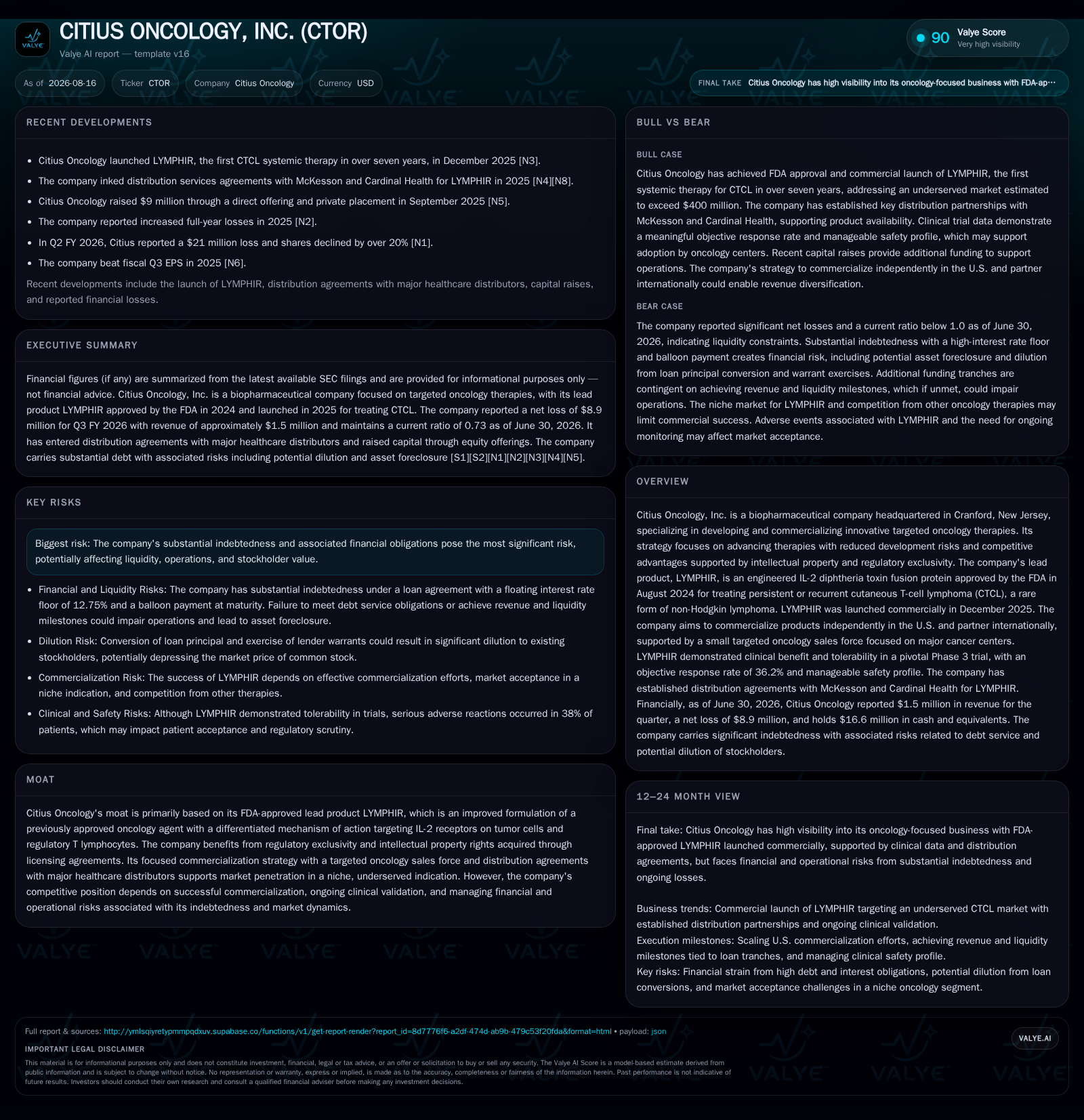
Citius Oncology entered its early commercial phase with FDA-approved LYMPHIR targeting cutaneous T-cell lymphoma (CTCL), reporting initial revenue of $1.49 million for the quarter ended June 2026. The company utilizes a specialized oncology sales force focused on major cancer centers in the U.S., aiming to expand through partnerships internationally. However, substantial indebtedness structured in milestone-conditioned tranches carrying high floating interest rates imposes financial constraints and liquidity risks as the firm faces forthcoming amortization obligations and balloon payments. Success in sustaining commercial momentum and meeting revenue milestones is critical to unlocking additional funding and supporting ongoing operations. Label expansions and international licensing represent growth levers, but near-term execution and financing stability remain key watchpoints.
LYMPHIR Commercial Launch Progress Amid Early Sales Metrics
Citius Oncology’s transition from development to commercialization is anchored by LYMPHIR (denileukin diftitox-cxdl), an engineered IL-2 diphtheria toxin fusion protein approved by the FDA in August 2024 for persistent or recurrent cutaneous T-cell lymphoma (CTCL). The product’s commercial launch occurred in December 2025, targeting an underserved niche oncology indication estimated at over $400 million market potential according to management disclosures [S1]. By Q2 2026, the company recorded approximately $1.49 million in product revenue [F1], positioning LYMPHIR’s penetration at an early stage consistent with expected adoption curves within rare cancers.
This modest revenue figure reflects both the nascent lifecycle post-launch and constrained patient population inherent to CTCL. The timing underscores an initial phase reliant on building institutional demand through select cancer centers—a hallmark strategy for targeted oncology products where prescriber education and payer reimbursement negotiations typically lag approval timing.
Intellectual Property and Regulatory Exclusivity Underpinning Competitive Positioning
Citius Oncology’s competitive moat leverages regulatory exclusivity afforded post-FDA approval combined with proprietary intellectual property rights stemming from licensing arrangements covering LYMPHIR’s novel fusion protein formulation. This IP portfolio effectively blocks biosimilar competitors for the foreseeable future within the CTCL indication, mitigating substitution risk common in biologic oncology franchises [S1], [S2].
Such regulatory protections are crucial given high development costs typical of engineered biologics; they facilitate pricing leverage in negotiations with payers despite reimbursement pressures per evolving healthcare reform dynamics [S1]. Continued patent enforcement alongside exclusivity periods directly impacts sustainable revenue streams and supports longer-term valuation assumptions.
Oncology Sales Force Deployment Targeting Niche Patient Segments
Reflecting its strategic focus, Citius Oncology has deployed a compact yet specialized sales force dedicated to oncology professionals at major U.S. cancer treatment centers—the primary referral points for CTCL patients. This focused sales model aligns with best practices observed among comparable biotechs like Seattle Genetics and Immunomedics, which prioritize knowledgeable engagement over expansive generalist sales teams due to limited patient populations and high specialization requirements.
While efficient from an operating expense perspective, this approach inherently limits rapid volume scale-up but optimizes return on sales investment amid a complex prescription environment requiring extensive physician education about LYMPHIR’s mechanism and clinical benefits [S1]. It represents a tradeoff between reach and resource allocation typical in rare oncology therapeutics commercialization.
Milestone-Based Debt Financing Structure and Its Operational Implications
The company’s capital structure is heavily influenced by a tiered loan agreement totaling $10 million as of June 30, 2026, characterized by a substantial floating interest rate floor set at 12.75% per annum during an interest-only period followed by mandatory amortization including principal repayment plus a significant balloon payment of approximately $1.06 million at maturity [S2], [S4], [F1]. This financing arrangement conditions access to subsequent Tranche 2 and Tranche 3 funds upon achieving defined net revenue thresholds and liquidity metrics.
The operational implication is that failure to meet these financial milestones could preclude unlocking additional financing necessary to sustain commercialization efforts or pursue pipeline development activities. The loan’s lien encumbers substantially all company assets, including valuable intellectual property, exposing Citius Oncology to foreclosure risk if covenants are breached—potentially jeopardizing going concern status given reliance on these R&D assets for future growth [S2], [S4].
This structure creates an acute interdependency between commercial execution success—manifested through sales growth—and financial viability, intensifying pressure on management amidst early-stage revenue figures.
Growth Opportunities Through Label Expansion and International Partnerships
Beyond U.S.-centric commercialization efforts, Citius Oncology is pursuing strategic growth avenues via label expansion trials assessing LYMPHIR's efficacy in other oncologic indications such as gynecologic cancers when combined with immune checkpoint inhibitors; preliminary investigator-initiated studies have reported encouraging Phase 1 results announced earlier this year [S15]. Such expansions could significantly broaden addressable markets subject to successful pivotal trials leading to regulatory approvals.
Internationally, the company initiated shipments of LYMPHIR into Europe through regional distribution partners starting April 2026, marking a shift towards leveraging external partners for non-U.S. market access while conserving internal resources devoted domestically [S21], [S24]. This hybrid model potentially balances scalable global reach with controlled fixed costs but depends heavily on partner execution capabilities.
Liquidity Risks and Cash Burn Headwinds in Early Commercial Transition
As of June 30, 2026, Citius Oncology held cash and cash equivalents of approximately $16.5 million against total debt of $10 million resulting in a net positive cash position but accompanied by a current ratio below one (0.73), underscoring liquidity constraints when short-term liabilities are considered alongside working capital needs [F1]
Cash burn remains elevated due to simultaneous investment in sales infrastructure rollout for LYMPHIR commercialization alongside R&D expenditures aimed at pipeline advancement and regulatory compliance costs as a public entity following its merger completion timeline starting late 2023/early 2024 [S1], [S2].
The combination of cash utilization intensity and looming debt amortization schedules poses material risks requiring prudent expenditure management or successful capital raises/refinancing—which face uncertainty given milestone contingencies embedded within loan agreements.
"What To Watch": Upcoming Milestones, Revenue Trajectory, and Financing Triggers
Critical upcoming markers include quarterly net revenues serving as gating criteria for accessing additional loan tranches; failure here could precipitate liquidity shortfalls or necessitate alternative financing arrangements under potentially dilutive or costly terms [S2], [S3]. Regular updates on sales trajectory serve as real-time demand gauges informing both internal forecasts and external investor expectations.
Concurrently, monitoring progress on label expansion clinical programs may signal future revenue diversification potential affecting long-term valuation support; delays or failures here would reinforce dependency on narrow current indications. International partner effectiveness in scaling non-U.S. distribution will also materially influence medium-term growth profiles.
Financial Profile Discussion: Balancing Cash Reserves Against Debt Amortization Needs
Citius Oncology's financial position as of mid-2026 presents a delicate balance between available cash reserves ($16.5 million) relative to debt service obligations including principal amortization onset post-interest-only period under its $10 million loan facility bearing high-cost floating rates above a substantial floor (12.75%) plus balloon payments nearing $1 million at maturity [F1], [S2], [S4].
Operating losses persist driven by ramping commercialization expenses coupled with continued pipeline investment typical for early-stage biotech transitioning toward commercial viability; recent filings record operating losses exceeding $23 million annually prior to considering full commercial scale effects consistent with sector norms during initial product launches (Q3FY25 data) [F1]
It intentionally excludes investment advice or price targets.*
Disclaimer: This is research-only, informational analysis and not investment advice. It may include AI-generated interpretation and general industry context. Always verify important details using primary sources.

Comments