
Citius Pharmaceuticals’ Debt-Backed Commercialization Faces Milestone and Liquidity Risks
Citius Pharmaceuticals’ recent quarterly update spotlights its milestone-dependent debt structure and challenging liquidity amid ongoing commercialization efforts.
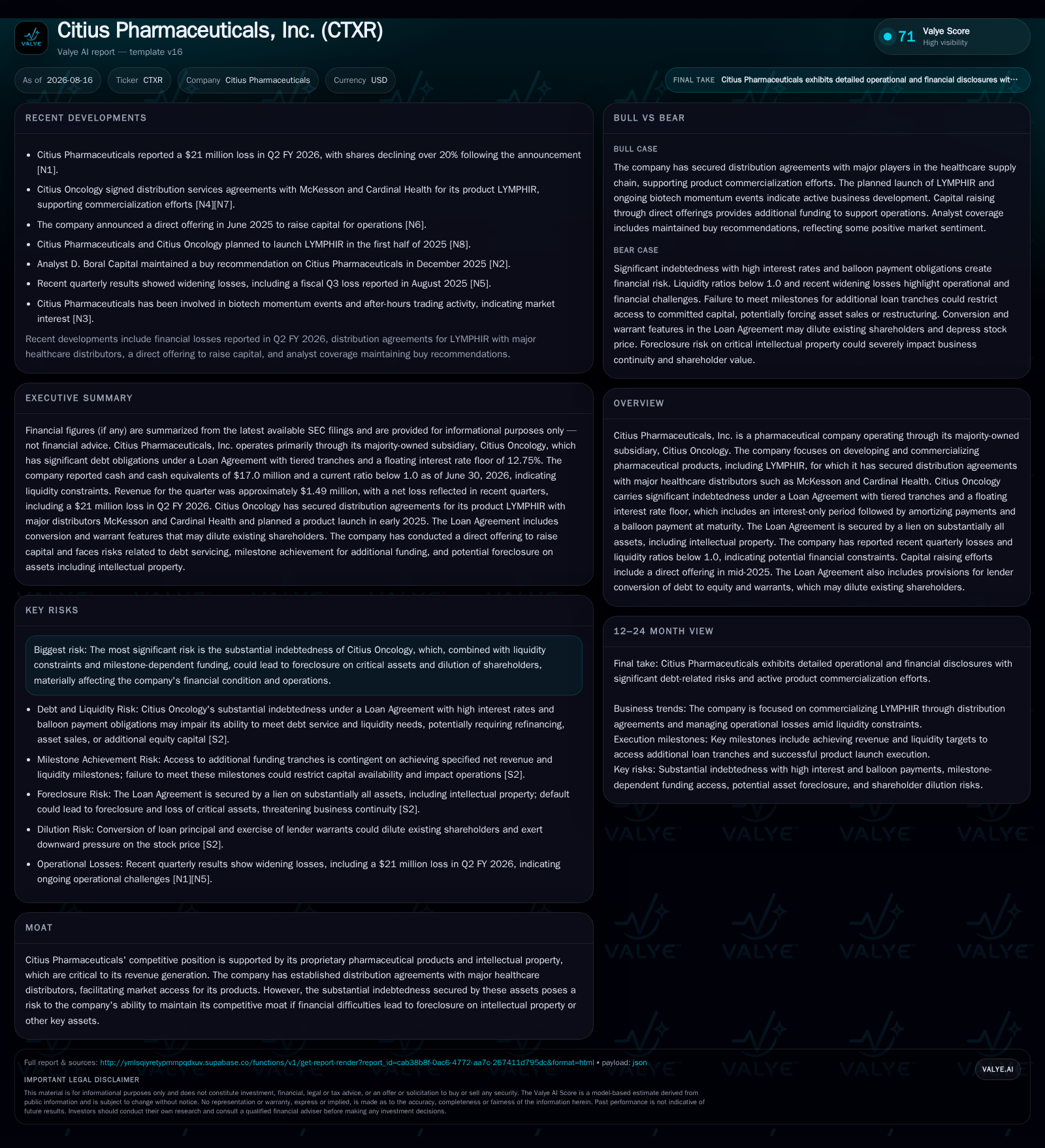
Citius Pharmaceuticals operates primarily through its majority-owned subsidiary, Citius Oncology, focusing on developing and commercializing pharmaceutical products like LYMPHIR™. The company has secured distribution agreements with major healthcare distributors to support market access. However, a tiered loan agreement with substantial indebtedness, high floating interest rates, and milestone-based tranche availability constrains financial flexibility. Recent filings reveal strained liquidity with a current ratio under 1.0 and upcoming balloon payment obligations that heighten refinancing risks. Operational progress depends crucially on achieving revenue milestones to unlock further debt tranches and expanding institutional demand for LYMPHIR™.
Recent Quarterly Update Highlights Financial Constraints
Citius Pharmaceuticals’ latest quarterly filing for the period ended June 30, 2026 reveals continuing operating losses alongside strained liquidity metrics that underscore financial pressure on the business [F1]
This liquidity environment is complicated by Citius Oncology’s substantial indebtedness under a tiered Loan Agreement featuring a floating interest rate floor at an elevated 12.75% per annum and an initial interest-only period followed by amortizing principal payments [S2][S4]. The loan also includes a $1.06 million balloon payment due at maturity, which may be challenging to satisfy from available cash flows or refinancing options given ongoing negative operating income trends [S2][F1]. These debt terms amplify refinancing risk and constrain operational flexibility.
Business Model: Proprietary Pharmaceutical Development Supported by Distribution Partnerships
Citius Pharmaceuticals primarily operates through its majority-owned subsidiary Citius Oncology, which develops and commercializes pharmaceutical products anchored by proprietary intellectual property. Its lead commercial product is LYMPHIR™ (denileukin diftitox-cxdl), a biologic targeting oncology indications [S1]. Revenue generation depends heavily on successful product commercialization through established distribution channels and protection of intellectual property rights.
Strategically, Citius Oncology has secured distribution agreements with major U.S. healthcare distributors such as McKesson Corporation and Cardinal Health [S1]. These partnerships are critical for channeling LYMPHIR™ into hospitals, clinics, and specialty pharmacies—key touchpoints for physician prescribing behavior. Monetization is directly linked to product sales volumes achieved through these networks.
To bridge this gap, firms often employ milestone-based financing structures that condition capital availability on clinical progress or early commercial achievements.
Citius Oncology’s tiered Loan Agreement exemplifies this approach by tying access to Tranche 2 and Tranche 3 funds to net revenue and liquidity milestones [S2][S4]. While this reduces lender risk exposure initially, it introduces operational risk if milestones are not met timely—potentially restricting capital access amid ongoing cash burn.
Such financing models are common among peers navigating the transition from clinical-stage development to commercialization but pose challenges balancing R&D expenditures with debt servicing requirements under uncertain market uptake.
Growth Drivers
- Milestone Achievement Unlocking Additional Capital: Access to subsequent loan tranches depends on meeting net revenue thresholds within specified periods; attaining these is crucial for sustaining operations and growth initiatives [S2][S23].
- Expanding Institutional Demand for LYMPHIR™: Recent disclosures highlight growth in institutional accounts ordering the product, indicating increasing market acceptance that could drive sales expansion over time [S6].
- Geographic Expansion via European Shipments: Initial LYMPHIR™ shipments in Europe through regional partners demonstrate efforts to broaden market reach beyond the U.S., potentially diversifying revenue streams [S25].
- Clinical Data Supporting Therapeutic Positioning: Positive Phase 1 investigator-initiated trial results combining LYMPHIR™ with pembrolizumab in gynecologic cancers suggest therapeutic potential that may enhance product differentiation subject to further development [S13].
Risks and Watchpoints
What Investors Should Monitor Next
Key indicators include whether Citius Oncology meets its net revenue milestones unlocking further tranche availability under the Loan Agreement. Quarterly disclosures clarifying LYMPHIR™ revenue progression, expansion of institutional customer base, geographic rollout status beyond initial markets such as Europe, and any capital markets activity addressing refinancing will be critical demand signals.
Additionally, regulatory or clinical updates validating LYMPHIR’s efficacy in oncology settings will materially affect its competitive positioning potential.
Management commentary regarding strategies for addressing upcoming amortization schedules post-interest-only period and plans for the balloon payment will inform execution risk assessment amid existing funding constraints.
Financial Profile Discussion
As of June 30, 2026, Citius Pharmaceuticals held approximately $17 million in cash and equivalents against current liabilities exceeding $51 million, resulting in a current ratio around 0.84—a sign of inadequate short-term liquidity coverage without operational improvements or capital infusions [F1]. Publicly reported total debt remains minimal at $600 thousand from older data; however substantial indebtedness resides within Citius Oncology linked to the tiered Loan Agreement bearing significant obligations not fully reflected in consolidated figures [F1][S2][S4].
Capital raised via registered direct offerings in mid-2025 provided temporary runway extension but milestone contingencies continue limiting full tranche access leaving medium-term financing uncertainty unresolved absent operational inflection points unlocking additional committed capital [S24]
This financial profile depicts a stretched situation where near-term solvency hinges on both meeting commercial milestones fueling LYMPHIR™ revenue growth—and securing manageable refinancing arrangements before principal amortization accelerates.
This analysis reflects information available as of August 16, 2026 from recent SEC filings including the August 14, 2026 Form 10-Q as primary anchor combined with associated event filings.
Disclaimer: This is research-only, informational analysis and not investment advice. It may include AI-generated interpretation and general industry context. Always verify important details using primary sources.

Comments