
MLP’s Maui Land Holdings Support Development Amid Regulatory and Market Challenges
Maui Land & Pineapple Company leverages strategic land assets on Maui to navigate real estate cycles and regulatory complexities.
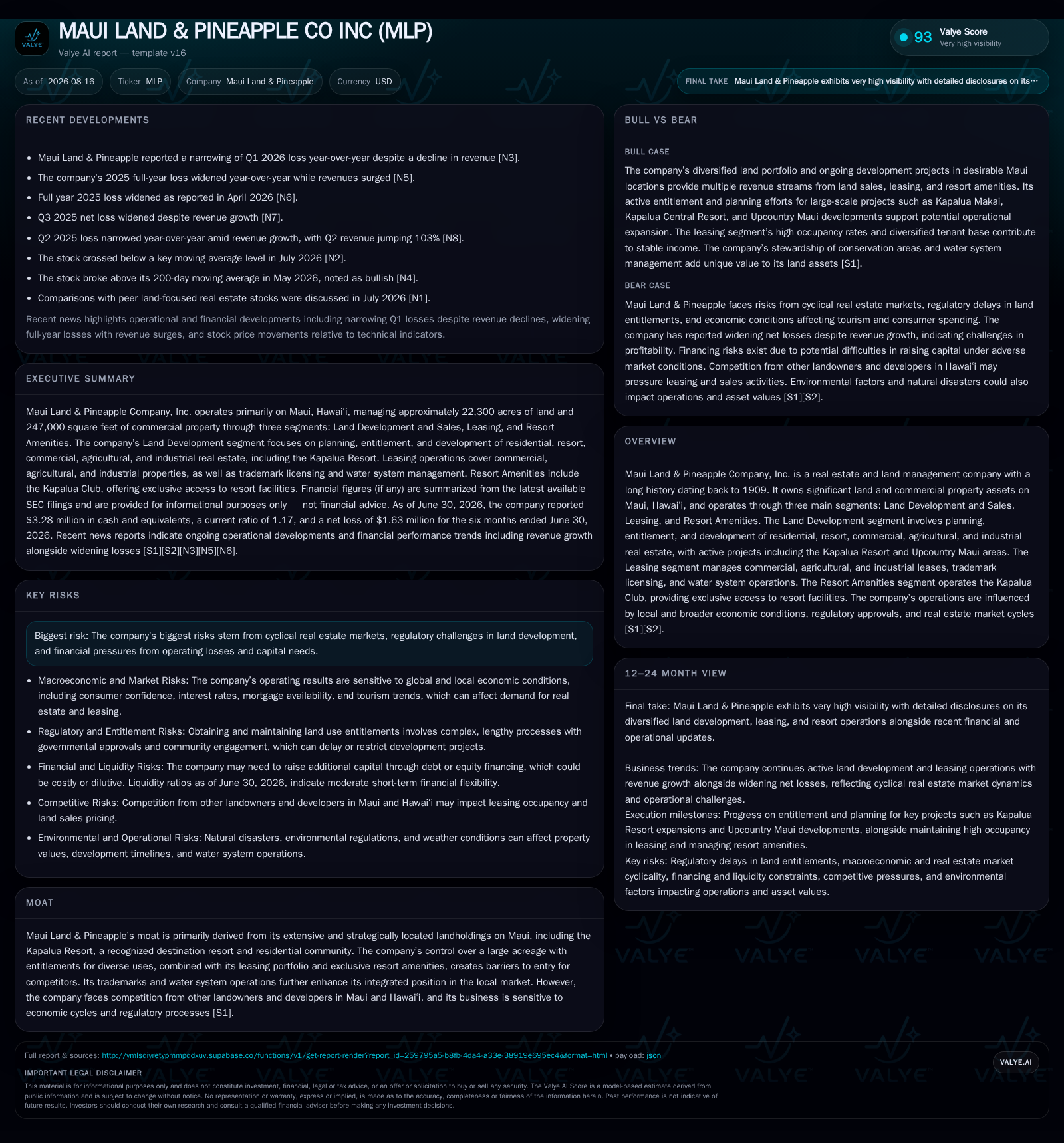
Maui Land & Pineapple Company, Inc. (MLP) operates as an integrated landholder, developer, lessor, and resort amenities provider on Maui, Hawaii. The company’s latest quarterly report reflects ongoing efforts in land development projects including Kapalua Resort expansions and Upcountry Maui initiatives, balanced against cyclical real estate trends and regulatory hurdles. Its business model benefits from controlling high-value acreage with entitlements for diverse uses but faces capital intensity and lease market sensitivities tied to tourism and local economic conditions. MLP's financial condition reveals modest liquidity amid operating losses, underscoring capital management as a key watchpoint for supporting long-term project execution.
Recent Operating Update
MLP’s latest quarterly SEC filing as of August 14, 2026 confirms ongoing stability in its risk profile with no material changes reported despite persistent macroeconomic uncertainties affecting real estate markets broadly [S2]. An accompanying 8-K press release reiterated the company’s operational continuity through the June 30 quarter without notable deviation from prior performance trends [S3][S17]. This steadiness suggests that the company is navigating the well-recognized cyclical headwinds typical for Hawaiian real estate and tourism-facing leasing segments without triggering new risks or exposures.
Business Model Overview
Maui Land & Pineapple Company’s core model revolves around ownership and integrated management of approximately 22,300 acres of strategically located land on Maui alongside nearly 250,000 square feet of commercial properties [S1]. Its revenue streams are segmented into three primary categories: Land Development and Sales; Leasing; Resort Amenities.
The Land Development segment undertakes planning, entitlement approvals, construction management, and sales across residential, resort, commercial, agricultural, and industrial uses. This includes major projects such as the Kapalua Resort—a master-planned destination known for premium residential lots with extensive resort amenities—and large tracts in Upcountry Maui zoned for mixed use with entitlements in place or under development [S1][S28]. Development milestones such as lot subdivision or infrastructure installation directly impact revenue recognition through property sales.
Leasing operations contribute roughly two-thirds of operating revenues (~$12.8 million in the last fiscal year) through diversified leases: commercial office space near resort activities; industrial sites; agricultural lands; plus ancillary income from trademark licensing and potable/non-potable water system operation [S1]. This diversification cushions revenue volatility but ties leasing demand heavily to local tourism trends and broader economic growth patterns affecting tenant businesses
The Resort Amenities business operates the private Kapalua Club—a non-equity membership offering exclusive access to golf courses, pools, dining venues, and other luxury services within Kapalua Resort—generating membership fees which offer relatively stable cash flow independent from development cycles [S1]
Industry Structure and Competitive Position
Operating within the Hawaii real estate ecosystem places MLP amid a complex web of regulatory constraints including stringent environmental controls, zoning laws requiring detailed entitlement approvals, community engagement mandates, and sustainability expectations [S1][S4]. These factors elongate project timelines and add considerable capital expenditure demands that inflate carrying costs.
Despite these challenges, MLP holds a competitive advantage via its expansive parcels carved out across coveted Maui locations featuring natural elevation for ocean views that are highly prized in residential real estate markets. The breadth of entitled acreage allows flexibility in product offering—ranging from luxury single-family homes to mixed-use developments—which diversifies risk across different customer demographics including second-home buyers from continental US west coast markets who typically drive demand in Hawaii’s housing sector [S1][S28].
Peers such as Alexander & Baldwin Inc., also active in Hawaiian land development and leasing realms, operate under similar constraints but may differ in portfolio composition emphasizing commercial versus resort-oriented assets. MLP’s integration of water system operations and trademark royalties further embeds the company into the local economic fabric beyond pure land ownership.
Growth Drivers
Population growth coupled with constrained land supply on Maui sustains long-term demand for new housing developments despite short-term price fluctuations. Tourism market growth fuels leasing segment momentum by supporting commercial tenants engaged in hospitality or retail sectors within resort communities.
Strategic expansions like Kapalua Mauka (with over 900 acres entitled for nearly 640 homes alongside recreational facilities) exemplify MLP's opportunity pipeline potentially unlocking phased sales generating inflows over time [S28]. Moreover, joint ventures executed in Upcountry Maui provide additional capital-sharing avenues while accelerating development pace—yielding milder funding burdens amidst capital-intensive escalation phases.
Ancillary asset monetization—such as expanding potable/non-potable water infrastructure servicing both domestic owners and commercial tenants—bolsters recurring revenue streams with relatively stable usage rates less correlated to volatile real estate transactions.
Risks and Constraints
Cyclical slowdown risks remain pronounced given pockets of weakened consumer sentiment or tightening mortgage financing conditions that dampen both sales velocities and lease renewals [S4]. Regulatory delays or changes impose execution risk especially where environmental remediation or wastewater treatment compliance requires costly upgrades as currently underway under a State Department of Health order related to existing facilities.
Lease occupancy rates can fluctuate with macroeconomic shocks reducing demand from resort-adjacent businesses exposed to tourism downturns.
The slow-moving nature of entitlement approvals combined with infrastructural capital needs may amplify carrying costs unfavorably if market conditions soften unexpectedly. Lastly sustainability regulations or potential natural disasters remain perennial operating hazards impacting asset value preservation.
What To Watch Next
Key indicators include tracking development milestones for Kapalua Mauka subdivisions such as entitled lots sold or infrastructure completions signaling presales readiness. Leasing occupancy percentage trends across commercial properties will reveal near-term demand health linked to tourism seasonality.
Monitoring updates on regulatory permissions—particularly wastewater treatment facility remediation—and any shifts in County or State level zoning frameworks could materially alter project timelines or cost structures.
On financials, quarterly cash flow from operations relative to capital expenditures will indicate balance sheet resilience amid ongoing investments. Changes in debt covenant compliance or moves toward incremental equity infusions also warrant observation.
Financial Profile Discussion
As of June 30, 2026 balance sheet data shows MLP maintained cash & equivalents around $3.3 million with current assets totaling $7.7 million against current liabilities near $6.55 million yielding a current ratio of approximately 1.17 [F1]. This modest liquidity snapshot highlights prudent short-term funding but minimal cushion for unexpected outflows.
Reported total debt figures remain elevated, with net debt approximated at $40.5 million after cash offsets indicating significant leverage tied largely to supporting land development activity [F1]. Ongoing compliance with revolving credit facility covenants—which cap liabilities at $45 million—is critical for uninterrupted funding access given anticipated capital intensiveness ahead.
Operating losses reflected in recent annual reporting emphasize reliance on careful cash flow management: latest net income posted a loss near $10.6 million signaling early-stage pre-development spending dominates current earnings profiles necessitating patience until more substantial property sale revenue materializes [F1]
Overall financial posture suggests constrained flexibility but manageable-risk scenario provided project execution milestones proceed timely accompanied by measured sales progress collateralizing future profitability pathways.
This analysis synthesizes publicly filed information without projecting investment advice or financial forecasts. All metrics are cited directly from official SEC disclosures dated between April and August 2026.
Disclaimer: This is research-only, informational analysis and not investment advice. It may include AI-generated interpretation and general industry context. Always verify important details using primary sources.

Comments