
Vulcan Infrastructure & Power’s Capital Crunch and Strategic Pivot Shape Q2 2026 Outlook
Liquidity pressures and a pending PIPE transaction underscore Vulcan Infrastructure & Power Inc.’s near-term operational and financial challenges in cryptocurrency mining infrastructure.
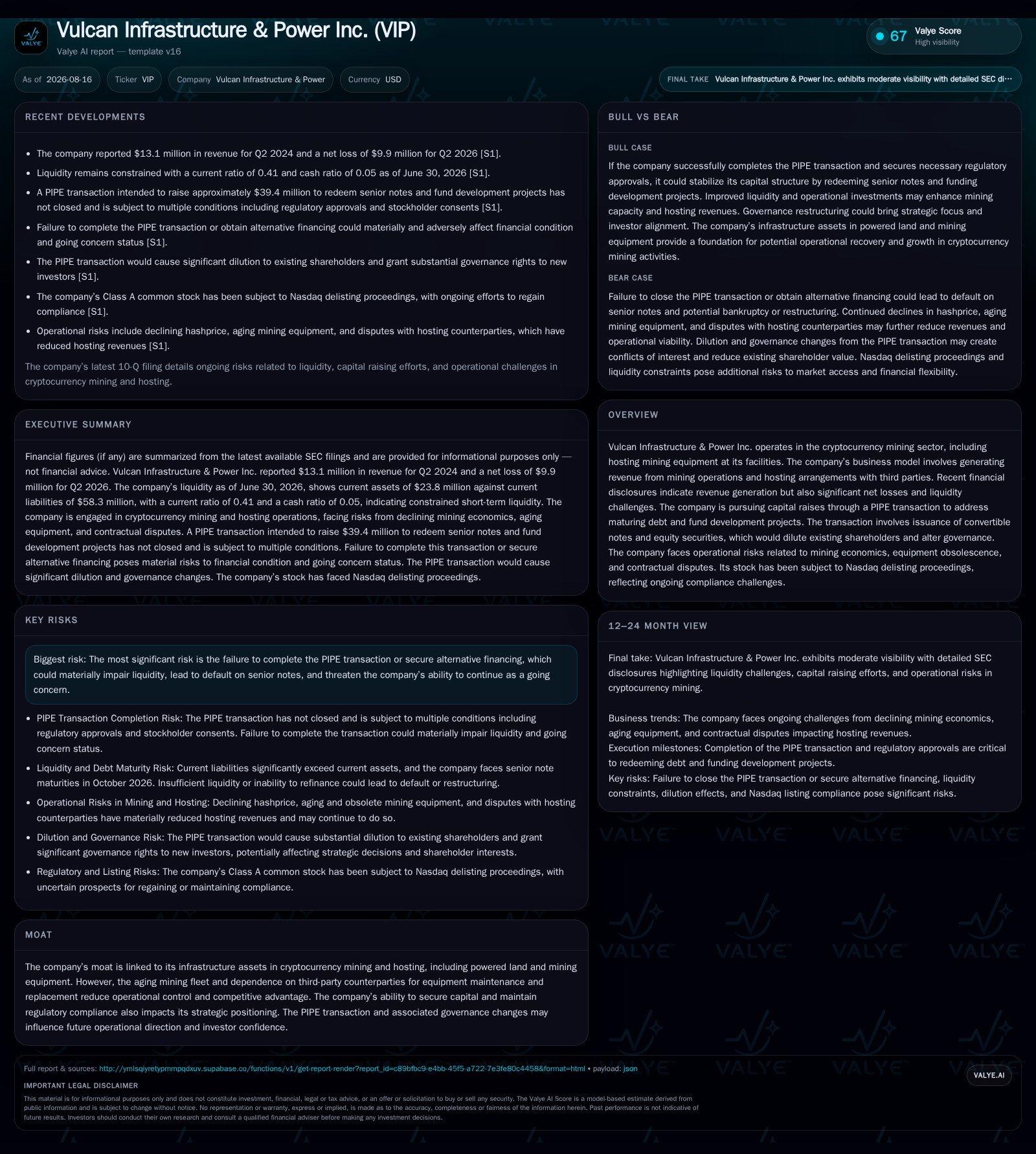
Vulcan Infrastructure & Power Inc. (VIP) reported ongoing net losses and liquidity shortfalls in Q2 2026, with a critical need to refinance $33 million in Senior Notes maturing in October 2026. The company has executed subscription agreements for a $39.4 million PIPE transaction intended to redeem these notes and fund predevelopment efforts at new mining sites. However, the PIPE's closing is conditional and still pending stockholder approval and regulatory clearances, creating significant near-term financing risks. VIP’s business model combining cryptocurrency mining with hosting services faces headwinds from an aging mining fleet, contractual dependencies, and volatile market conditions, weakening its competitive positioning relative to peers like Marathon Digital and Riot Platforms. Operational metrics such as hosting utilization and equipment obsolescence remain key growth levers but are constrained by VIP’s financial and regulatory challenges.
The company reported cash and equivalents totaling approximately $3.2 million against current liabilities of $58.3 million resulting in a precarious current ratio near 0.41—indicating significantly strained short-term liquidity [F1]. This imbalance is underscored by an approaching $33.1 million principal repayment due on Senior Notes in October 2026 [S2][S20]. Failure to meet this maturity without refinancing would threaten VIP's ability to continue as a going concern.
In response, VIP entered into subscription agreements on July 19, 2026 for a $39.4 million Private Investment in Public Equity (PIPE) transaction designed primarily to retire these near-term obligations while funding key predevelopment operations at its Dresden, New York site and its Columbus, Mississippi greenfield project [S5][S20]. Despite executing these agreements, the transaction remains subject to critical closing conditions including receipt of Nasdaq listing approvals for newly issued shares, successful stockholder consent becoming effective post-SEC filing timelines, ancillary agreement executions such as security pledges securing convertible notes tied to the PIPE financing, and certain regulatory clearances beyond the company's control [S10][S17][S26]. Execution risk persists as delays or non-completion would force VIP into alternative but potentially dilutive or restrictive financing strategies.
Alongside capital raises under the PIPE transaction are governance shifts whereby certain investors gain significant rights including board observer privileges and pro rata participation rights extending up to three years post-closing—further diluting existing shareholders’ influence [S23][S26]. Additionally, the issuance includes convertible promissory notes with security interests over substantial company assets including powered land holdings located at potential expansion sites [S22], reflecting creditor protections that underscore the financing risk environment.
Business Model: Mining Operations Coupled with Hosting Services
VIP operates predominantly within the midstream segment of cryptocurrency value creation by running proprietary proof-of-work mining rigs utilizing specialized ASIC miners primarily focused on Bitcoin mining while simultaneously providing hosting services where third-party miners place their hardware within VIP’s facilities featuring power infrastructure and cooling capabilities. Revenue generation consists of two interconnected streams: revenues from mined cryptocurrency sales—the direct output of internal mining—and stable hosting fees derived from contracted colocation arrangements with other miners who pay for electricity supply, rack space, network connectivity, and onsite maintenance services.
The company’s operational profile is shaped by capital-intensive fixed assets including powered land sites at Dresden NY and Underwood ND housing over 6,200 miners currently; however, these assets suffer from aging equipment profiles leading to deteriorating energy efficiency measured by joules per terahash (J/TH) — a critical industry-specific KPI affecting unit economics adversely amid volatile coin prices. Furthermore, maintaining high operational uptime—a metric correlated tightly with hosting utilization rates—is essential to maximize fixed-cost absorption but is challenged by equipment obsolescence alongside maintenance reliance on third-party service providers which constrains control.
Industry Structure and Competitive Positioning
Cryptocurrency mining infrastructure companies like VIP exist in a hypercompetitive environment marked by constant technological evolution necessitating frequent fleet refreshes with increasingly efficient ASIC miners that provide competitive advantages versus peers through lower cost-per-unit hash rate deployment. Peers such as Marathon Digital Holdings or Riot Platforms epitomize scale advantages; they deploy gigawatt-level capacities across geographically diversified sites with access to lower-cost renewable power agreements enhancing margins structurally amid crypto cycles.
VIP contrasts with these players through smaller scale operations concentrated principally at Dresden NY—with expansions planned but delayed due to financing risk—and dependence on relatively older asset bases that degrade gross margin potential absent upgrades funded by robust liquidity inflows. Hosting service competition also intensifies from specialist colocation providers like Core Scientific who can leverage broader network effects to secure longer-duration client contracts offering more predictable revenue streams.
Growth Drivers: Capital Raises Enable Expansion But Execution Remains Key
Growth hinges on several intertwined vectors: successful recapitalization allowing older miner fleet replacement increasing hash rate capacity; scaling hosting facilities with higher utilization rates locking-in recurring revenue; leveraging low-cost electricity contracts improving cost-per-kilowatt-hour metrics; alongside diversification pathways targeting AI/HPC workloads leveraging existing infrastructure synergies described in company disclosures [S10]
The company’s July PIPE transaction is explicitly intended not only for debt redemption but also funding operational expansions at its Dresden site in New York State—a location poised for grid interconnection improvements—and developing new powered land assets in Mississippi allowing future host engagements or proprietary mining deployments subject to regulatory approvals [S20]
However, tangible progress requires clearing multi-layered regulatory hurdles discussed extensively with respect to reporting requirements tied to Nasdaq listing rules affecting equity issuance timing along with collateral pledge enforcement mechanisms protecting convertible note holders – all add layers of execution risk limiting agility.
Risks and Watchpoints: Financing Uncertainty Amid Market Volatility
Foremost risk remains failure to close the committed PIPE financing before October Senior Notes maturity forcing potential debt default or triggering bankruptcy-related restructuring measures impacting shareholder value severely [S2]. The restrictive covenants accompanying the MIG Convertible Note post-closing severely limit additional indebtedness or asset dispositions raising concerns around operational flexibility through next year [S22]
Operational risks have heightened relevance given deteriorating equipment age profiles leading to decreased efficiency potentially inflating energy costs amid rising electricity price environments increasing cost per mined coin unfavorably compared to peers achieving better efficiency benchmarks. Regulatory considerations including environmental statutes affecting power procurement introduce compliance uncertainty especially considering ongoing Nasdaq delisting proceedings noted elsewhere lowering investor confidence.
Customer concentration within hosting arrangements or dependency on specific third-party miners add counterparty credit risk exposures exacerbated if economic downturns induce contract cancellations reducing facility utilization rates crucial for fixed cost coverage.
What To Watch Next: PIPE Closing Milestones And Operational KPIs
Upcoming catalysts include:
- Effectiveness of stockholder consent following SEC filings enabling PIPE closing,
- Receipt of requisite Nasdaq listing approvals facilitating issuance of PIPE shares,
- Finalization of collateral security documents related to convertible note issuance,
- Execution progress on predevelopment work at Dresden NY site raising hosted capacity metrics,
- Operational throughput improvements reflected via updated hash rate capacity disclosures,
- Any material announcements regarding fleet refresh initiatives or AI/HPC workload integration signaling strategic pivot execution,
- Liquidity position updates providing insight on runway past debt maturities.
Monitoring quarterly filings for adjusted revenue splits between mined coin sales versus hosting fees alongside evolving gross margins will gauge whether incremental capital deploys convert into sustainable operating leverage.
Financial Profile Discussion
As of June 30, 2026, VIP carries approximately $36.9 million in total debt against cash and equivalents near $3.2 million yielding net debt near $33.7 million—a leverage scale implying heavy reliance on imminent refinancings or asset monetizations [F1]. Notably elevated current liabilities relative to current assets underpin substantial short-term tension reflected by sub-0.5x current ratio metrics highlighting acute liquidity concerns requiring rapid resolution either via PIPE closing or alternate strategies [F1].
Operative losses continue though precise Q2 profit-and-loss details are not fully disclosed; prior annual periods closed at net loss levels consistent with capital-intensive sector norms given depressed recent cryptocurrency price cycles impacting block rewards values realized per unit hash rate deployed
Summarily, the company’s immediate financial health pivots upon completion of strategic equity-linked capital raises integral for senior note redemptions avoiding forced restructurings while providing resources for growth investments essential for restoring competitive parity vis-à-vis benchmark industry peers.
This analysis relies solely on publicly filed documents through August 14, 2026 combined with industry standard contextual framing relevant to cryptocurrency mining infrastructure operators. It does not constitute investment advice but provides an analytical view into Vulcan Infrastructure & Power Inc.’s operational challenges amidst evolving cryptocurrency sector dynamics.
Disclaimer: This is research-only, informational analysis and not investment advice. It may include AI-generated interpretation and general industry context. Always verify important details using primary sources.

Comments