
Laser Photonics Corp’s Vertical Integration and Market Expansion Amid Liquidity Challenges
Laser Photonics sustains growth through vertical integration, technology licensing, and diversified markets despite ongoing financial constraints.
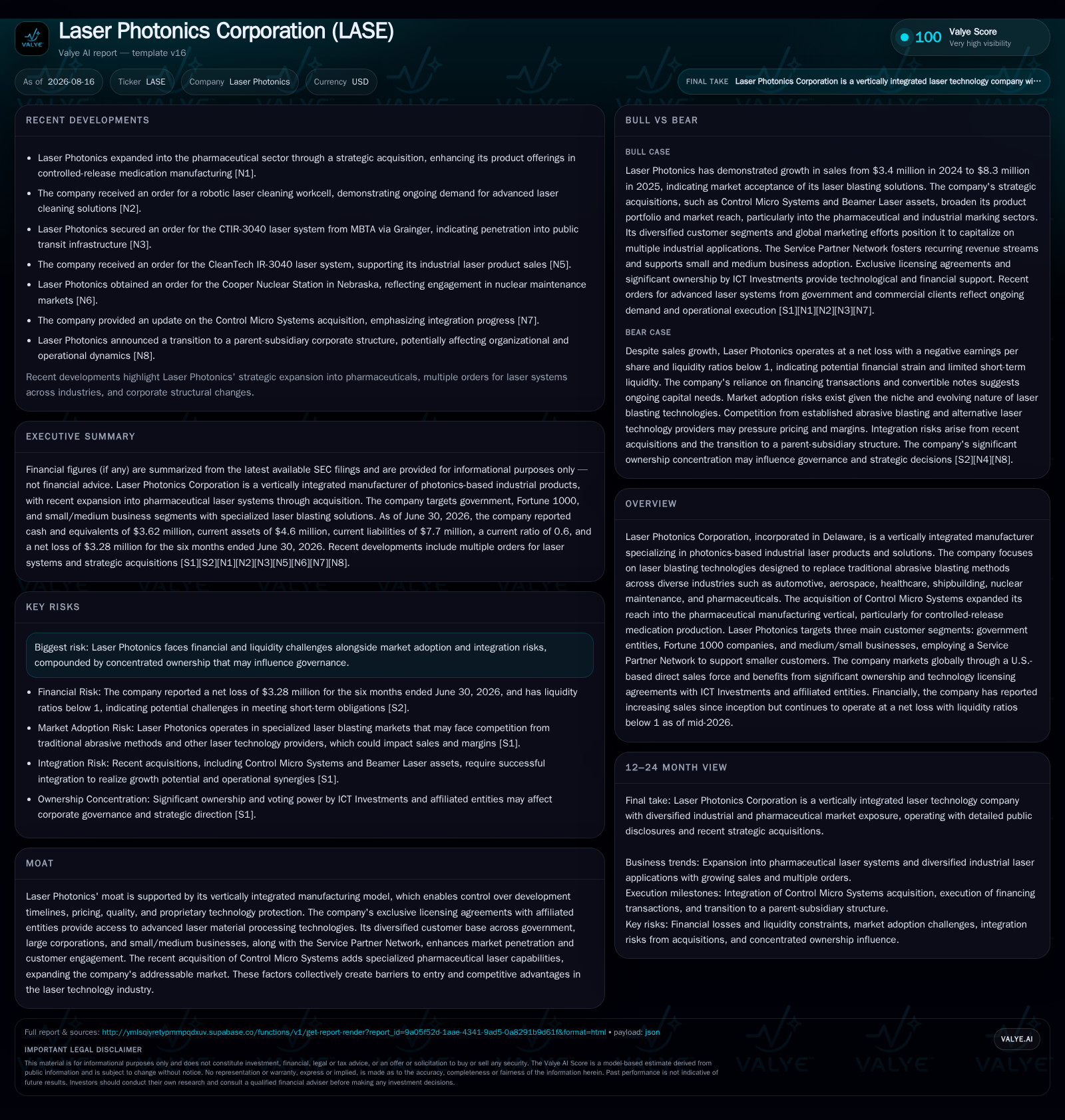
Laser Photonics Corporation, a vertically integrated manufacturer specializing in photonics-based industrial lasers, continues to expand its technological footprint and market reach with recent acquisitions and partnerships targeting government, Fortune 1000, and SMB segments. The company’s latest quarterly report highlights improvements in working capital driven by financing activities but maintains substantial doubt about its ability to continue as a going concern due to recurring losses and negative operating cash flows. Its moat rests on proprietary laser blasting technologies and exclusive licensing relationships underpinning competitive product advantages across multiple industrial sectors, including pharmaceuticals. Key risks remain around liquidity, capital raising, and successful market adoption.
Recent Operating Update
Laser Photonics Corporation's Q2 2026 filing underscores persistent financial strain despite tangible steps toward stabilizing liquidity. The company reported a net loss of approximately $6.2 million for the first half of 2026 with operating cash outflows nearing $4.7 million over the same period [S16]. However, working capital improved somewhat due to a February public offering alongside warrant-induced equity exercises that generated over $2 million in net proceeds post-quarter end in July 2026 [S2]. Management’s commentary signals ongoing capital-raising initiatives combined with cost discipline targeting equipment sales growth and operating cash flow enhancements as immediate remedies for liquidity risk [S2]. Still, substantial doubt about the entity’s ability to continue as a going concern remains unresolved given reliance on external financing sources under uncertain terms.
Business Model Overview
Laser Photonics operates as a vertically integrated manufacturer within the industrial laser systems sector, designing and producing photonics-based laser blasting technologies that primarily substitute traditional abrasive blasting methods. Their product portfolio spans corrosion control, rust removal, laser cleaning, surface conditioning, coating removal, and welding preparation applications across automotive, aerospace, healthcare, shipbuilding, nuclear maintenance, heavy industry, machine manufacturing, and pharmaceutical sectors [S1]. Vertical integration affords them control over critical value chain variables such as manufacturing lead time, pricing strategy, quality assurance, and protection of proprietary technology—advantages that are important in an industry characterized by high R&D investment needs and rapid innovation cycles.
A notable recent strategic move was the acquisition of Control Micro Systems (CMS), expanding Laser Photonics’ addressable market into the pharmaceutical manufacturing vertical. This market is particularly attractive due to its recession resistance and substantial barriers to entry related to precision-controlled-release medication production via laser micro-drilling techniques [S1][S25]. The CMS acquisition included intellectual property rights as well as experienced engineering and support personnel—all expected to be integrated with Laser Photonics’ existing marketing channels.
Revenue streams arise primarily from direct sales of capital equipment to diversified customers segmented into government entities (highly regulated applications), Fortune 1000 enterprises (large-scale industrial users emphasizing efficiency gains), and medium/small businesses (served effectively through a Service Partner Network or SPN enabling demonstration-led sales) [S1][S4][S26]. This hybrid channel model leverages a U.S.-based direct sales force supplemented by partner-driven reach expansion internationally for smaller accounts
The Service Partner Network not only supports sales scalability via mobile demonstration units but also engages entrepreneurs interested in starting small laser cleaning or rental businesses—therefore creating ancillary recurring revenue from lead distribution fees within this ecosystem [S26]. This approach targets SMBs previously unable to afford or operate complex laser equipment due to pricing or technical barriers—a meaningful structural growth opportunity if execution proves sound
Industry Structure and Competitive Positioning
Laser Photonics competes within the broader industrial laser systems industry alongside established peers such as IPG Photonics, Coherent Inc., and Trumpf GmbH—firms offering extensive fiber lasers, photonics components, and manufacturing solutions at considerably larger scale. Unlike these diversified incumbents who serve multiple high-volume sectors including telecommunications and semiconductor fabrication lasers, Laser Photonics focuses on niche disruptive applications like abrasive blasting replacements powered by high-power laser cleaning technologies.
This specialization is both an opportunity—given rising demand for environmentally friendly precise surface treatment—and a challenge due to slower market adoption rates relative to mature laser segments. The company’s vertically integrated model coupled with exclusive licensing agreements obtained through affiliates gives it proprietary technology access shielding it from immediate replication by competitors. These licensing arrangements provide unique know-how in multiple laser material processing applications including cutting, marking, engraving, welding, brazing—all crucial for competitive differentiation [S13].
Additionally, the diversified customer landscape spanning governmental defense contracts (including collaborative projects like the Laser Shield Anti-Drone System for addressing unmanned aerial threats) enhances resilience against sector-specific downturns while extending technological credibility [S4]. However, Laser Photonics remains early stage relative to these peers in scale and profitability metrics.
Growth Drivers
Several structural factors underpin Laser Photonics’ growth thesis:
- Technological leadership via vertical integration: Enables faster product development cycles and tighter pricing control versus competitors reliant on outsourced components.
- Expansion into recession-resistant pharmaceutical manufacturing: CMS acquisition opens lucrative controlled-release medication markets reliant on precision laser processing.
- Service Partner Network scaling: Facilitates penetration into under-served SMBs by reducing cost/access hurdles inherent in industrial laser adoption.
- Government & defense spending: Ongoing projects like LSAD reinforce expansion possibilities within highly regulated public sector clients requiring specialized solutions.
- Replacement of traditional abrasive blasting: Increasing industrial automation trends favor precision laser blasting that reduces environmental/operational downsides inherent in sandblasting.
- Global diversification of customer base: Direct sales force focus on major accounts plus partner-supported localized service boosts international footprint potential.
KPIs relevant here include order backlog size reflecting demand visibility; manufacturing lead times indicating operational efficiency; after-market service revenue signaling installed base growth; technology licensing income reflecting IP monetization effectiveness; as well as customer retention rates highlighting solution stickiness.
Risks and Constraints
Financially, Laser Photonics faces significant hurdles due to recurring operating losses totaling over $13 million in operating income deficit during 2025 alone [F1], coupled with negative working capital estimated at approximately -$3 million entering mid-2026 [F1][S16]. This has compelled reliance on short-term secured loans with blanket liens alongside periodic equity offerings that dilute existing shareholders but are necessary for liquidity maintenance [S2][S19][S20]. While management has taken steps including inducement transactions generating around $2.2 million after Q2 quarter-end by July 2026 alone [S2], continued capital raising is essential yet uncertain.
From an operational perspective, market adoption barriers remain material given customer hesitancy transitioning from tried-and-true abrasive methods to relatively newer laser blasting alternatives. Integration complexities exist especially within pharmaceutical manufacturing where upscaling from prototype testing (such as precision micro-drilling) demands rigorous validation protocols impacting sales cycle length [S1]. Concentrated ownership stakes held collectively above 60% by ICT Investments affiliates may pose governance risks affecting minority shareholder influence on strategic decisions [S13].
Technology risk includes maintaining pacing against rapid innovation cycles characteristic of photonics equipment sectors; regulatory compliance burdens particularly for government contracts; cybersecurity provisions considering connected equipment vulnerabilities; as well as supply chain dependencies for specialized components intrinsic to advanced laser hardware production.
What To Watch Next
Key near-term developments include:
- Progress integrating CMS capabilities into the broader sales infrastructure aiming for accelerated pharma market penetration.
- Expanding orders or demonstrations from government programs including defense-related LSAD anti-drone systems leveraging recent successful prototype tests [S4].
- Reports on manufacturing lead times reduction which would validate vertical integration benefits promised.
- Continued tracking of Service Partner Network expansion metrics reflecting SMB market traction.
- Liquidity events such as successful equity offerings or debt financings mitigating going concern doubts documented through H2 2026 filings.
- Transitioning from development-stage revenue recognition towards sustained recurring equipment sales accompanied by after-sales service growth confirming commercial scalability.
Financial Profile Discussion
As of June 30, 2026, Laser Photonics held current assets totaling approximately $4.6 million against current liabilities near $7.7 million yielding a low current ratio around 0.6—a signifier of tight short-term liquidity conditions [F1]. The company has secured short-term loans under business loan and security agreements with blanket liens on assets, including the 2025 Term Loans and the 2026 Term Loan, both with maturities within months of borrowing dates [S2]. Management has completed warrant exercises and inducement transactions subsequent to quarter-end generating approximately $2.2 million in net proceeds in July 2026 to support liquidity [S2]. Despite these efforts, ongoing operating losses and negative working capital underscore continued liquidity risk and reliance on external financing sources under uncertain terms [S2][S16].
Capital structure features short-dated loans secured by blanket liens requiring refinancing or repayment soonest with prepayment penalties adding complexity to cash management strategies [S2]. Operating losses predominantly stem from costs associated with research & development initiatives maintaining technology edge alongside sales & marketing expenditures necessary for building out commercial footprint in disparate industry verticals requiring longer sales cycles typical for specialized industrial hardware firms.
Overall financial indicators confirm that while the business model exhibits promising structural strengths anchored in vertical integration and exclusive technology licenses enabling differentiated product offerings across growing markets including pharmaceuticals and government defense segments; realization of this potential hinges critically on Laser Photonics securing stable funding sources promptly while ramping revenues sufficiently toward profitability sustainability benchmarks common among industrial laser system device manufacturers.
This analysis is based on publicly available SEC filings dated through August 14th, 2026 (10-Q), annual reports filed April 20th, 2026 (10-K), recent event disclosures up to July 24th, 2026 (8-K), supplemented by companyfacts financial data snapshots ending mid-2026.
Disclaimer: This is research-only, informational analysis and not investment advice. It may include AI-generated interpretation and general industry context. Always verify important details using primary sources.

Comments