
Jupiter Neurosciences Advances Clinical and Licensing Strategy Despite Nasdaq Compliance Risks
Jupiter Neurosciences progresses its neurodegenerative disease therapeutics and longevity supplement business despite acute liquidity and listing compliance challenges.
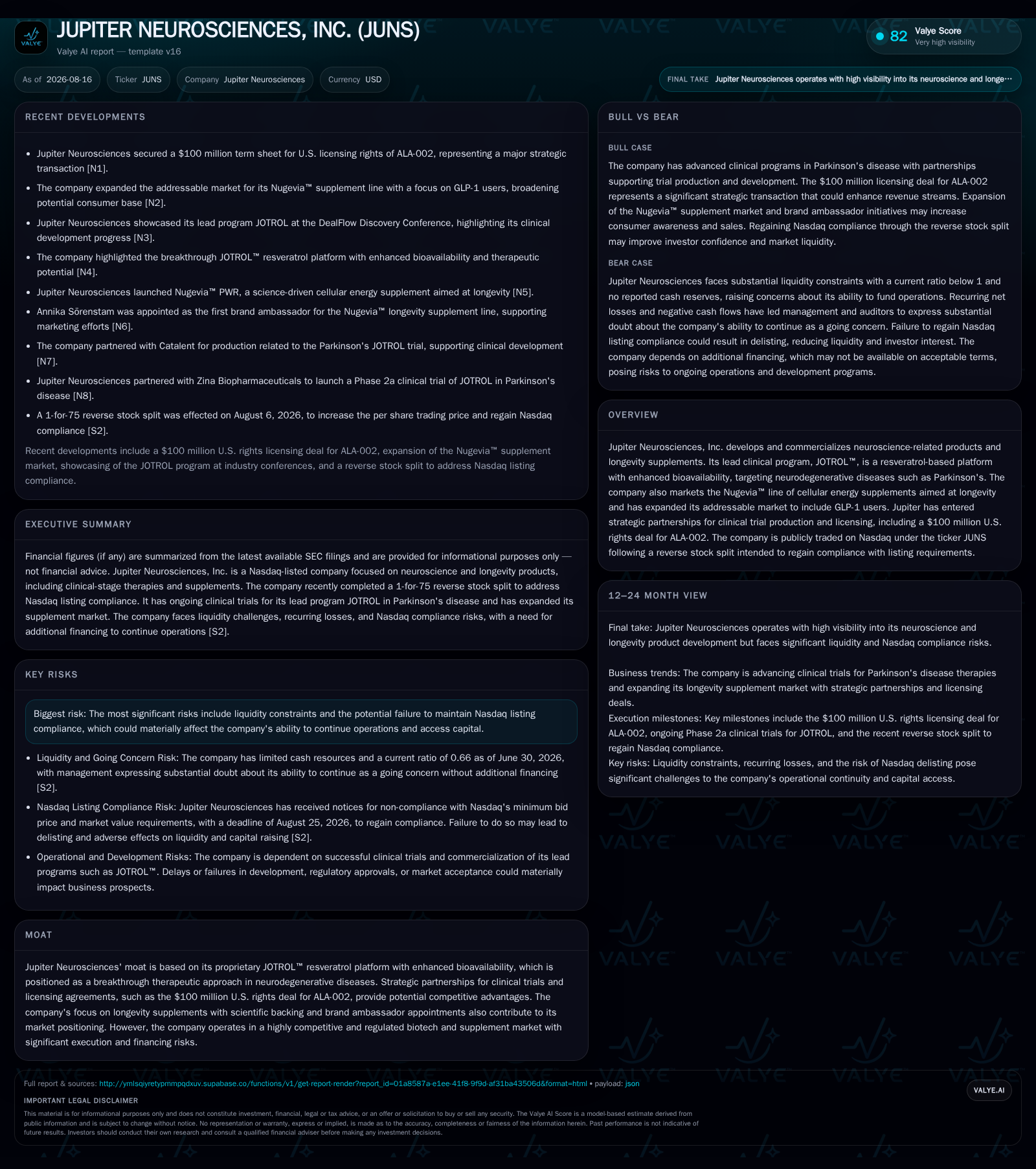
In its latest quarterly filing, Jupiter Neurosciences disclosed significant liquidity constraints that threaten ongoing operations without additional capital. Concurrently, the company fortified its clinical-stage pipeline with a $100 million U.S. licensing agreement for the JOTROL™-based drug ALA-002, targeting Parkinson’s disease and related neurodegenerative conditions. Jupiter also continues expanding its direct-to-consumer longevity supplement brand Nugevia™, leveraging proprietary enhanced bioavailability technology. However, risk persists from Nasdaq listing compliance pressures following a recent reverse stock split and substantial operating losses.
Latest Operating Update Highlights Strategic Momentum Amid Cash Strains
Jupiter Neurosciences’ latest quarterly filing dated August 14, 2026 ([S2]) underscores a pressing liquidity shortfall with current assets of approximately $2.55 million versus current liabilities of about $3.88 million as of June 30, 2026 ([F1]). The company explicitly warns that failure to raise sufficient capital may force severe operational reductions or insolvency proceedings—a scenario frequently encountered by early-stage biotech firms navigating prolonged development cycles before meaningful revenues materialize.
To address Nasdaq’s minimum bid price rule after sustained share price declines, Jupiter executed a substantial 1-for-75 reverse stock split effective August 6, 2026 ([S3][N2]). While this move is a common corrective mechanism to maintain exchange listing eligibility, it reflects underlying market confidence challenges that could complicate future fundraising efforts.
Despite these financial headwinds, Jupiter advanced its strategic pipeline by signing a U.S. rights licensing agreement for ALA-002 ([N1]), a resveratrol-based therapeutic derived from the company’s proprietary JOTROL™ platform. This deal carries potential milestone payments aggregating up to $100 million contingent on clinical progression and regulatory approvals—a crucial near-to-mid-term inflection point validating the commercial viability of their drug delivery technology.
Proprietary Resveratrol Platform Enables Dual Therapeutic and Consumer Revenue Streams
Central to Jupiter’s business model is JOTROL™, an orally administered resveratrol formulation engineered for substantially enhanced bioavailability compared to conventional resveratrol ([S1]). Overcoming resveratrol’s historically poor systemic exposure is essential both scientifically and commercially; improved bioavailability not only enhances therapeutic efficacy but also establishes significant intellectual property barriers against generic competition.
Clinically, JOTROL™ is undergoing Phase IIa trials targeting Parkinson’s disease—a major neurodegenerative disorder with high unmet medical need—positioning Jupiter within a competitive but opportunity-rich segment where successful trial outcomes could unlock further licensing milestones and regulatory advances.
Parallel to pharmaceutical development, Jupiter leverages the same platform in its consumer-facing Nugevia™ line of longevity supplements ([S1]). These products focus on mitochondrial health and cognitive support, marketed directly to consumers via social media channels since late 2025. This hybrid approach enables some early revenue generation through product sales while maintaining long-term upside tied to clinical-stage drug success.
Competitive Landscape: Balancing Biotech Licensing Models and Nutraceutical Market Dynamics
Within the clinical-stage biotech arena focused on CNS disorders, Jupiter aligns with peers reliant on milestone-driven licensing revenues linked closely to regulatory milestones—companies like ACADIA Pharmaceuticals or Axsome Therapeutics provide illustrative parallels (). These firms face intense pressure to demonstrate clinical proof points quickly while managing cash burn.
On the consumer health side, Nugevia competes in a crowded nutraceutical space alongside established brands such as Herbalife and Amway that emphasize science-backed formulations marketed directly to health-conscious consumers (). Success here depends heavily on marketing efficiency and product differentiation anchored in proven bioavailability advantages.
Jupiter’s intellectual property strategy centers on exclusive license rights secured from Aquanova covering key patents related to JOTROL™, providing an essential moat against competitor encroachment ([S1]). Maintaining these protections amid rapid innovation cycles is critical given the bifurcated nature of their business spanning pharmaceutical R&D partnerships and consumer product commercialization.
Growth Drivers: Clinical Advancement and High-Value Licensing Deals
Key growth catalysts revolve around progressing JOTROL™ through its Phase IIa Parkinson’s disease trial milestones. Positive clinical data would validate therapeutic potential necessary for regulatory approvals and trigger milestone payments under existing or future licensing agreements ([S1]). The recent $100 million U.S. license deal for ALA-002 exemplifies this model’s financial leverage contingent on achieving clinical endpoints ([N1]).
Additionally, expanding consumer adoption of Nugevia supplements taps into growing demand for longevity products supported by credible scientific platforms, with direct-to-consumer marketing effectiveness playing a pivotal role in scaling sales ([S1]). Strategic partnerships further support growth by mitigating operational risks related to manufacturing scale-up or regional licensing expansions.
Risks: Capital Constraints, Listing Compliance Challenges, and Clinical Uncertainty
Jupiter faces material execution risks including urgent capital needs exacerbated by annual net losses exceeding $8 million ([F1]) coupled with a balance sheet reflecting working capital deficits ([F1][S2]). Sustained access to financing is critical given ongoing R&D expenditure requirements and operating costs.
Nasdaq listing compliance remains precarious following prolonged sub-$1 share prices necessitating the recent reverse split ([S2][S3]), which can undermine investor confidence and increase cost of capital.
Operational dependence on exclusive licensing agreements—particularly with Aquanova for JOTROL™ patents—poses continuity risks should contractual terms be disrupted or renegotiated unfavorably ([S1]). Moreover, milestone payments tied to clinical trial outcomes introduce inherent uncertainty reflective of broader CNS drug development challenges.
What Investors Should Monitor Next
Upcoming developments worth close attention include progress updates from the Phase IIa Parkinson’s trial that could unlock licensing revenue milestones or enhance market valuation ([S2]). Equally important are any announcements regarding additional partnership deals or geographic expansion initiatives involving JOTROL™.
Financially, monitoring cash burn trends against capital raising efforts will be essential given the liquidity shortfall highlighted in recent filings. Market reaction post-reverse stock split will also provide insight into investor sentiment toward Jupiter's repositioning efforts amid ongoing operational pressures ([N2][S3]).
Financial Profile Discussion: Liquidity Pressures Highlight Need for Capital Infusion
As of June 30, 2026, Jupiter reported current assets totaling approximately $2.55 million against current liabilities near $3.88 million ([F1]). Historical net losses exceeding $8 million annually further accentuate funding pressures ([F1]).
These financial dynamics underscore how critical successful clinical development milestones and licensing deals are not only for revenue generation but also as catalysts facilitating access to necessary external financing ([N1][S2]). The recent $100 million U.S. rights deal partially mitigates runway concerns but does not eliminate reliance on equity raises or alternative financing sources amid persistent cash burn.
In sum, Jupiter Neurosciences operates at an inflection point where advancing proprietary drug candidates through pivotal clinical phases and expanding consumer supplement sales present tangible growth opportunities; however, these are tempered by acute liquidity challenges and market compliance risks typical for small-cap biotechs navigating complex dual-sector strategies.
Disclaimer: This is research-only, informational analysis and not investment advice. It may include AI-generated interpretation and general industry context. Always verify important details using primary sources.

Comments