
Brainstorm Cell Therapeutics Faces Funding and Litigation Challenges While Advancing NurOwn® Development
Recent quarterly results highlight financial strain and ongoing litigation as Brainstorm pursues regulatory progress for its proprietary cell therapy in neurodegenerative diseases.
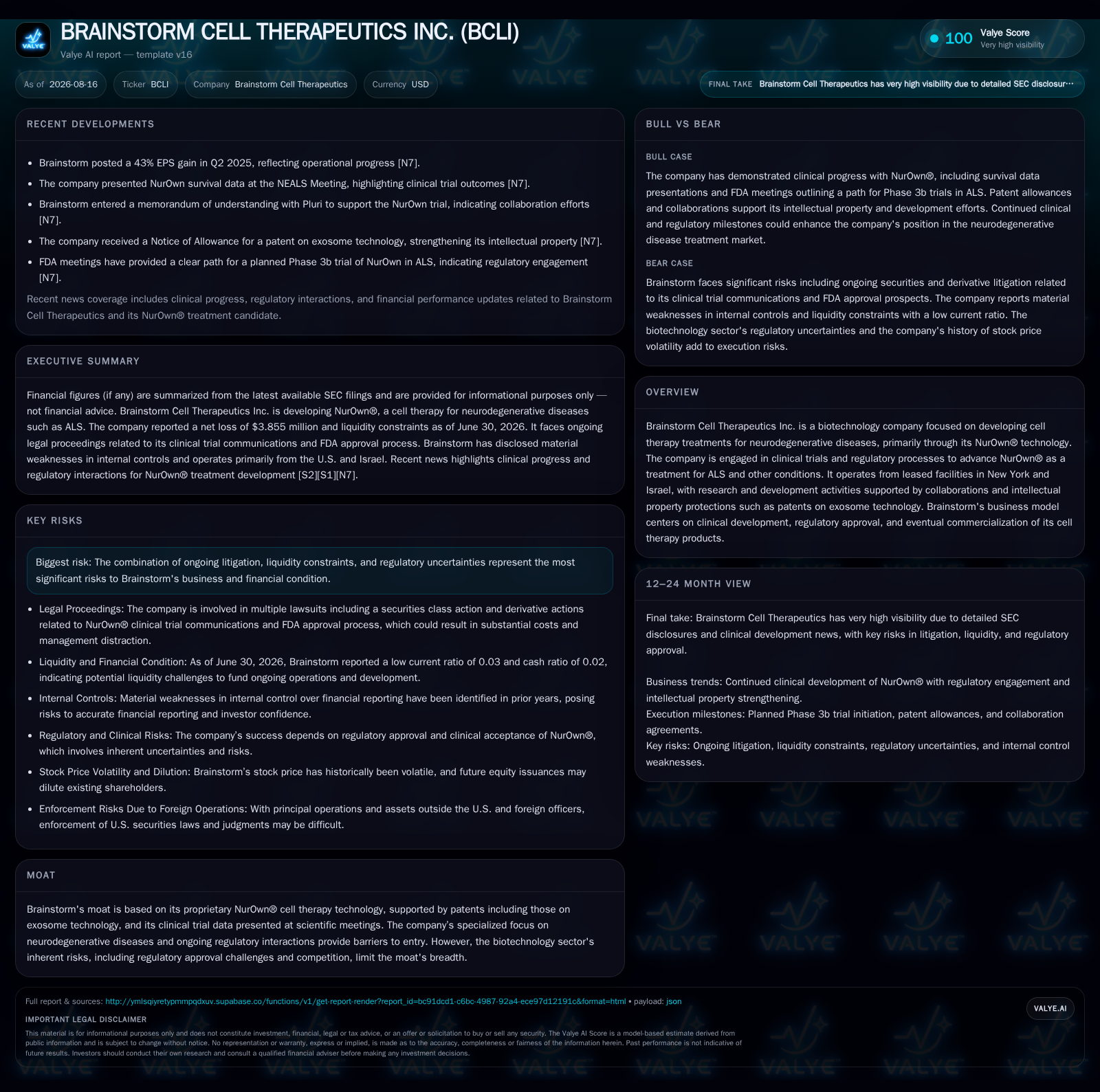
Brainstorm Cell Therapeutics Inc. continues to operate in the clinical-stage biotech space focused on cell therapy for neurodegenerative diseases through its NurOwn® technology. The latest quarterly filing reveals significant liquidity constraints, with cash reserves dwindling and a highly leveraged balance sheet, intensifying concerns about continued operations without new funding. Litigation against its Israeli subsidiary poses additional financial and operational distraction risks. Despite these challenges, Brainstorm maintains progress in clinical trials and intellectual property protections that underpin its strategic value proposition within the biotech sector’s complex regulatory environment.
Recent Operating Update
Brainstorm Cell Therapeutics’ latest 10-Q filing dated August 14, 2026, underscores severe financial pressures amidst ongoing R&D advances in its proprietary NurOwn® technology [S2]. The company reported only $22,000 cash and equivalents as of June 30, 2026 [F1], against current liabilities totaling nearly $12.4 million—a current ratio of approximately 0.03 exposes critical liquidity challenges. Total debt of about $1.26 million further amplifies the firm’s leverage position [F1]. These figures reveal Brainstorm's acute need for capital to sustain operations through costly clinical trials and administrative overhead.
Additional pressure stems from litigation initiated by Sourasky University Medical Center in Israel seeking roughly $0.7 million for alleged unpaid fees related to the use of clean rooms integral to manufacturing NurOwn® [S27]. Though management denies the claims and expects no material adverse impact on operations or financial condition, the legal dispute signals operational risks tied to core facility contractual arrangements in Brainstorm’s principal R&D hub.
Concurrently, the company continues intermittent capital raises through at-the-market offerings, private placements, and convertible promissory notes with investors—some carrying substantial original issue discounts and amortizing interest [S16], [S20]. However, there is no assurance that sufficient funding will be available on acceptable terms going forward to prevent dilution or operational disruptions.
Business Model Analysis
Brainstorm operates primarily as a clinical-stage biopharmaceutical developer specializing in autologous cell therapies for neurodegenerative disorders—most notably amyotrophic lateral sclerosis (ALS). Its flagship product candidate NurOwn® involves harvesting mesenchymal stem cells (MSCs), differentiating them ex vivo into neurotrophic factor secreting cells using patented exosome-driven processes, then re-administering them to patients. This approach is an example of personalized regenerative medicine that aims to repair or delay neuronal damage.
Revenue is presently nonexistent since Brainstorm has not commercialized any product; all expenditures flow into research and development activities primarily conducted through its Israeli subsidiary Brainstorm Cell Therapeutics Ltd., alongside newly established manufacturing entities [S2]. Revenue mechanics hinge on successful completion of late-stage clinical trials leading to regulatory approval followed by commercial-scale production under biologics manufacturing protocols—an uncertain but potential future phase.
Margins are currently negative given heavy R&D spend and administrative costs typical of clinical-stage biotechs lacking product sales. Incremental positive margin contributions await licensing deals or direct product commercialization post-approval. The company strategically relies on maintaining intellectual property protections including patents related to MSC propagation techniques and exosome applications to preserve competitive advantage amid a crowded cell/gene therapy field.
Industry Structure and Competitive Position
Brainstorm operates in the biotechnology sector centering on innovation-driven therapy development characterized by extended clinical trial timelines subject to strict FDA scrutiny. Within this domain, cell therapies for neurodegenerative diseases such as ALS represent a niche yet highly competitive sub-segment populated by peers like Athersys and Mesoblast who also pursue autologous or allogeneic stem cell platforms.
The competitive moat stems chiefly from the company’s proprietary NurOwn® technology supported by robust patent coverage on exosome technology—a key driver behind MSC differentiation efficacy—and clinical data evidencing potential therapeutic benefit presented at scientific forums [S1]. Regulatory incentives such as FDA Fast Track designation and Orphan Drug status enhance clinical development prospects but do not eliminate risk.
Market entry barriers involve complex manufacturing scale-up demands due to personalized biologic nature requiring stringent quality controls—a factor that constrains rapid expansion until technologies are industrialized fully. In addition, reimbursement uncertainty for novel cell therapies places demand-side constraints impacting long-term commercial viability.
Growth Drivers
Progression through clinical trial phases remains paramount; Brainstorm’s near-term catalysts focus on enrollment rates, data readouts from Phase 3b studies under Special Protocol Assessment (SPA) agreements with the FDA, which can de-risk eventual approval decisions [S1]. Intellectual property portfolio extensions related to MSC exosomes may bolster market position by limiting direct competition.
Strategic partnerships or licensing may emerge as essential growth avenues given capital limitations in-house; biotech firms often collaborate with larger pharma entities to access distribution channels, market expertise, or co-development funds. Expedited regulatory pathways linked to orphan designations also offer accelerated review timelines if efficacy signals meet predefined endpoints.
Increasing global incidence rates of ALS and other neurodegenerative diseases provide an expanding target population needing therapeutic innovation—a secular growth driver that underpins sustained R&D investment rationale [S1]. Meanwhile improvements in manufacturing capacity for biologics could enable scalable supply-demand matching once approval occurs.
Risks and Constraints
Brainstorm’s foremost risks revolve around persistent liquidity shortfalls rendering it vulnerable to funding shortages that could halt trial progression or cause undesirable equity dilution [S2], [F1]. The lawsuit with an Israeli medical center introduces operational distractions and potential incremental costs despite denied liability claims [S27].
Regulatory approval remains inherently uncertain despite existing FDA engagements; any negative outcome or additional data requisition could significantly delay commercialization timelines. Intellectual property disputes pose another latent threat given the complexity surrounding exosome-related patents within this rapidly evolving scientific area.
Competition from emerging alternative cell/gene therapies targeting similar indications may limit market penetration if they demonstrate superior safety or efficacy profiles. Manufacturing scale-up obstacles specific to autologous therapies complicate cost-effective supply chains necessary for widespread adoption.
Finally, shareholder litigation risks introduced by ongoing securities class actions add financial drain possibilities along with stock price volatility amplified by capital raise execution uncertainty [S1].
What to Watch Next
Investors and analysts should monitor key upcoming catalysts including clinical trial enrollment milestones and interim data releases expected under the SPA-regulated Phase 3b program [S1]. Regulatory feedback timelines following FDA submissions will also be crucial barometers of risk reduction toward potential marketing authorization.
Financially, successive quarterly updates will be scrutinized for signs of extended cash runway or successful capital acquisition events enabling continuous R&D funding without severe dilution or operational disruptions. Resolution or progress on litigation matters could materially affect investor sentiment.
Intellectual property strengthening moves such as new patent grants or licensing agreements would signal defensible long-term positioning against competitive encroachment. Similarly, partnership announcements with larger pharmaceutical companies may indicate validation and resource influx facilitating commercialization prospects.
Financial Profile Discussion
As detailed in the August 2026 quarterly filing, Brainstorm confronts significant balance sheet stress reflective of early-stage biotech economics without sales inflows [S2], [F1]. Cash balances stand at a minimal $22K at quarter-end June 30, 2026 while current liabilities exceed $12 million—dominated by trade payables including overdue rent accrued against which approximately $0.57 million had been previously recognized [S27], [F1].
Total debt amounts to approximately $1.26 million consisting predominantly of short-term convertible promissory notes bearing high implicit interest costs alongside amortization schedules initiated recently that will pressure cash flow further [S20], [F1]. Operating losses persist reflecting ongoing heavy expenditure on research programs vital to progressing NurOwn®, consistent with peer early-stage biotechnology profiles where net income turns positive only post-commercialization phases.
The company’s reliance on equity markets for capital raises—including ATM programs generating several million dollars intermittently—and convertible notes issuance demonstrates limited but crucial funding channels in place albeit without guarantees of sustainability or favorable pricing [S16], [S20]. The financial profile thus epitomizes typical biotechnology developmental venture risk marked by elevated burn rate compounded by capital markets dependence.
This analysis synthesizes information exclusively drawn from recently filed SEC documents regarding Brainstorm Cell Therapeutics Inc., avoiding speculative assertions unsubstantiated by primary disclosures. The company’s prospects lean heavily on forthcoming clinical advancements balanced precariously against pronounced capital constraints and legal exposures inherent in pioneering therapeutic development sectors.
Disclaimer: This is research-only, informational analysis and not investment advice. It may include AI-generated interpretation and general industry context. Always verify important details using primary sources.

Comments