
Tribeca Strategic Acquisition's SPAC IPO and Trading Separation Foreshadow Upcoming De-SPAC Event
Tribeca Strategic Acquisition Corp., a Cayman Islands-incorporated SPAC, completed a $140 million IPO in June 2026 and recently enabled separate trading of its shares and warrants ahead of its targeted business combination deadline.
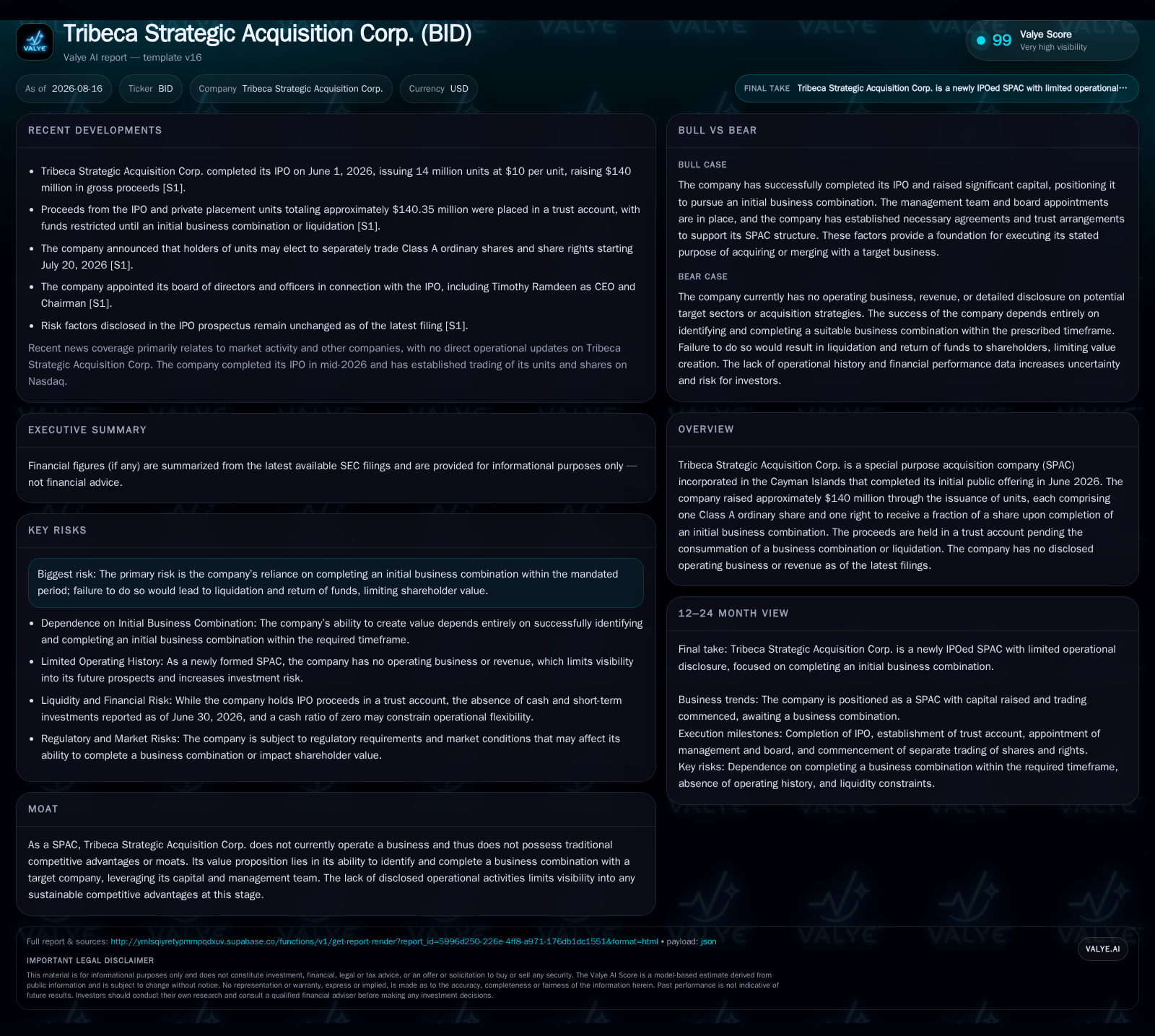
As a newly public special purpose acquisition company (SPAC), Tribeca Strategic Acquisition Corp. has positioned itself as a capital vehicle for acquiring and taking private companies public through a de-SPAC transaction. Having raised $140 million in gross proceeds during its IPO in June 2026, the company holds funds in a trust account pending an initial business combination within the standard 21-month timeframe. Recent SEC filings disclose that, beginning July 20, 2026, the trading units can be split into Class A ordinary shares and accompanying share rights, which facilitates liquidity and pricing transparency for investors ahead of potential merger execution. While still without operating revenues or target disclosures, the company faces typical SPAC risks centered on completing a business combination before liquidation deadlines.
Recent Operating Update: Initial Public Offering Completed and Units Begin Separate Trading
Tribeca Strategic Acquisition Corp., incorporated in the Cayman Islands, completed its initial public offering (IPO) on June 1, 2026, issuing 14 million units at $10 per unit, raising gross proceeds of approximately $140 million [S6][S9][F1]. Each unit consists of one Class A ordinary share plus one right to receive one-tenth of an additional Class A share upon consummation of an initial business combination (the "Share Rights") [S3][S9]. Concurrently with the IPO close, about $140.35 million was deposited into a U.S.-based trust account managed by Efficiency INC., serving as trustee for preserving investors' capital pending an acquisition [S9][S18].
Shortly after the IPO, on July 17, 2026, Tribeca announced that holders of these units could elect to separate their units into component Class A ordinary shares and Share Rights starting July 20, allowing these two instruments to trade independently on Nasdaq under symbols "BID" (shares) and "BIDWR" (share rights) respectively. Unseparated units will retain the ticker "BIDWU" [S3][S15]. This separation aligns with common SPAC market practice designed to improve liquidity and price discovery for each security type ahead of any qualifying merger.
As of the quarter ended June 30, 2026—the company’s first quarterly report since going public—Tribeca had no operating revenues and no material operating expenses outside corporate administration. Operating income was negative $228,865 with net income slightly positive at $243,475 reflecting non-operating factors typical for newly formed SPACs without active businesses [F1][S2]. The current ratio stood at a comfortable level of approximately 1.24 (current assets $883,100 vs liabilities $714,344), indicating sufficient liquidity mainly due to cash held in trust [F1]. This balance sheet profile is standard for SPACs pre-deal.
Business Model: Capital Vehicle Facilitating Public Market Access for Private Companies
Tribeca Strategic Acquisition Corp. operates exclusively as a special purpose acquisition company (SPAC). Its business model involves raising capital from public investors through an IPO structured as sales of units combining shares with attached rights/warrants. These funds are placed in escrow-like trust accounts until the SPAC identifies and closes a business combination with a private target company within mandated timeframes—typically up to about two years from IPO closing date.
Revenue generation or profit accrual from operations does not occur until after completing this "de-SPAC" transaction whereby ownership is transferred through merger or acquisition. At that point, combined entities seek sustained revenue growth from their underlying business operations as publicly traded companies. Until then, earnings are usually limited to interest income on trust funds minus administrative costs such as legal fees and board compensation.
Industry Structure and Competitive Position: Standard SPAC Framework Awaiting Deal Execution
Situating Tribeca within the broader SPAC ecosystem reveals it functions as an intermediary between capital markets investors seeking liquidity vehicles and private companies searching for efficient paths to become publicly listed entities. Its incorporation jurisdiction (Cayman Islands) is common among SPACs due to favorable regulatory environments.
In comparison to prominent peers like Pershing Square Tontine Holdings or Social Capital Hedosophia—both known for high-profile deals—Tribeca has yet to disclose management pedigree beyond CEO Timothy Ramdeen’s role [S3], nor any official targeted industry sectors or candidate pipelines. This lack of operational history means competitive advantages lie primarily in deal-making expertise expected but unproven publicly.
The underwriting partner BTIG LLC participated both in bringing the IPO to market and in purchasing private placement units totaling $1.4 million worth (140k units), aligning interests somewhat between sponsor/underwriter and public investors [S16][S18]. However, underwriting fees deferred or paid reduce net proceeds available for acquisitions.
Growth Drivers: Market Appetite for Alternative Liquidity Routes and Regulatory Tailwinds
The primary driver enabling Tribeca's entry is persistent demand among private firms for expedited public listings via nontraditional mechanisms like SPACs amid fluctuating IPO market dynamics. The relatively fast timeline (~21 months) allows companies quicker access to capital markets compared with traditional offerings burdened by regulatory delays.
Additionally, supportive SEC guidance clarifying disclosure standards around SPAC terms has restored some investor confidence compared with prior volatility periods characterized by regulatory crackdowns. Innovations such as permitting separate trading of component securities—as Tribeca enabled recently—enhance market efficiency.
Experienced management teams typically differentiate successful de-SPAC vehicles by leveraging networks for proprietary deal sourcing and structuring PIPE (Private Investment in Public Equity) transactions that inject fresh capital alongside closing deals.
Risks and Watchpoints: Deadline Pressure and Shareholder Redemption Incentives
Crucial risks include failure to consummate an initial business combination within the mandated timeframe—approximately by March 2028 given June 2026 IPO close—which would trigger automatic liquidation procedures returning investor funds less minimal dissolution costs [S9][S2]. Such outcomes yield no traditional equity upside.
Dilution risk exists due to outstanding rights that can convert into additional equity post-merger; although standard practice provides some downside protection depending on final terms set during combination negotiations.
Finally, reputational damage from disappointing post-deal performance poses ongoing challenges given limited historical track record making investor retention difficult absent clear strategic narratives or sector focus announcements.
What To Watch Next: Business Combination Announcements and Shareholder Voting Outcomes
Key milestones will include identification and announcement of prospective target(s), initiation of shareholder votes approving any proposed mergers or charter amendments affecting redemption terms or deadlines. Market reaction leading up to such events will serve as indicators regarding perceptions of deal attractiveness.
Subsequent PIPE financing rounds or amendments granting extensions beyond initial deadlines would be critical signals regarding sponsor commitment levels.
Separately traded Class A shares versus share rights liquidity patterns post-July 20 will reveal investor segmentation preferences potentially impacting pricing power.
Disclaimer: This is research-only, informational analysis and not investment advice. It may include AI-generated interpretation and general industry context. Always verify important details using primary sources.

Comments