
Lionheart Holdings Confronts Liquidity and Deadline Pressures Ahead of Business Combination
As Lionheart Holdings approaches its extended March 2027 Business Combination deadline, liquidity constraints and absent deal announcements intensify execution risks.
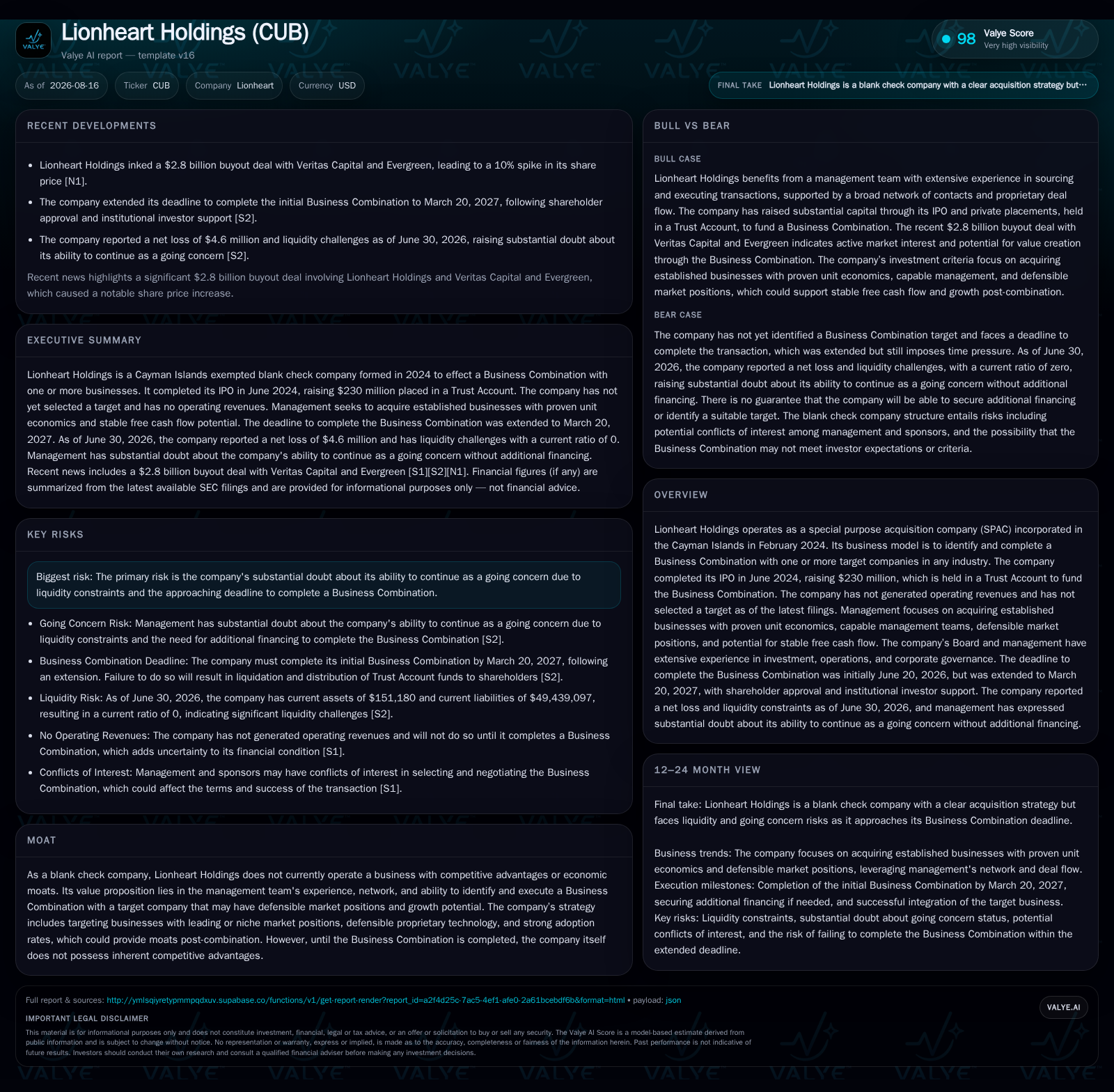
Lionheart Holdings, a Cayman Islands-incorporated SPAC that raised $230 million in its June 2024 IPO, faces growing uncertainty about completing a Business Combination before its extended March 20, 2027 deadline. The company disclosed substantial doubt regarding its ability to continue as a going concern due to tightening financing windows and shrinking operating liquidity outside the trust account. With no announced deal and increasing competitive pressures in the SPAC market, execution risk remains high. Sponsor incentives, shareholder redemption rights, and evolving market dynamics create a challenging backdrop for successful value creation.
Depleting Runway: Why Time is Still Tight Ahead of March 2027 Deadline
Lionheart Holdings faces an increasingly onerous timeframe after extending its original Business Combination deadline from June 20, 2026 to March 20, 2027. The latest quarterly filing on August 14, 2026 explicitly flags substantial doubt about the company’s ability to continue as a going concern over the next year largely due to financing pressures and the looming liquidation timeline for the trust account absent deal closure [S2]. This truncated window intensifies pressure on management to identify suitable targets, negotiate terms, perform rigorous due diligence, secure approvals from multiple stakeholders including shareholders and regulators, and close transactions—often complex undertakings demanding careful orchestration.
Such deadline compressions are generally associated with heightened execution risk across the SPAC universe. Extended combination periods provide some cushion but ultimately reduce runway when market volatility or competitive urgency abounds. For Lionheart—which had initially planned for a two-year hunt—the additional nine months may still prove insufficient given zero announced deals to date and cost escalation inherent in protracted deal processes [S1][S2]. Key industry KPIs like "Time Remaining in Combination Period" directly correlate with willingness of potential targets to engage amid competing bidders and concerns about capital sufficiency.
No Revenue Route: Understanding a SPAC's Pre-Merger Financial Model
As a blank check company incorporated in early 2024 with no operating history or revenues before completing its Business Combination, Lionheart’s fundamental business model revolves around maintaining investor capital securely within a trust account post-IPO while proactively scouting acquisition candidates [S1]. Raised proceeds totaling $230 million (net of over-allotment) were deposited into this segregated Trust Account under trustee control where they earn minimal return but preserve principal until deployed toward combination transaction funding or returned upon liquidation [S1].
Operating expenses prior to deal consummation derive primarily from administrative costs such as legal fees, salaries for management focused on transaction sourcing/negotiation rather than operations, underwriting deferred fees contingent on deal success, compliance costs related to public company reporting obligations, and due diligence outlays [S1]. These costs exert negative leverage owing to zero revenue inflows during this phase. This dynamic mandates tight cost control while relying heavily on sponsor financial support or bridge loans if cash outside the trust dwindles — an increasingly precarious scenario per recent filings [S2]. The clear implication is that maximizing value realization hinges entirely on executing an accretive Business Combination rather than internal growth or product-market traction.
Competitive Hunt: How Market Dynamics Shape Target Acquisition Risks
The SPAC landscape has grown crowded since Lionheart’s IPO in mid-2024; numerous blank check companies aggressively compete for attractive private targets offering rapid public listing routes alternative to traditional IPOs [S1]. However, this surge in SPAC supply coincides with waning investor enthusiasm toward de-SPAC transactions amid regulatory scrutiny and uneven post-merger performance reported by peers historically. Such factors dampen target willingness to engage with SPAC partners given perceived reputational or valuation challenges.
The filing notes increased competition reduces available opportunities and inflates acquisition costs potentially beyond accretive thresholds for Lionheart’s shareholders [S1]. Furthermore, some private companies prefer conventional IPO pathways citing clearer price discovery or prefer direct listings minimizing dilution from sponsors’ founder shares or warrants. This marketplace tension elevates risk of protracted search timelines or foregoing suitable deals outright, especially for a SPAC constrained by timeline extensions that compress diligence windows further. Peer comparisons highlight both failed mergers leading to liquidations or successful combinations yielding strong post-merger trajectories largely dependent on sponsor track record and deal terms.
Incentive Architecture: Sponsor Motives and Shareholder Risk Alignment
Lionheart’s capital structure reflects standard SPAC mechanics designed to align sponsor incentives with value creation while exposing public shareholders to redemption choices that can complicate deal certainty. Post-IPO capitalization included founder shares granted to sponsors at nominal prices with approximately 4 million private placement warrants purchased at $1 each simultaneously with the public raise of roughly $230 million attributed mainly to public shares and accompanying warrants exercisable at $11.50 per share [S1]
Sponsors stand to receive promote payments equivalent typically to ~20% of equity value post-merger contingent on deal closure — financially motivating them to consummate transactions even under suboptimal terms compared to purely shareholder-driven outcomes. Conversely, public shareholders retain redemption rights allowing exit at approximately Trust Account per-share values should they disapprove proposed deals or find valuations unattractive. This embedded conflict means sponsors lean toward closing deals that preserve their investment while shareholders may seek safety through redemptions diluting combined entity capital pools.
Deferred underwriting fees - fees payable only upon transaction completion - further introduce complex financial incentives where intermediaries stand compensated solely if deals succeed potentially biasing advisory efforts toward closing deals expediently despite growing market headwinds [S1]. Balancing these forces is critical in assessing execution plausibility as sponsors’ economic interests diverge from public holders facing downside concentration prior to combination.
Unpacking Liquidity Signals From Current Balance Sheet Metrics
While Lionheart holds significant cash resources segregated within its Trust Account originally funded at $230 million during the IPO quarter mid-2024 [S1], recent balance-sheet snapshots at June 30, 2026 expose among the lowest operating liquidity measured by current assets ($151k) relative to current liabilities (~$49.4 million), resulting in an effectively zero current ratio excluding trust funds [F1]. This severe disparity reveals tight operational cash flow preventing expenditures unrelated directly to trust administration or mandatory ongoing corporate governance.
Management's repeated expression of substantial doubt regarding going concern status in its August 10-Q confirms reliance on sponsor bridge financings or additional equity injections now more critical than ever [S2]. Without new capital infusions beyond trust maintenance funds (which cannot be used for operational expenses), day-to-day activities such as legal fees for pending deal negotiations or staff remuneration may be compromised raising alarm about near-term survival absent progress on announced transactions.
Typical SPAC profiles maintain minimal operating expense burn rates but robust unrestricted cash balances; Lionheart's stark divergence portends elevated refinancing risk looming beside its compressed timeline. Peer cases with similarly stretched operating liquidity but adequate trust funds underscore importance of sponsor commitment both financially and operationally as pivotal determinants whether companies can transform into viable combined entities rather than liquidate.
Key Watchpoints: Redemption Activity, Deal Announcements, and Capital Bridge Options
Investors monitoring Lionheart must focus intently on several upcoming catalysts signaling trajectory beyond speculative risk. Foremost among these is the public disclosure of any definitive agreements related to a Business Combination providing tangible valuation benchmarks and structural details; absent an announcement already delayed raises material doubts given deadlines approaching rapidly without extensions indicated so far in filings [S3][S2].
Shareholder voting rights coupled with redemption activity will influence net proceeds actually deployable toward acquisition funding post-announcement—high redemption rates could erode working capital substantially forcing new PIPE (Private Investment in Public Equity) rounds or sponsor equity bridges diluting existing holders or complicating governance structures.
Further extension requests might indicate ongoing negotiation difficulties yet also represent last-resort lifelines prolonging survival but simultaneously signaling apparent weakness undermining market confidence. Sponsor follow-on investments or bridge loan commitments would thus serve as reassuring signals supporting interim cash needs and execution resolve versus silent profiles amplifying downside concerns.
Collectively these metrics – deal clarity/timing, redemption rates post-vote revealment, sponsor funding activity – form essential barometers measuring whether Lionheart can surmount mounting hurdles inherent in the current capital markets environment fraught with mixed sentiment toward blank check vehicles.
Management’s formal statement expressing substantial doubt about going concern arises from anticipated cash needs to finalize complex mergers coupled with no firm announcements yet completed business combinations; sponsor bridge financing—which is discretionary rather than obligatory—is viewed as essential underwriters holding deferred fees contingent on success accentuate dependency profile dramatically [S2][S1]
Compared with typical peers maintaining moderate unrestricted cash alongside Trust Account segregation this dual-cash compartment dynamics highlight inherent fragility before value inflection points occur post-combination closing—acute timing sensitivity intertwines closely with sponsor commitment levels determining whether capital crunch eventually leads Liquidation scenario versus successful transition into operating public entity.
This analysis leverages the latest quarterly disclosures alongside annual business model context emphasizing how Lionheart Holdings operates within specialized SPAC sector mechanics characterized by zero revenues pre-combination reliant entirely on trust funds preservation and sponsor-fueled execution capability. The pressing combination deadline extension constricts time available for viable target identification amid intensified competition exacerbating pricing risks challenging transactional viability while balance-sheet cues raise critical liquidity questions foreshadowing possible existential outcomes absent marked strategic progress soon. Investors should monitor forthcoming definitive agreement disclosures, shareholder redemption rates post-votes if pertinent deals emerge, potential PIPE financings supplementing capital structure gaps alongside any announced bridge financing commitments by sponsors as decisive confirmation signals beyond pure speculative posture.
This report does not constitute investment advice but aims solely at informed analytical discussion grounded strictly on latest publicly filed data around Lionheart Holdings’ business model dynamics and operating state within prevailing SPAC market realities.
Disclaimer: This is research-only, informational analysis and not investment advice. It may include AI-generated interpretation and general industry context. Always verify important details using primary sources.

Comments