
Marker Therapeutics Advances Multi-Antigen T Cell Therapies Amid Heightened Clinical and Financial Scrutiny
Latest quarterly results highlight Marker’s strategic grant funding supporting MAR-T platform clinical expansion amid operational challenges.
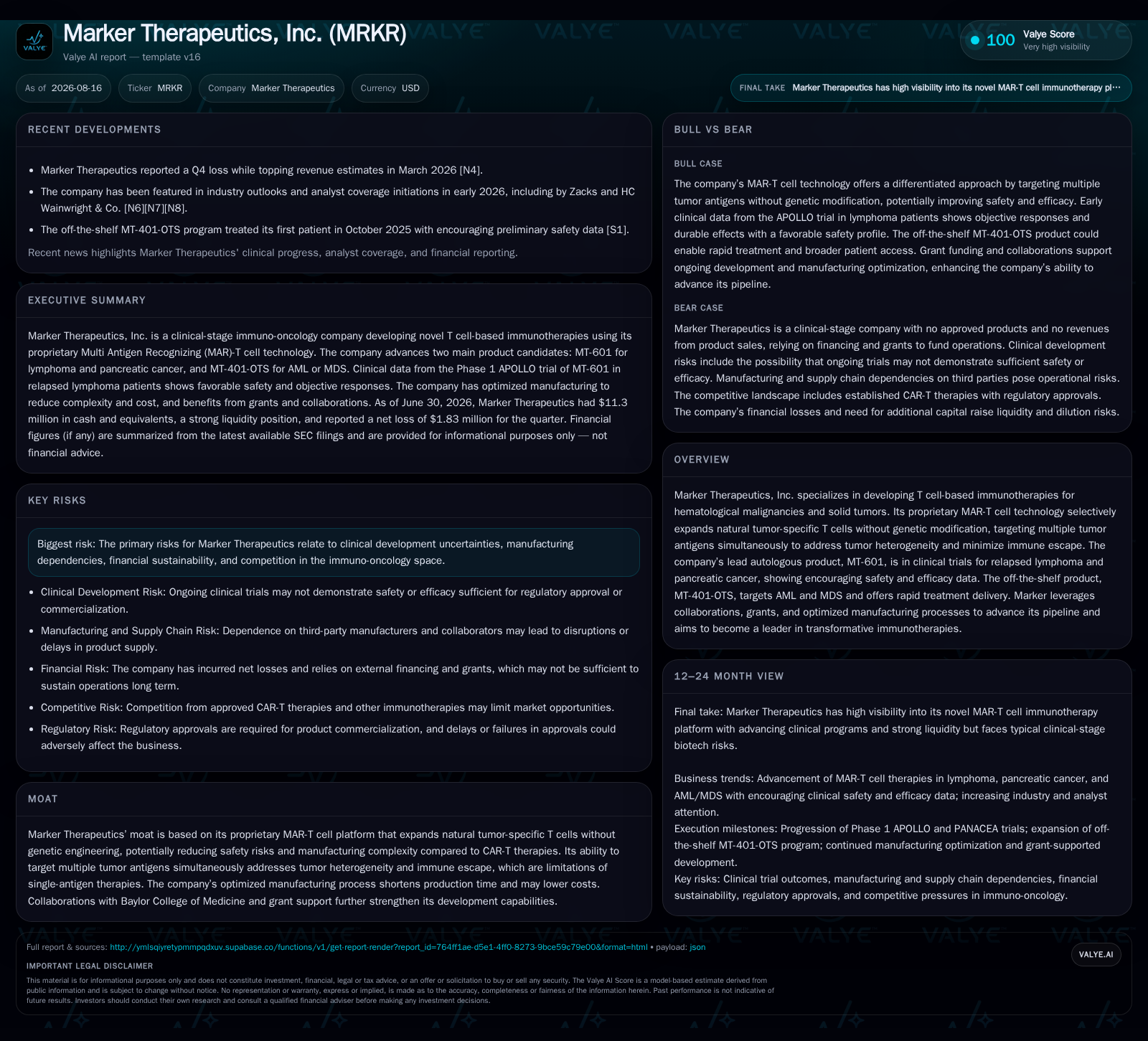
Marker Therapeutics’ August 2026 quarter filing reveals meaningful grant inflows boosting its MT-601 pancreatic cancer trial and expanded R&D capacity while underlining ongoing financial constraints with sub-$12 million liquidity. The company's proprietary MAR-T cell technology offers a novel, non-engineered multi-antigen targeting approach designed to overcome tumor heterogeneity seen in CAR-T therapies, showing encouraging safety signals in early clinical stages. However, progress remains dependent on continued clinical enrollment, manufacturing scale-up, and securing sufficient capital to sustain its development pipeline. Key near-term markers include trial enrollment pace, regulatory interactions, and grant funding milestones.
Accelerating Clinical Development Through Strategic Grant Funding: Q2 Highlights
Marker Therapeutics’ latest quarterly filing dated August 14, 2026 highlights solidification of its funding base through sizeable governmental grants supporting its lead clinical programs. Since December 2024, Marker has secured a substantial $9.5 million grant from the Cancer Prevention and Research Institute of Texas (CPRIT) earmarked for advancing MT-601 in metastatic pancreatic cancer patients; by Q2 2026 it had drawn $1.5 million from this pool [S2]. Additionally, a $4.2 million U.S. government grant awarded in July 2026 provides incremental non-dilutive capital to support ongoing R&D efforts. This injection is particularly important given the company’s limited commercial revenue — with zero recorded product sales — relying almost entirely on grants and equity financing to fund operations [S2,S1].
These grants alleviate some immediate financing pressures that had previously raised doubts about sustained clinical trial enrollments and continuation beyond mid-2026 [S2]. Importantly, this funding enables acceleration of patient recruitment for the MT-601 pancreatic trial as well as expanded investment in manufacturing capabilities essential for subsequent trial phases. Maintaining or increasing enrollment pace will be an essential operational marker to confirm efficient utilization of these funds toward regulatory milestones
MAR-T Platform Advantages: Inherent Clinical Safety and Multi-Antigen Targeting Immunity
Marker’s core scientific differentiation lies in its Multi Antigen Recognizing T cell (MAR-T) technology: a non-genetically engineered platform that selectively expands a patient’s natural T cells capable of recognizing numerous tumor-associated antigens simultaneously via native T cell receptors (TCRs) [S1]. This contrasts with commonly employed CAR-T or engineered TCR therapies that rely on genetic modification to retarget T cells against usually one or two antigens.
This multi-antigen approach strategically targets tumor heterogeneity — a significant cause of relapse due to antigen loss or immune escape observed in single-target therapies. Such breadth theoretically limits tumor adaptation by engaging up to six tumor-specific antigens encompassing hundreds of epitopes [S1]. Furthermore, Marker claims an encouraging safety profile lacking severe immune effector toxicities such as neurotoxicity (ICANS), which have dogged engineered T cell therapies to date; evidence so far is based on prior exploratory clinical data from Baylor College of Medicine (BCM) involving over 150 patients treated with MAR-T cells exhibiting favorable tolerability [S1].
This endogenous mechanism reduces complexities tied to gene editing — eliminating mutagenesis risk — while simplifying the manufacturing process by avoiding viral vectors or transfection steps that add cost and regulatory hurdles. Both factors can shorten production timelines crucial in aggressive cancers where timely infusion impacts efficacy.
Competitor Benchmarking: Placing Marker’s Progress in the CAR-T and TCR Landscape
Within the competitive immuno-oncology milieu that includes firms like Adaptimmune (TCR-engineered therapies) and Kite Pharma (CAR-T leader), Marker occupies a distinct niche focused on non-engineered multi-antigen T cell expansion [S1,S2]. While these peers have advanced multiple late-stage pivotal trials with genetically modified products commercially available or nearing approval, Marker remains early-stage clinically with MT-601 ongoing in phase 1/2 trials.
Despite slower late-stage momentum relative to large competitors with deep-pocketed backers, Marker leverages potential advantages in safety profile and manufacturing ease that could offer differentiated market positioning long term. However, dependency on third-party contract manufacturing organizations (CMOs), such as Wilson Wolf Manufacturing noted in agreements disclosed by Marker, underscores the sensitivity of its supply chain—a common bottleneck among cell therapy developers facing scalability issues [S1,S2].
Regulatory pathway uncertainties remain pronounced given no MAR-T therapy has yet received FDA approval; peer experiences suggest prolonged timeframes before commercialization despite promising preliminary endpoints.
Manufacturing Innovations Driving Cost Reduction and Faster Patient Delivery Models
Marker’s pipeline diversification includes both autologous (MT-601) and off-the-shelf allogeneic-like (MT-401-OTS) products targeting hematologic malignancies such as acute myeloid leukemia (AML) and myelodysplastic syndromes (MDS) [S1]. The lack of genetic engineering reduces production complexity significantly compared to CAR-Ts requiring lengthy viral vector transduction steps.
This streamlined manufacturing can shorten time-to-infusion — a critical factor given the fragility of hematological cancer patients awaiting treatment — improving retention during trial enrollment and potentially enabling faster commercial supply chains once approved [S2]. Total debt levels are negligible at under $70 thousand historically reflecting minimal leverage exposure.
Nonetheless, accumulated net operating losses continue at high levels driven by consistent R&D spending without offsetting revenues — typical for clinical-stage biotechs but underscoring dependence on external capital infusions such as grants or equity offerings for sustained development operations [S1,S2].
Recent enhancements of internal financial management systems and headcount aimed at supporting commercialization preparation signal intent to expand infrastructure ahead of potential regulatory approvals; however these investments will increase burn rate further necessitating prudent cash deployment strategies.
Proxying from prior guidance absent new large capital raises suggests current cash suffices into early-to-mid 2027 under expense assumptions barring unexpected delays or cost overruns.
Risk Factors Centered on Clinical Execution, Manufacturing Dependencies, and Capital Access
Marker explicitly acknowledges multiple substantial risks impinging future prospects including intrinsic clinical development uncertainties inherent to all novel immunotherapies: failure to demonstrate statistically robust safety or efficacy endpoints could stall or terminate programs irreparably [S1,S17]. Regulatory agency unfamiliarity with non-engineered MAR-T modalities may extend review durations necessitating additional data burdens.
External manufacturing reliance introduces vulnerability should third-party facilities face quality issues or incapacity limiting batch availability critical for trial continuance. Loss or deterioration in strategic academic collaborations with BCM likewise could impair research progress.
Capital constraints constitute ongoing existential risk given sustained losses; inability to raise fresh equity or secure further grants amid volatile macroeconomic conditions could force operational cutbacks compromising milestone achievement timelines [S25,S27]. Equity dilution risk also remains elevated given usage of ATM sales agreements as a potential primary financing avenue.
Monitoring Catalysts: Trial Readouts, Regulatory Milestones, and Partner Collaborations Ahead
Investors should prioritize several forward-looking developments when assessing Marker’s trajectory: - Enrollment completion benchmarks for MT-601 pancreatic cancer phase cohorts supported by CPRIT funds; - Expansion updates on off-the-shelf MT-401-OTS studies addressing AML/MDS; - Announcements regarding additional governmental grants or licensing collaboration expansions with BCM or other academic partners; - Regulatory interactions signaling FDA feedback on development plans or potential fast-track designations; - Published interim data elucidating patient response rates or adverse event profiles across indications [S1,S2]. These catalysts will concretely validate technical hypotheses underlying MAR-T therapies’ durability against heterogeneous tumors while shaping commercial outlook amidst funding realities
Financial Profile Discussion
Marker Therapeutics’ financial footing remains characteristic of pre-commercial biotech firms reliant primarily on external funding sources rather than product sales revenues [F1,S2]
Grant income—including active CPRIT awards—has become an increasingly pivotal component of funding strategy reducing direct dependence on equity dilution during critical mid-stage trials; since formal award dates markers have successfully drawn tranches aligning capital injections with accelerated spending necessities outlining improved financial planning precision.
Nevertheless, persistent net losses throughout recent years underscore sizable recurring operating cash outflows mandated by ongoing R&D intensification plus preparatory commercialization staffing investments highlighted this quarter [S2]
In sum, investors must weigh technical promise demonstrated through proprietary multi-antigen MAR-T technology against financing intermittency risks common for developmental immuno-oncology enterprises actively transitioning from discovery toward scalable therapeutic commercialization.
Disclaimer: This is research-only, informational analysis and not investment advice. It may include AI-generated interpretation and general industry context. Always verify important details using primary sources.

Comments