
Vynleads Accelerates Subscription Platform Shift Amid Engagement and Enterprise Challenges
Latest quarterly disclosures reveal operational pressures as Vynleads advances its AI-enabled subscription wellness platform with a cautious enterprise sales outlook.
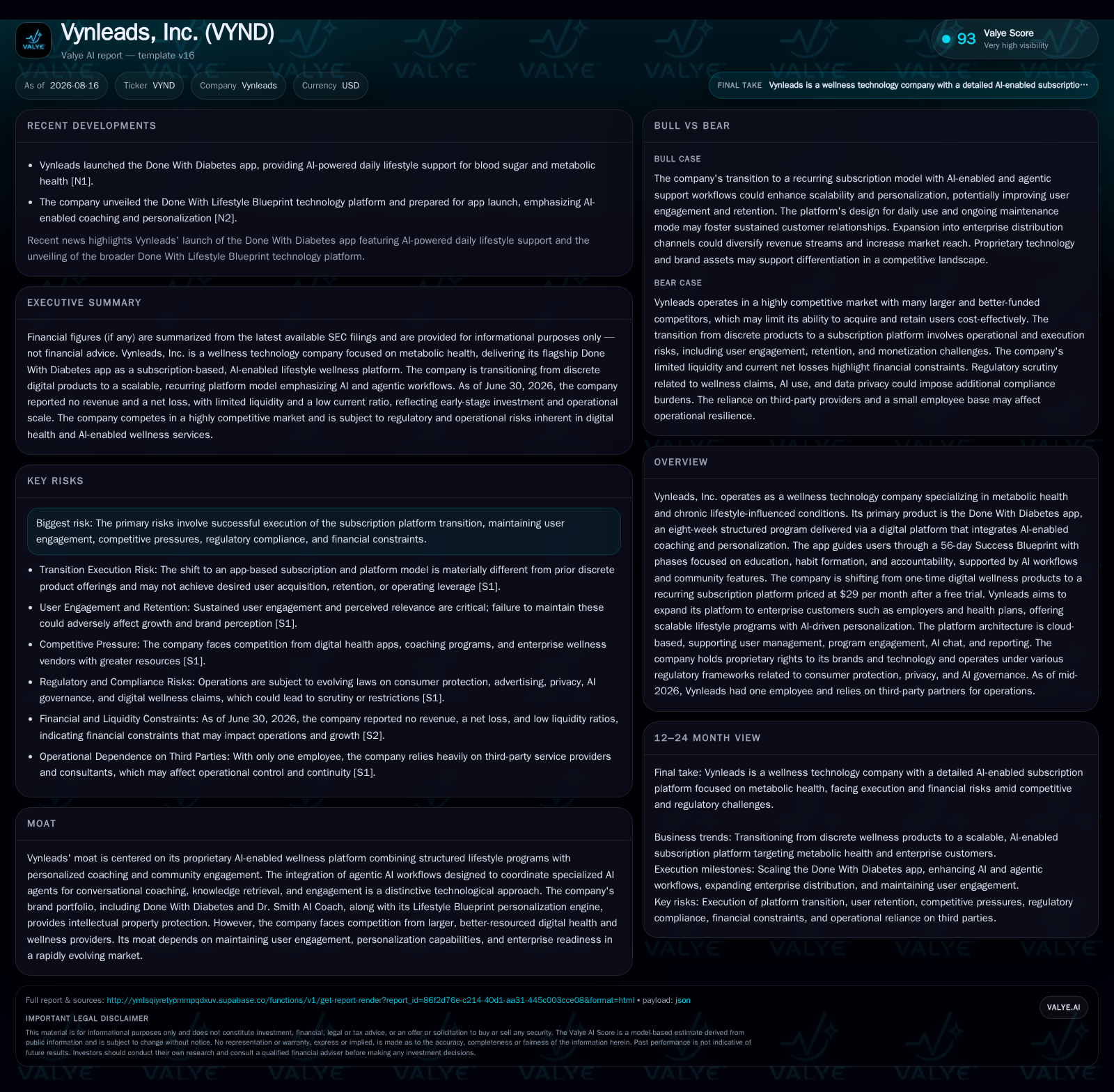
Vynleads is navigating a pivotal transition from discrete product sales to a subscription-based model centered on its Done With Diabetes app, now featuring AI-driven personalized coaching and community engagement. The 2026 Q2 report highlights slower than expected subscriber conversion and retention challenges, alongside a protracted enterprise sales pipeline restraining near-term revenue visibility. This reflects broader industry dynamics where sustained user engagement and long sales cycles govern growth trajectories. Financially, constrained liquidity despite zero debt emphasizes the critical need for improved operating leverage as Vynleads scales its technology platform and expands into enterprise channels.
Latest Operating Update Reveals Subscription Scaling Challenges
Vynleads’ latest 10-Q filing dated August 14, 2026 provides fresh insight into the difficult path of scaling its subscription-based wellness platform. The company continues marketing the Done With Diabetes app under a pricing model that starts with a seven-day free trial before moving users to a $29 per month subscription. However, the report signals that converting free-trial users into paying subscribers remains slower than management's initial expectations [S2]. Furthermore, early indications of churn suggest retention hurdles are emerging as a key operational constraint.
On the enterprise front, Vynleads confirms ongoing delays due to complex evaluation processes typical in employer and health plan channels. These involve rigorous security reviews, reporting validation, and compliance certifications that have extended sales cycles beyond earlier forecasts [S2]. Given these factors, near-term revenue visibility remains limited despite clearly articulated strategic intent.
Done With Diabetes App: Subscription Model Economics and Engagement Dynamics
The shift from discrete wellness products toward a recurring digital engagement model is foundational to Vynleads’ current strategy [S1]. The Done With Diabetes program is an eight-week structured app experience designed around phases of education, habit formation, and accountability reinforced by daily missions and community participation. Its monetization engine relies on monthly subscriptions priced at $29 following trial onboarding.
This SaaS approach aligns unit economics with lifetime value (LTV) potentials: higher retention translates directly into improved margins by spreading fixed platform costs over longer-term subscriber relationships [S1]. The company's proprietary Lifestyle Blueprint personalization engine backed by Dr. Smith AI Coach enables scalable one-to-many digital coaching through agentic AI workflows—automated collaboration of specialized AI modules fostering personalized habit guidance without linear human support cost increments
Yet this model hinges critically on key performance indicators such as subscriber conversion rate from free trials to paid users, daily mission engagement frequency, churn rate, and program completion percentages. Weakness in any of these metrics disproportionately erodes projected operating leverage and threatens profitability prospects—a known challenge across direct-to-consumer digital wellness firms like Noom or Headspace.
AI-Enabled Coaching as Technological Moat Amid Market Competition
Vynleads positions its platform’s technological moat around its agentic AI workflows: ensembles of specialized AI agents orchestrating personalized wellness guidance seamlessly within user interactions [S1]. This differentiates it technologically from standard chatbot offerings and generic fitness apps by layering dynamic content retrieval, conversational context awareness, sequencing research views, and community moderation under one integrated system
Intellectual property encapsulating Dr. Smith AI Coach’s algorithmic framework alongside the Lifestyle Blueprint personalization engine theoretically limits commoditization risks from larger players entering the space. Peer analogs such as Virta Health also emphasize AI-driven metabolic health coaching but often complement their offerings with clinician input or telehealth services creating distinct service models.
Nevertheless, reliance on imperfect AI outputs introduces product risk—errors or biases could degrade user trust or invite regulatory scrutiny regarding health claims conveyed digitally. As agentic systems amplify content propagation across multiple AI modules and into community forums, mitigating legal and reputational risks becomes increasingly critical.
Enterprise Sales Pipeline: Long Cycles Temper Growth Prospects
A core element of Vynleads’ growth strategy is pivoting toward enterprise wellness programs sold primarily to self-insured employers and health plans seeking scalable lifestyle management solutions incorporating clinical alignment and compliance transparency [S1]. However, unlike direct-to-consumer channels enabling relatively fast trial-to-paid conversions, enterprise sales demand extensive piloting phases, deep integration with existing health IT systems, multi-stakeholder decision-making processes, plus rigorous data privacy assurances.
These gating factors prolong sales cycles considerably—reflecting common themes seen in publicly reporting peers like Omada Health whose enterprise adoption similarly experiences multi-quarter evaluation intervals prior to contract signing.
This lengthened pipeline impacts financial planning since upfront investments in product customization, implementation tooling enhancements (especially around administrative reporting capabilities), and increased security audits must be absorbed well before revenue recognition commences fully.
User Engagement and Retention: Key KPIs Steering Growth Outlook
Beyond user acquisition headcount metrics lies the more consequential dimension of engagement quality—how deeply users interact with the app’s daily missions and persist through increasingly autonomous “Lifetime Wellness Mode” phases designed to sustain habits post-program completion [S1].
High retention rates directly correlate with customer lifetime value (LTV) by reducing churn-related revenue loss while bolstering brand advocacy measured indirectly via net promoter scores (NPS). Frequent interactions with Dr. Smith AI Coach serve as leading indicators of stickiness; likewise elevated program completion rates reflect successful behavior change penetration essential for validating digital therapeutic efficacy.
Failing to meet benchmarks in these engagement aspects limits operational leverage by increasing per-subscriber service costs relative to revenue realized—particularly damaging given Vynleads’ small size relative to well-resourced competitors.
Competitive Context: Positioning Against Larger Digital Health Platforms
The competitive landscape features numerous digital wellness vendors ranging from purely behavioral apps like Noom or Headspace targeting broad mental-health/wellbeing markets to clinically oriented digital therapeutics specialists such as Omada Health integrating physician oversight technologies [S1]. Larger players often enjoy advantages through scale-driven marketing reach, deeper R&D investment capacity enabling richer evidence packages supporting clinical claims or more comprehensive platform ecosystems embedding wellness within broader healthcare pathways.
Vynleads’ focus on metabolic health combined with cutting-edge agentic AI coaching strives for differentiation but contends with resource constraints that may limit rapid market share expansion or delayed product enhancement timelines necessary for enterprise demand fulfillment.
Risks in Execution, Regulatory Compliance, and Financial Sustainability
Key execution risks cluster around achieving durable subscription growth amidst mounting churn pressures while optimizing user engagement sufficiently to sustain lifetime customer values high enough for positive unit margins over time [S1]. Regulatory frameworks governing medical claims disclosure coupled with growing scrutiny over AI-driven health advice elevate compliance complexity; inaccurate AI outputs risk reputational damage or legal ramifications if construed as clinical research views beyond permissible scope
From a financial perspective, as of June 30, 2026 balance sheet disclosure shows cash & equivalents totaling approximately $18.2 million contrasted against current liabilities exceeding $475 million resulting in an extremely low current ratio near 0.06—a ratio indicating significant liquidity pressure despite the absence of any debt burden [F1][S2]. This financial profile underscores the tension between continuing to invest aggressively in platform development plus sales expansion versus maintaining solvency amid slow monetization ramps.
What to Watch: Milestones in Subscription Growth and Enterprise Wins
Critical upcoming indicators include improvements in subscriber conversion rates succeeding planned promotional activities designed to accelerate transition off free trials onto sustained paid subscriptions [S2]. Likewise important will be securing material enterprise contracts demonstrating proof points validating the platform’s scalability beyond consumer channels — helping justify additional resource allocation toward tailored compliance & reporting tooling [S1][S2].
On product innovation timelines expect close monitoring for rollout progress of enhanced agentic AI workflow capabilities increasing personalization sophistication plus any integration features facilitating smoother onboarding into employer or payer ecosystems.
User-centric KPIs such as monthly active user counts rising alongside upward trends in average session lengths or daily mission completions would signal strengthening platform stickiness forecasting healthier long-term retention outcomes.
Financial Profile Discussion: Recent Liquidity Status Supports Near-Term Operations
As of June 30, 2026 balance sheet disclosure shows cash & equivalents totaling approximately $18.2 million contrasted against current liabilities exceeding $475 million resulting in an extremely low current ratio near 0.06—a ratio indicating significant liquidity pressure despite the absence of any debt burden [F1][S2]. This imbalance reflects accrued obligations likely tied to accrued expenses or deferred revenues related to contracted services rather than external financing obligations.
Monitoring subsequent quarterly filings for cash burn trends alongside potential capital raising activities will be crucial for assessing ongoing operational viability.
Disclaimer: This is research-only, informational analysis and not investment advice. It may include AI-generated interpretation and general industry context. Always verify important details using primary sources.

Comments