
Proficient Auto Logistics’ Expansion Amid Customer Concentration and Debt Increases
Recent acquisition and convertible notes issuance highlight growth ambitions amid operational and financial risks.
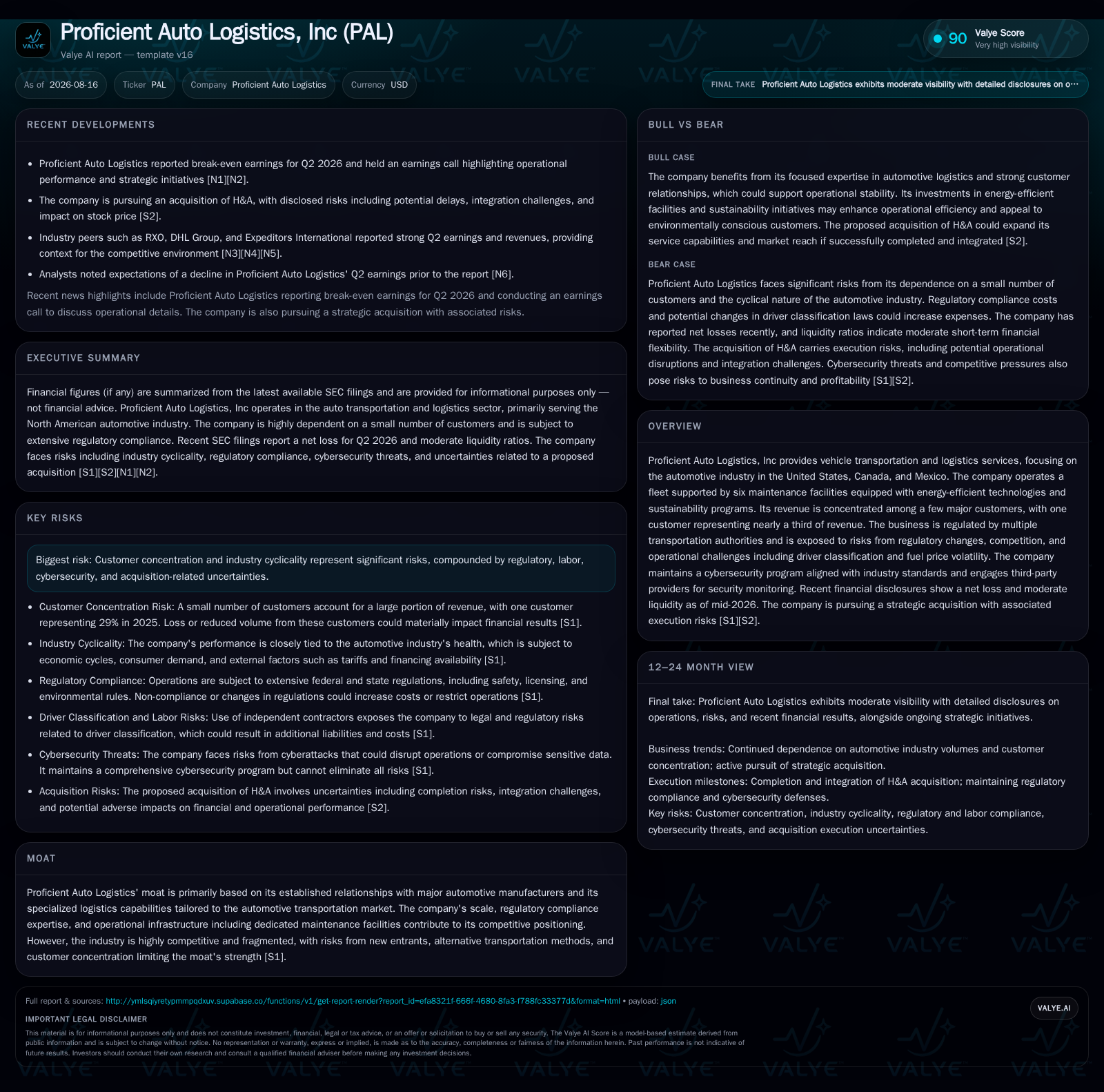
Proficient Auto Logistics, Inc. recently completed the acquisition of Hansen & Adkins Auto Transport, expanding its footprint in North American automotive logistics. This strategic move is supported by a $75 million convertible senior notes offering to finance part of the $130 million purchase price, increasing debt leverage. The business remains focused on specialized vehicle transportation for major automotive manufacturers but retains significant customer concentration risks and regulatory challenges. Its operating loss in Q2 2026 reflects ongoing integration costs and cyclical headwinds, while sustainability initiatives and maintenance infrastructure bolster its competitive position. Key watchpoints include successful acquisition integration, debt management, and contract renewals with prominent customers.
Recent Operating Update and Strategic Acquisition
Proficient Auto Logistics (PAL) announced the completion of its acquisition of Hansen & Adkins Auto Transport (H&A) on August 14, 2026 [S25]. The purchase price totaled approximately $130 million including assumed debt of about $75 million. Around $52 million was paid in cash funded from existing liquidity sources and borrowings under credit agreements, while roughly $3 million was issued in common stock alongside earnout provisions contingent on performance targets [S14], [S18]. This transaction represents a clear strategic move to bolster PAL’s service footprint across North America benefiting from H&A’s established operational network.
To support this transaction and reinforce liquidity during integration, PAL concurrently closed a private placement of $75 million aggregate principal amount of convertible senior notes due 2033 bearing a coupon of 5.5% annually [S3], [S27]. The notes offer conversion to common stock at an initial conversion price near $6.50 per share with provisions for early redemption related to market price thresholds. While the note proceeds provide essential capital for the acquisition, their issuance notably increases PAL’s leverage profile.
In its Q2 2026 earnings released August 10, PAL reported a consolidated operating loss of approximately $3.2 million attributed in part to acquisition-related expenses and residual cyclicality impacting vehicle transport volumes [F1], [N1]. Revenue remained stable but pressures from fuel cost volatility, driver labor market tightness, and customer contract renegotiations represent continuing challenges.
Business Model Specifics
PAL's core business centers on providing specialized vehicle transportation services predominantly for new automotive vehicles between manufacturing plants, distribution hubs, dealerships, and final markets within the United States, Canada, and Mexico [S1]. The company operates a fleet managed through integrated logistics services that include route optimization and compliance oversight tailored to the auto industry’s just-in-time delivery demands.
Monetization primarily occurs through contractual agreements with large automotive OEMs or dealers who pay rates based on volume tiers or fixed terms; however, supplementary revenue streams may arise from brokerage services or third-party logistics arrangements [S1]. Notably, revenue concentration is significant: one customer represents nearly one-third of total revenues exposing PAL to negotiation leverage imbalances and volatility if customer volumes decline or contracts are lost
Operationally, PAL leverages six owned or leased maintenance facilities all outfitted with energy-efficient LED lighting and HVAC systems aligned with broader sustainability goals reducing operating costs over time while also mitigating environmental impact [S1]. These facilities support fleet readiness and uptime — critical KPIs contributing directly to service reliability such as fleet utilization rate and maintenance facility uptime.
Industry Context and Competitive Positioning
Within the highly fragmented North American automotive transportation sector—a capital-intensive domain governed heavily by transportation regulations—PAL competes against varied players including national trucking carriers like Ryder System (R), third-party logistics specialists such as XPO Logistics (XPO), railroads providing bulk vehicle transport alternatives, independent owner-operators, as well as in-house logistics arms maintained by OEMs themselves.
Competition hinges principally on factors such as service quality (e.g., on-time delivery rates), operational efficiency (fleet utilization), cost structure (including fuel efficiency given exposure to fuel price volatility), and regulatory compliance expertise especially pertinent given complex cross-border transportation rules in North America.
PAL's moat derives from its tailor-made logistic capabilities focusing exclusively on automotive transportation integrated with robust customer relationships developed over time. However, the significant customer concentration risk limits pricing power relative to diversified peers tactically spread across multiple segments or customers.
Growth Drivers
Several drivers underpin PAL’s growth trajectory: the recent H&A acquisition immediately expands geographic coverage and load capacity enhancing service offerings to existing OEM partners while creating access to new customer relationships [S18]
Technological investments in route optimization software combined with expanding sustainability measures improve operational efficiencies—key differentiators under industry scrutiny given emissions regulations aiming at reduced environmental footprints.
Rising automotive production volumes post-pandemic recovery spur demand for expanded vehicle transport logistics while just-in-time delivery preferences increasingly favor integrated providers able to deliver visibility across the supply chain.
The growing segment for electric vehicles introduces new handling requirements that PAL can potentially exploit by aligning maintenance facilities and fleet capabilities accordingly.
Finally, consolidation trends within the trucking/logistics industry continue opening opportunities to capture scale benefits through strategic acquisitions—evidenced by PAL’s recent deal structure blending cash funding and equity earnouts fostering alignment with sellers’ performance post-close [S14], [S18].
Risks and Watchpoints
Despite growth initiatives, PAL faces tangible risks that investors should monitor carefully:
- Customer concentration: The dependency on a limited number of large automotive customers escalates revenue volatility risk if any sizeable client scales down shipments or renegotiates contracts unfavorably.
- Regulatory environment: Transportation compliance is complicated particularly around driver classification (independent contractor vs employee distinctions), cross-border customs regulations across US/Canada/Mexico corridors subject to evolving trade policies.
- Labor market dynamics: Difficulty attracting/retaining qualified drivers or increases in driver compensation potentially erode margins especially amidst sector-wide driver shortages.
- Fuel price fluctuations: Volatile fuel costs directly impact operating expenses; although some contracts may allow partial pass-throughs this remains a margin pressure point.
- Acquisition integration risks: Successfully melding H&A’s operations into PAL’s framework without disruption is critical; failure could impair expected synergies leading to higher costs or lost revenues [S24], [S26].
- Cybersecurity threats: As reliance on IT infrastructure grows for fleet management/billing/communications PAL must maintain vigilant cybersecurity programs leveraging external consultants—any data breach or operational disruption could be material [S1].
- Financial leverage: Increased indebtedness from deal funding places constraints on financial flexibility; monitoring covenant compliance alongside liquidity metrics is essential [F1].
What to Watch Next
Analysts should track several upcoming milestones indicating execution progress:
- Full integration results from H&A acquisition particularly EBITDA synergy realization defined partially via earnouts totaling up to ~$22 million payable contingent on near-term EBITDA targets [S14], [S18].
- Quarterly contract renewal announcements especially relating to top revenue-contributing customers which will demonstrate ability to sustain volume levels despite concentrated exposure.
- Operating margin trends beyond one-off acquisition costs reflecting leverage over fixed fleet costs through enhanced utilization/higher productivity.
- Developments around regulatory changes affecting driver classifications or cross-border operations that might necessitate structural adjustments.
- Monitoring cash flow generation versus interest expense given recently increased leverage driven by $64 million total debt reported as of June 30, 2026 ($56 million net debt after cash) alongside convertible notes maturity in 2033 [F1], [S3], ensuring capacity for capital expenditure required to maintain fleet/maintenance standards.
- Follow-up disclosures regarding environmental initiatives quantifying cost savings or carbon footprint reductions enhancing competitive positioning.
Financial Profile Discussion
As of June 30, 2026, Proficient Auto Logistics maintained cash balances near $8.1 million against total debt approximating $64.2 million resulting in net debt close to $56.0 million [F1]
Operating income recorded a loss of about $3.2 million for Q2 reflecting largely temporary headwinds from acquisition-related integration costs coupled with prevailing market softness during the period [F1], consistent with recent earnings commentary highlighting break-even adjusted earnings outlook amidst these transitional dynamics [N2].
The recently issued convertible senior notes adding $75 million principal amount at a fixed coupon rate increase fixed-charge obligations extending through 2033 but provide essential funding for growth via acquisitions while retaining manageable interest costs relative to the company’s earnings base given low current yields.
Capital expenditure commitments center primarily around fleet maintenance facility upgrades sustaining uptime metrics essential for reliable auto carrier operations as well as investments in sustainability-oriented technologies aimed at energy consumption reduction which have nontrivial upfront capital requirements but potential medium-term cost offsets.
Overall financial standing supports an ongoing growth strategy though continued focus on deleveraging post-acquisition integration would be prudent given cyclical industry exposure coupled with concentrated customer revenues.
This analysis aims solely to provide an informed perspective based on Proficient Auto Logistics’ publicly disclosed filings as of mid-2026 without any investment research views or advice.
Disclaimer: This is research-only, informational analysis and not investment advice. It may include AI-generated interpretation and general industry context. Always verify important details using primary sources.

Comments