
CH4 Natural Solutions Corp’s SPAC Progress Marks Capital Structure and Liquidity Challenges
MTNE recently completed a partial over-allotment exercise but faces liquidity constraints and redemption risks while pursuing a business combination.
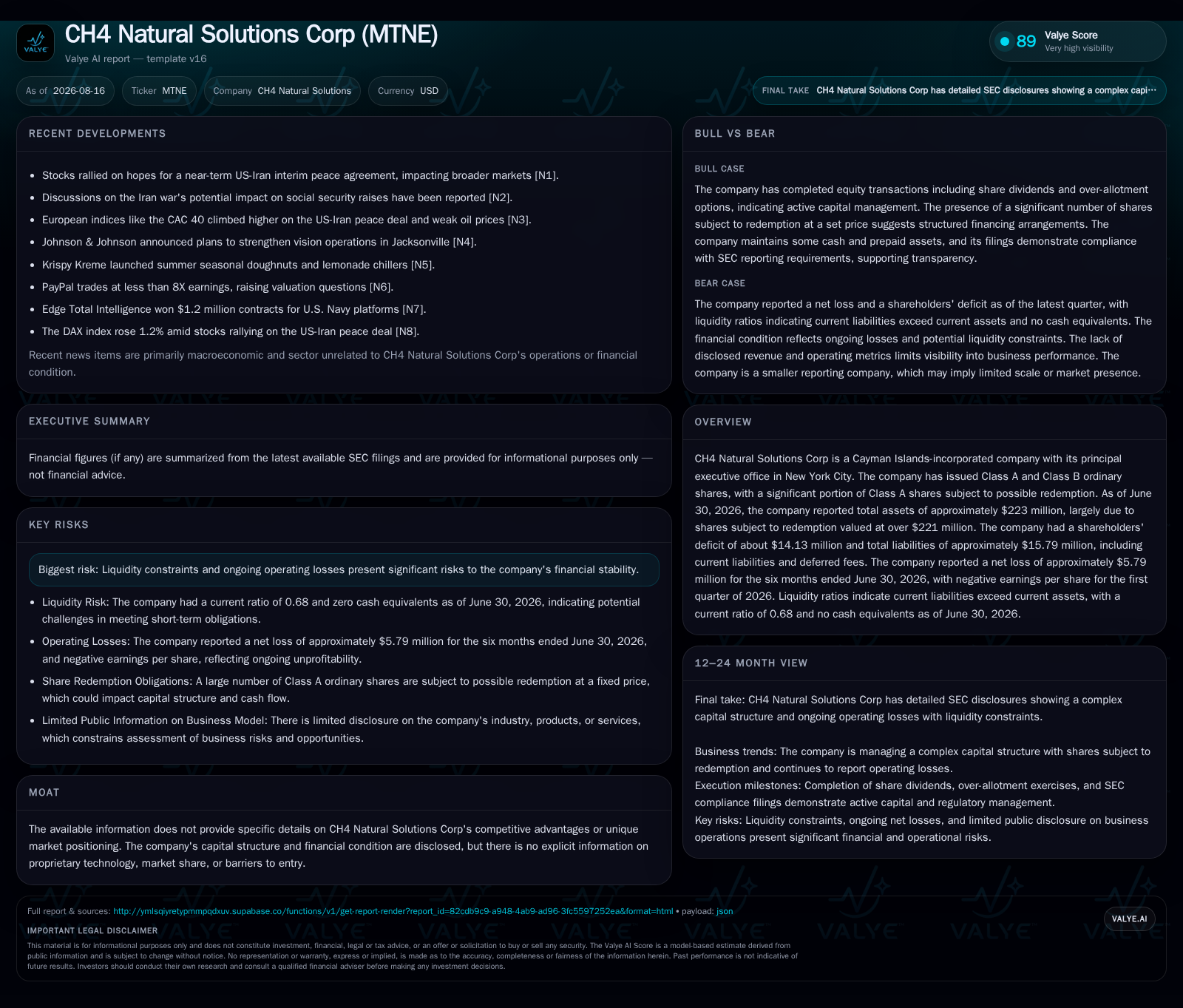
CH4 Natural Solutions Corp (MTNE) operates as a blank check company formed for the purpose of acquiring or merging with private companies through a de-SPAC transaction. Its recent quarterly filing details capital raising via IPO units and partial over-allotment exercise, accompanied by a complex capital structure involving founder shares, warrants, and public shares subject to redemption. Despite raising significant funds held in trust, the company reports no cash equivalents outside the trust account, a current ratio below one, and ongoing net losses that cast doubt on its ability to fund operations for at least the next year absent additional sponsor support. The sponsor has reduced its founder share ownership through forfeitures tied to over-allotment outcomes. With no announced business combination yet, MTNE remains vulnerable to typical SPAC risks including shareholder redemptions, capital dilution, and regulatory scrutiny.
Recent Operating Update
CH4 Natural Solutions Corp (MTNE) disclosed in its August 14, 2026 Form 10-Q that it completed an initial public offering (IPO) on May 4, 2026, issuing 20 million units at $10 each and generating gross proceeds of $200 million [S2][S23]. Shortly thereafter, the underwriter partially exercised an over-allotment option by purchasing an additional 2 million units on May 8, raising $20 million more and total gross proceeds approximating $220 million [S2][S23]. The remaining one million units under the over-allotment were forfeited after expiration on June 15, resulting in forfeiture of corresponding founder Class B shares totaling 333,333 shares [S2][S9][S23].
All proceeds from these transactions are held almost entirely in a trust account invested in demand deposit accounts with limited short-term treasury obligations permissible per SPAC conventions [S2][S28]. This trust account is segregated to fund the proposed business combination, with direct access restrictions to protect investor capital. Notably, as of June 30, 2026, MTNE reported zero cash equivalents outside this trust fund and only $1.45 million of cash overall—essentially all locked within this trust [F1][S22].
Sponsor ownership has changed materially; originally holding approximately 11.5 million founder shares after a November 2025 share dividend adjustment, the sponsor voluntarily surrendered about 3.8 million shares for cancellation by April 22, 2026—reducing founder shares owned to roughly 7.67 million shares [S2][S9]. This surrender correlates with the partial over-allotment exercise outcome affecting the overall offering size and sponsor equity stake dynamics.
Business Model
MTNE is structured as a Special Purpose Acquisition Company (SPAC), a publicly traded shell entity that raises capital upfront through an IPO by selling units comprising common shares plus warrants. The funds raised are placed into a trust account waiting until the company identifies an acquisition target with fair market value usually exceeding at least 80% of those hold funds.
Revenue generation is currently nonexistent—the SPAC does not operate productive assets or engage commercial operations pre-merger. Instead, its value proposition for investors resides in successfully locating and acquiring one or more private companies (a "business combination" or de-SPAC transaction). Post-merger, MTNE would rely on operating income from combined enterprise activities.
Capital structure intricacies include:
- Founder Shares: Reserved for sponsors as incentive compensation ("sponsor promote") prior to deal closure; dilutes public holders post-merger.
- Units: Comprised of one Class A ordinary share plus half warrant; sale proceeds flow into trust account.
- Warrants: Exercisable post-business combination at $11.50/share; potential source of dilution when exercised.
- Redemption Rights: Public shareholders may opt to redeem shares for pro-rata amounts from the trust upon certain events like liquidation or shareholder vote prior to deal closure.
These structural elements influence investor returns through dilution risk from warrants and founder shares while redemption rates affect usable merger capital.
Industry Structure and Competitive Position
Operating within the blank check vehicle sector—a market segment populated by numerous SPACs such as Pershing Square Tontine Holdings or Churchill Capital—MTNE faces intense competition to identify attractive private targets amid shifting market sentiment around SPAC transactions.
SPAC success depends heavily on timely completion of business combinations within mandated deadlines (usually within two years), sponsor quality attracting pipeline targets, investor retention minimizing redemptions at deal announcement/vote time, and efficient capital deployment.
MTNE's lack of disclosed target businesses leaves market perception reliant solely on financial metrics and corporate governance signals management provides during pre-combination phase.
Compared to peers with more advanced deal pipelines or stronger sponsor reputations, MTNE currently shows typical early-stage SPAC characteristics: significant capital raised but no operative earnings stream yet alongside inherent risks associated with liquidity management and shareholder redemptions.
Growth Drivers
Primary growth levers for MTNE revolve around executing one or more business combinations that:
Success factors include market receptivity toward SPACs when equity markets perform well and regulatory clarity supporting such vehicles’ operation versus periods of volatility limiting capital raising appetite.
Risks and Watchpoints
MTNE’s key risk exposures derive from common SPAC lifecycle traps compounded by modest sponsor financial commitment disclosures:
- Liquidity Constraints: The company has less than adequate working capital beyond the trust account to cover operational expenses for more than one year without sponsor funding; current ratio stands at approximately 0.68 indicating short-term asset coverage weakness [F1][S14].
- Shareholder Redemptions: Public Class A ordinary shares carry redemption rights impairing deployable merger capital if exercised heavily upon combination announcement [S22].
- Dilution Risks: Founder shares reduction via forfeiture was observed likely linked to over-allotment activity; warrants outstanding provide future dilution potential if exercised post-merger impacting shareholder value concentration dynamics [S9][S23].
- Going Concern Doubts: Management explicitly stated substantial doubt regarding continuation without additional sponsor loans or capital infusions despite lack of obligation for sponsor assistance; timing mismatch with liquidity requirement raises execution risk [S8][S14].
- Uncertainty Around Business Combination: No definitive merger agreement or target named yet; failure or delay triggers mandatory liquidation risking investor returns subject only to trust liquidation proceeds less expenses.[S28]
- Concentration of Credit Risk: Majority funds held at single custodian potentially exceeds FDIC limits exposing liquidity vulnerability though industry standard for SPACs [S25].
What to Watch Next
Critical near-term milestones include:
- Announcement of definitive agreement(s) regarding business combination(s); monitors time elapsed since IPO as regulatory deadlines enforce completion window typically within two years.
- Shareholder vote timing on proposed transactions which will trigger possible redemption exercises providing insight into investor confidence levels.
- Sponsor readiness evidence including disclosure about working capital loans or capital contributions reinforcing going concern status resolution.
- Activity around warrants—exercise volumes indicate shareholder valuation outlook impacting dilution forecasts.
- Over-allotment option residuals remaining unexercised suggest limited immediate upside-triggered fundraising progress but reduce potential sponsor share forfeitures further adjusting equity stakes.
- Management commentary updates especially addressing liquidity plans may confirm or erode confidence in operational runway ahead of merger close.
Financial Profile Discussion
As of June 30, 2026, MTNE’s balance sheet reflects total current assets of approximately $1.57 million against current liabilities near $2.3 million resulting in a current ratio below unity at roughly 0.68 indicative of working capital insufficiency inherent for non-operating SPAC shells without proximate merger income [F1]. Cash recorded is effectively zero outside the trust fund where nearly all IPO proceeds reside insulated from general liabilities by regulatory design but inaccessible for working capital needs absent specific withdrawals typically restricted pre-merger [F1][S22].
In aggregate financial health assessment emphasizes early-stage SPAC vulnerabilities amplified by limited external financing options beyond IPO unit sales underscoring critical reliance on completing timely business combination(s) to unlock enterprise value creation possibilities consistent with industry norms but constrained presently by absence of reported deals [S28][F1]
This analysis is based exclusively on information publicly disclosed in CH4 Natural Solutions Corporation’s SEC filings as of August 14, 2026 ([S2], [S3]) supplemented by latest numeric data snapshots ([F1]). It refrains from speculation regarding deal prospects or valuation pending formal announcements. The aims are focused insight into MTNE’s SPAC structural mechanics, capital dynamics, operational risks, financing posture, and sector-relative positioning without investment opinion.
Disclaimer: This is research-only, informational analysis and not investment advice. It may include AI-generated interpretation and general industry context. Always verify important details using primary sources.

Comments