
FOCUS UNIVERSAL’s Profitability and Product Development Challenge Amid IoT Market Pressures
August 2026 filings reveal sustained revenue declines and mounting losses, underscoring operational and financial strains in Focus Universal’s IoT hardware business.
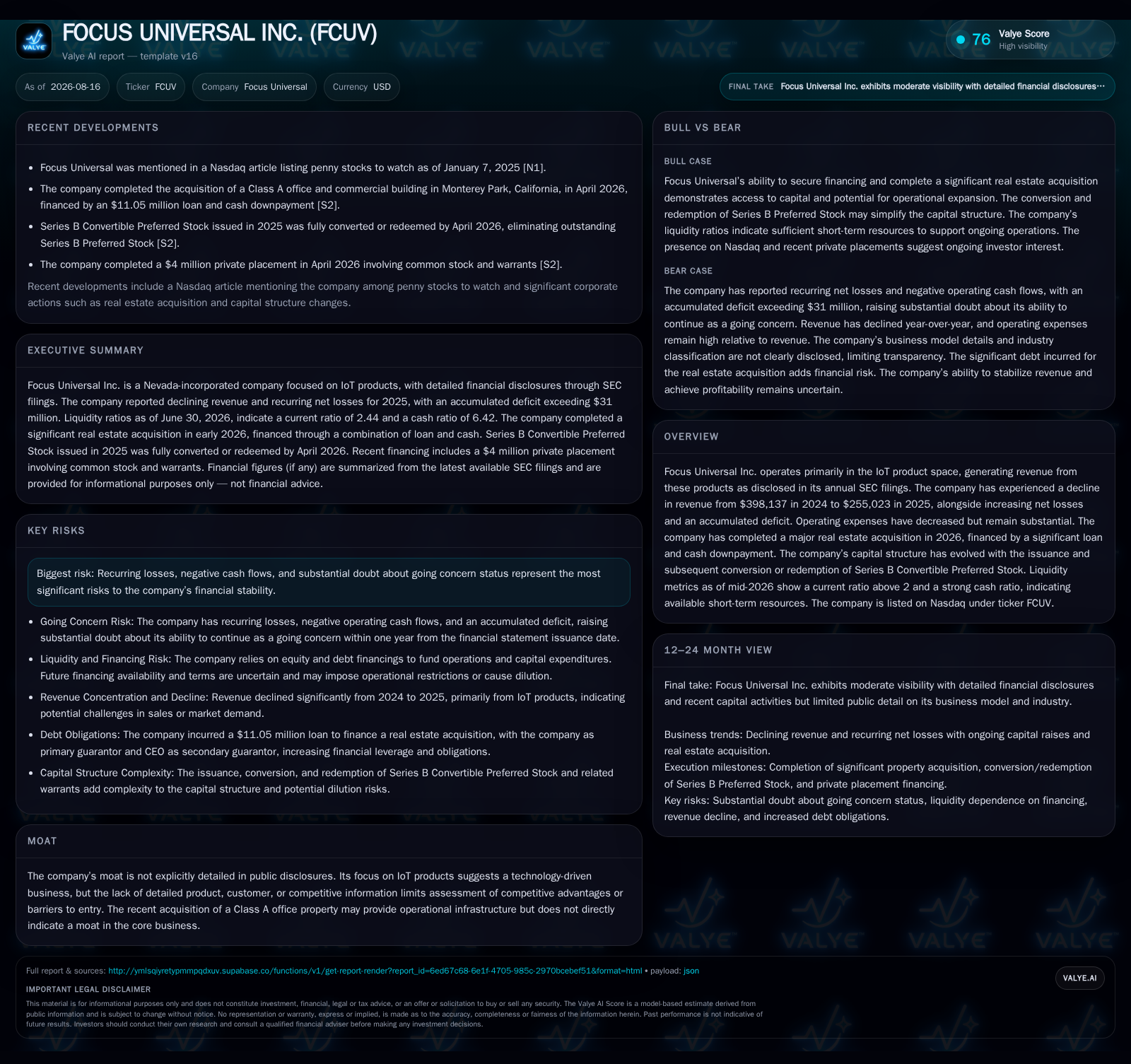
Focus Universal Inc.’s latest quarterly 10-Q reports a sharp revenue drop of approximately 36% year-over-year to $255,023 alongside continued negative gross margins and substantial operating losses. The company’s reliance on outsourced manufacturing exacerbates quality control and scaling challenges, while high research and development expenses impose ongoing cash flow pressure. Competitive pressures in the IoT device market constrain pricing power and customer adoption, limiting gross margin recovery. Near-term growth depends on expanding demand within smart home and industrial IoT segments, but liquidity concerns and structural financial risks remain prominent.
Quarterly Operating Deterioration Highlights Revenue Slide and Loss Expansion
es or ASP uplift.
Embedded Outsourcing Risks Strain Quality Control and Scale in Manufacturing
FOCUS UNIVERSAL relies heavily on outsourced manufacturing to produce its wireless sensor devices—a typical approach within IoT hardware to mitigate capital-intensive facility investments [S1]. However, this dependency impairs the company’s ability to maintain strict quality control and assure timely supply chain responsiveness. The lack of direct oversight heightens risks related to product reliability and increases susceptibility to supplier disruptions or component cost fluctuations. Additionally, intellectual property protection during offshore production introduces concerns over proprietary technology leakage [S1]. These factors constrain agility needed to adjust production rapidly or optimize cost-of-goods sold (COGS), ultimately exerting downward pressure on gross margins. Comparative contract manufacturers such as Flex or Jabil illustrate how scale enables faster issue resolution; Focus Universal's smaller scale limits such leverage.
IoT Device Product Development Intensity Maintains Innovation but Heightens Cost Pressure
The company’s financials reveal significant investment into research and development, with expenditures near $920K for the year ended December 31, 2025 despite overall reduced operating expenses [S1]. This elevated R&D spend relative to declining revenues underlines a strategic emphasis on sustaining innovation—necessary to advance new wireless sensor products aligned with evolving connectivity protocols but also reflecting the pre-commercial nature of much of the product pipeline. The long cycle times typically involved in bringing complex IoT hardware solutions to market exacerbate cash flow strain, as returns are deferred beyond immediate expenditure periods. Such an intensity level demands efficient project management execution and intellectual property creation milestones to justify ongoing costs. Without successful commercialization trajectories or licensing arrangements, these expenses impede near-term profitability prospects.
Competitive Dynamics Constrain Pricing Power and Customer Adoption Trajectories
Focus Universal faces competition from established IoT hardware providers like Digi International and Sierra Wireless that operate at greater scale with broader product portfolios encompassing wireless sensors and connectivity modules. These counterparts benefit from more diversified customer bases and established channel relationships which enhance market reach. The general industry trend towards commoditized hardware erodes pricing power; customers gravitate towards proven brands or integrated smart home technology solutions offered by firms such as Alarm.com. The company lacks disclosed evidence of durable competitive moats or differentiated intellectual property that could command premium pricing or defend market share robustly [S1]. Consequently, customer adoption rates slow as alternatives proliferate and connectivity standards evolve rapidly.
Growth Hinges on Expanding Smart Home and Industrial IoT Demand Amid Cost Challenges
Despite company-specific headwinds, underlying industry growth drivers persist rooted in accelerating adoption of smart home applications and industrial automation requiring energy-efficient remote monitoring devices. Advances in wireless connectivity infrastructure such as LPWAN and emerging government incentives for smart city implementations provide tailwinds for IoT device demand expansion. Declining costs of electronic components also support potential margin improvement if manufacturing efficiencies are realized. However, Focus Universal's capacity to capitalize on these trends is hampered by finite liquidity resources restricting marketing investments and delayed scaling of sales operations [S1]. The recent acquisition of a Class A office building expands physical infrastructure but does not directly enhance software integration capabilities crucial for end-to-end solution positioning within these expanding segments [S22].
Risks Center on Liquidity Strains, Regulatory Hurdles, and Technological Obsolescence
Persistent operating losses culminating in a net loss of approximately $4.8 million for the year ended December 31, 2025 weigh heavily on financial sustainability with accumulated deficits surpassing $31 million posing substantial going concern risks flagged explicitly by management [S1][S2]. Regulatory complexity further constrains growth; domestic and international rules governing wireless communication pose certification barriers limiting speed-to-market for new sensor products. Outsourced manufacturing exposes vulnerabilities related to safeguarding intellectual property amid potential unauthorized replication or retention overseas—a recognized hazard given operations linked to China-based facilities [S1]. Compounding these factors is the inherent risk of rapid obsolescence typical within technology-driven sectors forcing continuous reinvestment lest products become outdated before commercial viability is reached.
Near-Term Indicators to Monitor: Revenue Trends, R&D Efficiency & Cash Burn
In absence of explicit forward guidance from Focus Universal's filings through August 2026, key metrics that would illuminate progress include monthly or quarterly unit sales volumes disclosed in future reports which signal market traction shifts. Average selling price adjustments would show whether competitive pressures soften or intensify amidst changing product mixes. Tracking research effectiveness via measurable pipeline milestones or intellectual property accrual represents another important vector indicating potential for improved cost efficiencies over time. Cash reserve depletion rates against available liquidity reveal how long current resources can sustain ongoing development before urgent refinancing becomes necessary [S2]. Such data points together will be critical barometers testing hypotheses around recovery potential or signaling need for deeper strategic realignments.
Financial Profile Discussion: Current Liquidity Cushion Against Debt Burden
As of June 30, 2026, companyfacts reports total debt of approximately $18 million, with net debt near $12.6 million considering cash and equivalents last reported at $5.37 million as of September 30, 2024 [F1]. Current assets stood at about $2 million against current liabilities of approximately $836,000, yielding a current ratio near 2.44x, suggesting manageable short-term obligation coverage at face value [F1]. However, accumulated deficits exceeding $31 million underline persistent unprofitability stresses that limit equity cushions and increase refinancing risk profiles should operating cash flow remain negative. The recent $11 million loan facility financing the corporate office acquisition adds fixed charge obligations amid ongoing losses, adding complexity to capital management going forward [S22].
This analysis bases all company-specific insights strictly on SEC filings through August 14, 2026 combined with standard industry knowledge applied conservatively without speculative assertions about detailed client relationships or proprietary technology advantages beyond disclosed facts.
Disclaimer: This is research-only, informational analysis and not investment advice. It may include AI-generated interpretation and general industry context. Always verify important details using primary sources.

Comments