
Scilex Holding’s Strategic Focus on Non-Opioid Pain Products Faces Financial and Market Access Challenges
Scilex’s portfolio of FDA-approved non-opioid pain management therapies advances with clinical-stage assets, but liquidity constraints and market penetration remain key concerns.
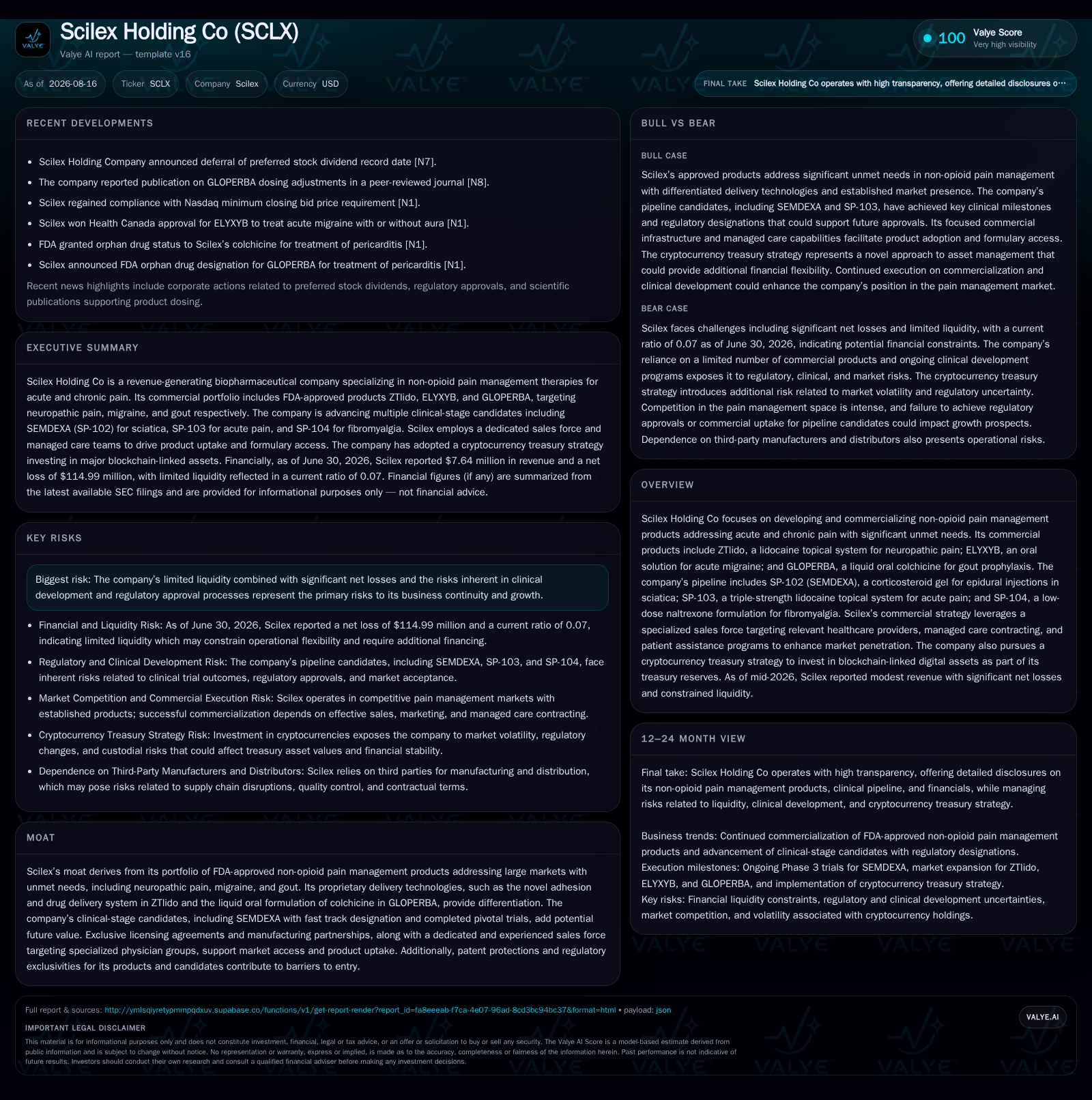
Scilex Holding Co operates in the niche of non-opioid pain management, marketing three FDA-approved products and developing a pipeline of novel formulations targeting large unmet needs in acute and chronic pain. The company’s commercial model utilizes a specialized sales force and managed care contracting to drive adoption. However, recent quarterly disclosures highlight severe liquidity pressures with a current ratio below 0.1 and ongoing net losses weighing on operational stability. Despite promising late-stage assets like SEMDEXA and innovative delivery systems, financial sustainability and effective market penetration are critical watchpoints. Progress on clinical milestones, reimbursement gains, and sales execution will determine if Scilex can capitalize on its differentiated portfolio amid competitive and regulatory risks.
As of June 30, 2026, Scilex reported cash and equivalents of $566,000 against current liabilities exceeding $512 million—a current ratio of approximately 0.07 that highlights significant working capital constraints [F1]. Although total debt was reported at zero as of end-2022 [F1], no more recent debt or refinancing disclosures were available to assess current leverage or liquidity in detail.
Business Model: Proprietary Non-Opioid Pain Products Target Acute & Chronic Needs
Scilex distinguishes itself through its focus on safe, non-opioid therapeutics addressing large unmet medical needs in both acute and chronic pain settings. Its commercially marketed products include ZTlido®, a lidocaine topical system approved for neuropathic postherpetic neuralgia pain; ELYXYB®, an oral solution approved for acute migraine treatment; and GLOPERBA®, a novel liquid formulation of colchicine designed for gout flare prophylaxis which launched mid-2024 [S1]. These products leverage differentiated delivery technologies—topical transdermal patches or liquid oral formulations—to enhance patient adherence and therapeutic outcomes compared to older generics or opioid alternatives.
The revenue model relies primarily on prescription drug sales through physician prescribing channels within outpatient specialty care settings. Managed care contracting plays a central role in market access, affecting pricing and formulary inclusion. Additionally, Scilex deploys patient assistance programs intended to reduce out-of-pocket costs—a critical factor influencing prescription volume when competing therapies require co-payments or prior authorizations [S1]. This multifaceted commercial approach attempts to drive prescription growth while managing payer reimbursement complexities typical in pharmaceuticals.
The product pipeline offers potential upside with three candidates advancing through clinical development: SEMDEXA (SP-102), a Phase 3-completed corticosteroid viscous gel for epidural injection treating sciatica; SP-103, a higher-strength lidocaine topical system targeting acute pain indications; and SP-104, an early-stage low-dose naltrexone formulation aimed at fibromyalgia symptom relief [S1]. These assets build on the company’s strengths in drug formulation innovation and could extend market reach upon successful regulatory approvals.
Industry Structure & Competitive Positioning
Scilex operates within the pharmaceutical sub-sector specializing in non-opioid analgesics. This niche benefits structurally from shifting prescriber behavior away from opioids due to regulatory pressure highlighting addiction risks. However, achieving commercial success requires proprietary advantages such as novel drug delivery platforms that improve pharmacokinetics or reduce side effects to differentiate from generics or existing alternatives.
Topical drug delivery systems like those in ZTlido® present significant barriers via patented adhesion technologies combined with controlled-release profiles that improve efficacy for neuropathic pain sufferers. Similarly, GLOPERBA's liquid oral colchicine addresses tolerability issues seen with capsule forms used historically for gout flares. These intellectual property protections underpin exclusive market access windows critical for scalable product uptake.
Commercial execution depends heavily on building specialized sales forces with targeted call frequency towards relevant healthcare providers including neurologists for migraines or rheumatologists for gout [S1]. Securing managed care formulary placement is another key hurdle influencing prescriber adoption rates given variability among private insurers despite Medicare serving as a common benchmark
Peers such as Cara Therapeutics or Collegium Pharmaceutical parallel Scilex’s playbook emphasizing innovative delivery mechanisms coupled with niche pain indications but typically sustain more robust balance sheets allowing sustained R&D investment alongside commercial expansion efforts.
Growth Drivers
Scilex’s growth prospects hinge on multiple factors integral to non-opioid pain management firms:
- Regulatory Advancement: Timely FDA approval of pipeline candidates—particularly SEMDEXA’s recent Phase 3 completion—could open new acute pain segments enhancing revenues substantially.
- Market Expansion: Extension of indications beyond initial approvals could widen addressable markets if supported by positive clinical data.
- Managed Care Inclusion: Broader formulary acceptance reduces price barriers incentivizing prescribers towards Scilex products versus legacy therapies or opioids.
- Innovative Delivery: Continued development of differentiated topical or oral formulations fosters patient adherence improving real-world effectiveness and competitive positioning.
- Shift in Prescriber Behavior: Increasing awareness of opioid risks sustains demand shifts towards safer alternatives benefiting Scilex’s portfolio broadly.
Monitoring prescription volume trends alongside sales force coverage metrics will be essential markers translating these drivers into commercial traction.
Risks & Watchpoints
The primary risks loom large given the company’s precarious financial standing:
- Liquidity Crisis: Current working capital imbalance creates near-term survival risks absent fresh financing or asset sales [F1].
- Clinical & Regulatory Risk: Pipeline assets still require positive clinical outcomes and FDA approval; setbacks could damage valuation appreciably.
- Reimbursement Uncertainty: Managed care coverage decisions vary widely; exclusion from payor formularies can stall adoption irrespective of clinical merit.
- Competitive Pressures: Both opioid alternatives and generic/non-pharma innovations challenge market share gains.
- Intellectual Property Lifespan: Patent expirations may open entry to generics limiting long-term exclusivity benefits.
- Operational Execution: Scaling specialty salesforces efficiently against budget constraints is challenging yet necessary for penetration.
- Cryptocurrency Treasury Volatility: Though part of diversification strategy, crypto holdings may introduce unpredictable financial swings unrelated to core pharma business fundamentals [S1].
Close attention to quarterly cash burn rates alongside milestone achievements in pivotal trials will provide timely insight into operational resilience.
What to Watch Next
Key anticipated developments include:
- Announcements regarding regulatory filings or approvals especially around SP-102 (SEMDEXA) reflecting progress towards commercial launches.
- Updates on managed care contracting expansions reflecting improved payer receptivity enabling broader prescription uptake.
- Sales volume disclosures from core products indicating traction improvements post-launch initiatives or patient assistance impacts.
- Financing transactions or strategic partnerships that alleviate liquidity constraints facilitating R&D continuity.
- Clinical trial recruitment completions or endpoint readouts signaling forward momentum in pipeline validation.
Tracking these milestones together with monitored improvement in sales force productivity metrics will shape forward-looking assessments substantially.
Financial Profile Discussion
As of mid-2026 quarter-end, Scilex’s financial snapshot shows cash and equivalents of $566,000 against current liabilities exceeding $512 million, resulting in a current ratio near 0.07 which indicates severe short-term liquidity risk if unaddressed [F1]. No updated debt or refinancing disclosures were available beyond the zero total debt reported at end-2022 [F1]. This financial position underscores the critical need for near-term capital raises or asset monetization to sustain operations.
Such financial strain may impair the company’s ability to invest sufficiently in late-stage trials or expand market access capabilities without dilutive financing events or asset divestitures. Additionally, exposure linked to cryptocurrency treasury strategies adds unpredictability given crypto market volatility distinct from core pharma operations [S1].
In sum, while Scilex holds technologically differentiated products addressing validated patient needs within an attractive industry niche benefiting from opioid-use caution trends, the near-term viability critically hinges on resolving liquidity shortages paired with operational execution focused on gaining formulary inclusion and expanding prescription volume across key indications.
Disclaimer: This is research-only, informational analysis and not investment advice. It may include AI-generated interpretation and general industry context. Always verify important details using primary sources.

Comments