
PSB Financial’s Transition to Stock Form and Its Regional Lending Focus
PSB Financial’s May 2026 conversion from mutual to stock form establishes a new capital structure and governance framework amid continued regional banking operations centered on residential lending in Montana.
In May 2026, PSB Financial completed its mutual-to-stock conversion, becoming the bank holding company for Pioneer State Bank. This fundamental change enabled equity issuance, including an employee stock ownership plan (ESOP), reshaping its capital base and governance. The firm’s business remains concentrated in residential single-family mortgage lending, primarily funded through deposit accounts sourced from local communities in Deer Lodge and Dillon, Montana. Asset quality remains stable with minimal nonaccruals, though the bank posted a net loss for Q2 2026 reflecting early post-conversion expenses. Going forward, monitoring loan growth, net interest margin trends, and deposit stability will be critical to gauge the operational transition amid typical regional banking risks and opportunities.
Conversion Completion Shapes Capital and Ownership Structure
PSB Financial's reorganization in May 2026 constituted a pivotal shift as it transitioned from Pioneer Federal Savings and Loan Association's mutual form of organization into a publicly held stock company via merger with Pioneer State Bank [S2]. This corporate realignment established PSB Financial as the parent bank holding company centered on Pioneer State Bank while preserving the historical accounting basis of assets and liabilities through this structural change
The transaction facilitated an initial public offering raising approximately $17.2 million gross proceeds at conversion, of which roughly $6.8 million was contributed directly to the bank subsidiary to bolster capital adequacy [S7]. Simultaneously, an Employee Stock Ownership Plan (ESOP) was instituted purchasing about 137,540 shares financed by a loan from PSB Financial itself—a mechanism designed to foster employee alignment with shareholders while creating an element of equity dilution evidenced as unallocated ESOP shares reducing shareholders’ equity on consolidation
This new capital structure enables PSB Financial to access permanent equity capital markets beyond the constraints of mutual ownership, providing flexibility for future growth initiatives or balance sheet strengthening required under ongoing regulatory scrutiny. However, as an emerging growth company electing transition period allowances under the JOBS Act, the firm retains some exemptions from full public company accounting reporting standards—potentially affecting comparability versus established public peers.
Focused Lending Model Drives Core Revenue Streams
Pioneer State Bank represents the company's singular operating segment focused predominantly on residential single-family mortgage lending that constitutes its primary source of net interest income generation [S2]. Supplementary commercial loan portfolios contribute modestly but remain consistent with community banking norms emphasizing localized credit exposure
Funding is predominantly derived from deposit accounts sourced through a limited branch network centered on Montana locales Deer Lodge and Dillon. This deposit base provides stable liquidity at generally favorable cost relative to lending yields—a critical dynamic underlying net interest margin (NIM), the principal profitability driver in regional banks [F1], [S8].
Loan portfolio quality appears resilient post-conversion: incurred accrued interest write-offs related solely to nonaccrual residential real estate first liens amounted to approximately $16,000 over six months ending June 2026—an immaterial sum reflecting vigilant credit risk management typical in prudent smaller community banks [S2]. Notably absent are collateral-dependent loans further limiting concentrated portfolio risk.
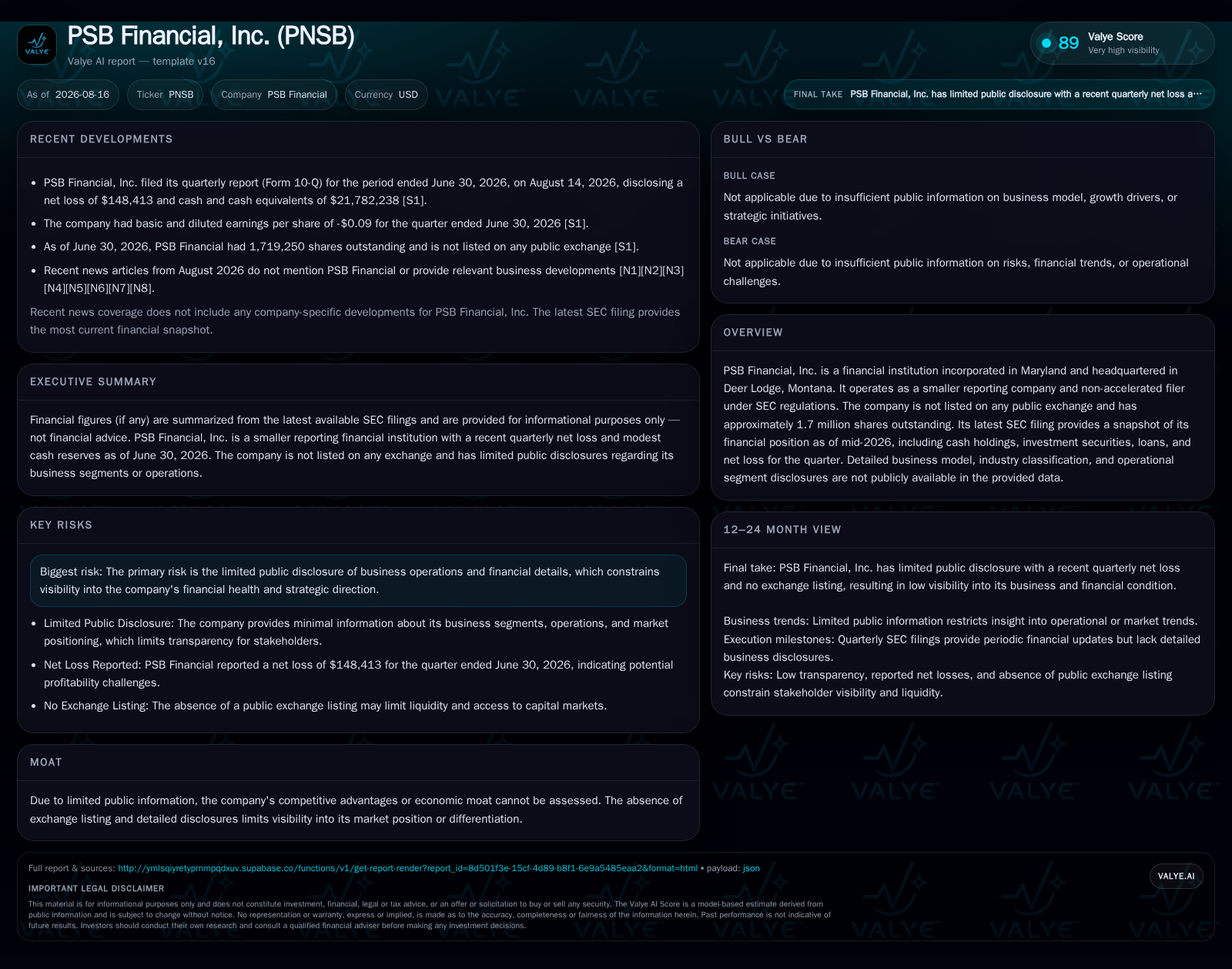
Despite this stability, Q2 2026 reported a net loss of about $148,000 influenced partially by upfront expenses linked to the conversion process and IPO-related costs before operational economies scale sufficiently for sustained profitability generation [F1], [S2].
The Local Banking Environment: Peer Comparisons and Competitive Positioning
Operating at smaller scale than regional banking incumbents such as Regions Financial Corporation or Zions Bancorporation—which have extensive branch networks servicing broader geographic footprints—PSB Financial embodies characteristics common among community banks focusing on local markets. The limited branch footprint reflects strategy targeting deep customer relationships over broad service platform breadth or aggressive expansion.
PSB's business model centers around straightforward residential lending backed by deposit account funding rather than diversified fee income streams from wealth management or expansive commercial banking products seen in larger peers. This operational narrowness offers simplicity but constrains revenue diversification potential and places premium importance on maintaining local market share amidst increasing competition from larger regional/national banks and fintech entities offering streamlined digital alternatives.
Limited digital channel disclosures suggest PSB relies heavily on traditional face-to-face relationship banking consistent with many rural community banks; however, this posture may expose vulnerability if fintech competition intensifies locally or if consumer expectations evolve rapidly.
Balancing Asset Quality and Credit Risk in Early Post-Conversion Period
Asset quality metrics conveyed in the latest filing highlight restrained credit risk with minimal deterioration noted over early post-conversion months. The exclusive focus of accrued interest write-offs on residential first lien mortgages placed in nonaccrual status—totaling around $16,000—indicates localized borrower stress without systemic concern thus far [S2]. Absence of loan collateral dependency reduces exposure to sector-specific asset price volatility.
Provisions for loan losses reflect ongoing cautiousness with management employing evaluations keyed to internally prepared ratings deploying traditional pass/special mention categorizations aligning with sector best practices. While earning performance is currently subdued owing chiefly to conversion-related expenses rather than credit losses per se, management’s reserve-building approach suggests preparedness for potential credit cycles affecting local Montana borrowers given economic sensitivities tied notably to housing market dynamics [S2].
Interest rate risk remains an inherent consideration given recent rising rate environments likely compress borrowing affordability over time impacting future NIM stability—a common challenge across regional banking competitors.
Growth Outlook Tied to Montana Economy and Residential Mortgage Demand
PSB Financial’s revenue growth trajectory is deeply intertwined with macroeconomic factors driving housing demand within its Montana markets. Employment levels and consumer confidence influence borrower appetite for creating residential mortgages—constituting the dominant component of their lending book—and concurrently impact core deposit accretion vital for funding said loans without resorting extensively to more costly wholesale funding sources.
Recent quarterly filings reveal improving deposit trends concurrent with notable cash equivalents accumulation partly reflecting IPO proceeds infusion providing liquidity cushions enabling measured loan portfolio expansion opportunities post-conversion [F1], [S8]. However, absent indications of technology-enabled outreach initiatives or product diversification signal reliance on traditional community bank strength rather than innovation-driven growth vectors.
Robustness of these local demand drivers will be determinative for how PSB can leverage new capital flexibility into increased origination volume supporting longer-term earnings scalability.
Risks: Limited Diversification and Regulatory Capital Scrutiny Ahead
Narrow concentration within residential mortgage lending inherently exposes PSB Financial to economic downturn sensitivity localized within Montana’s housing market cycle fluctuations. Lack of multi-product diversification also amplifies vulnerability should competitive forces materially pressure lending margins or deposit retention capabilities.
Transitioning capital requirements imposed by regulatory agencies following conversion may require vigilant management attention especially as the firm integrates public shareholder obligations alongside ESOP interests while maintaining compliance with regulatory capital adequacy benchmarks essential for sustainable growth capacity [S2]
Furthermore, limited publicly available detail complicates external analysis concerning strategic direction or unique competitive positioning—factors that constrain visibility into long-term moat potential relative to better capitalized regional rivals.
These milestones represent tangible KPIs anchoring operational monitoring aligned closely with typical regional banking success factors shaping competitive standing within Montana’s financial services landscape.
Disclaimer: This is research-only, informational analysis and not investment advice. It may include AI-generated interpretation and general industry context. Always verify important details using primary sources.

Comments