
Fermi Inc.’s Project Matador Progress and Financing Risks Shape Near-Term Outlook
Fermi’s August 2026 quarter filing highlights escalating execution and liquidity pressures amid conditional tenant leases and leadership upheaval.
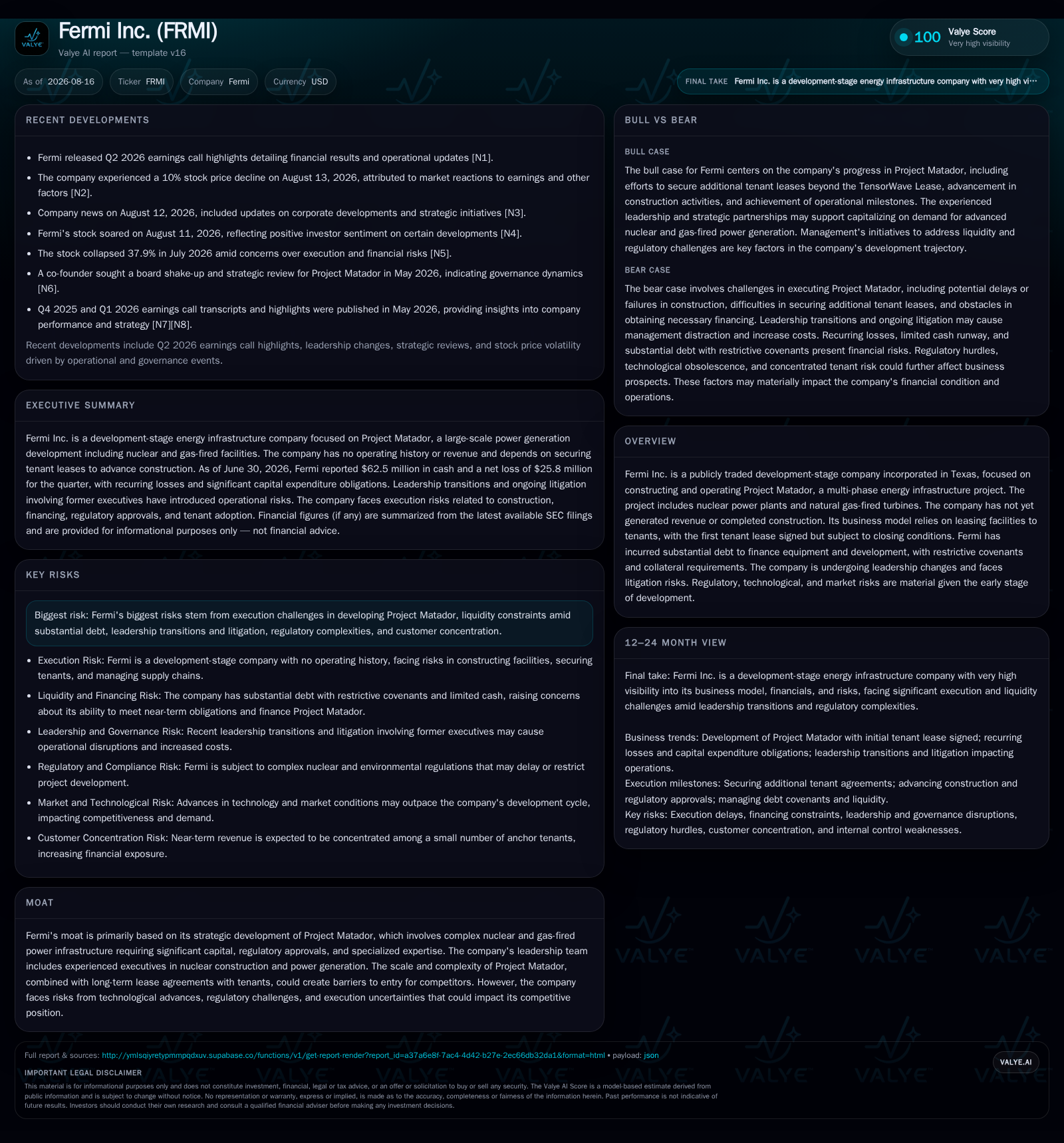
Fermi Inc., still in its development stage with no revenue, disclosed in its latest quarterly filing ongoing delays in Project Matador’s construction and conditional status of its key TensorWave lease, underscoring fragile early commercial footing. The company faces significant financial strain with over $530 million in debt, restrictive covenants requiring substantial liquidity maintenance, and a recent convertible notes offering that raises refinancing risks amidst leadership changes. These factors accentuate operational execution risks typical for capital-intensive energy infrastructure projects pending regulatory approvals and tenant onboarding, shaping an uncertain near-term outlook.
Quarterly Developments Underscore Execution Risk in Early Project Phase
Fermi Inc.’s 10-Q filed August 14 reveals that Project Matador remains firmly in the construction phase, with no facilities yet commissioned or generating revenue [S2]. The company has secured a single tenant lease agreement—the TensorWave Lease—which remains subject to closing conditions and has not commenced generating income. This limited commercial traction injects significant uncertainty into operational milestones and revenue visibility. Management commentary and risk disclosures emphasize the precarious nature of execution at this stage: delays or inability to secure definitive tenant agreements will materially impact business prospects
The filing also details pronounced leadership turbulence including the termination of former CEO Toby Neugebauer and CFO resignation, heightening risks around continuity in executing the complex development plan. Given the highly specialized nature of nuclear and natural gas infrastructure projects within Project Matador, such governance disruptions potentially slow decision-making or impair stakeholder confidence during a critical period [S2].
Strategic Lease-Dependent Revenue Model Heightens Tenant Agreement Significance
Fermi’s business model centers on developing large-scale energy generation assets—specifically nuclear plants combined with gas-fired turbines—and monetizing these through long-term leasing arrangements [S1]. This model aligns broadly with energy infrastructure developers like NextEra Energy Partners who leverage leased assets to generate steady cash streams post-construction. However, unlike mature peers with diversified lease portfolios and fully operational assets, Fermi has yet to complete construction or produce meaningful revenues
The TensorWave Lease is currently the sole anchoring contract but remains conditional to closing triggers typical in development-stage projects. This condition implies fragile early-stage revenue visibility wherein additional tenant signings or power purchase agreements are required to de-risk future cash flows. Without multiple firm leases signed or commercial operations underway, financial stresses intensify given ongoing capital expenditure demands [S2]. The sector conventionally views secured tenant agreements or PPAs as cornerstone value drivers for project valuation and financing.
Capital Intensity Meets Restrictive Financing: Understanding Fermi's Debt Covenants
Fermi’s capital structure reveals material leverage stress typical of similarly scaled early-stage energy developers. As of June 30, 2026, total debt stood near $537 million against approximately $62.5 million in cash equivalents—netting to roughly $474 million net debt—underscoring significant liquidity pressure amidst pre-revenue status [F1]
Debt comprises multiple equipment financing facilities backing turbine acquisitions and construction milestones (including the $500 million MUFG Turbine Warehouse Equipment Financing) along with $431 million aggregate principal amount of convertible senior notes issued in July 2026 at a 5% coupon due 2031 [S5][S6]. These instruments carry stringent covenants such as loan-to-value ratio maintenance where defaults could be triggered by sustained property value declines exceeding minimal thresholds post-appraisal. Liquidity covenants also mandate maintaining at least $20 million until repayment or lease execution occurs—a tough hurdle considering CapEx burn rates [S6].
Additionally, some amortization payments require settlement via common stock issuances, introducing dilution concerns alongside cash flow constraints. The layered complexity of these restrictive arrangements heightens refinancing risks especially if project delays persist or tenant leasing conditions are unmet.
Competitive Context: Positioning Against Established Energy Infrastructure Developers
Within the broader energy infrastructure development industry—characterized by heavy upfront capex investments, prolonged regulatory approval cycles, and complex engineering requirements—Fermi occupies an upstream role focused purely on asset development before operational handoff or direct energy sales. Peers such as Dominion Energy or NRG Energy operate more integrated models encompassing operations alongside asset ownership.
Comparatively, contractors like Fluor Corporation embody expertise in navigating EPC challenges inherent in constructing nuclear or gas-fired plants. Fermi’s moat relies on its execution capabilities for Project Matador’s unique scale and technology mix combining nuclear power plants with industrial gas turbines.
Long-term value depends heavily on securing multiple tenant leases or PPAs to reduce concentrated counterparty risk inherent at this stage where only one conditional lease exists. While NextEra Energy Partners exemplifies how infrastructure leasing can yield durability once operational ramp-up completes, Fermi must still traverse critical permitting approvals, commissioning hurdles, and tenant acquisition phases just to reach that inflection point.
Key Growth Enablers: Regulatory Progress, Capital Access, and Lease Pipeline Expansion
Fundamental growth drivers within this sector relate closely to securing phased regulatory permits enabling construction continuation plus contingent final approvals for power operations—steps closely monitored by investors due to their timeline uncertainty [S1]. Government incentives promoting clean energy adoption also offer potential tailwinds but require timely policy execution.
Capital access remains pivotal given the intensive upfront spending profile needed for procurement of specialized nuclear components and Siemens Energy SGT-800 gas turbines crucial to Project Matador’s design [S1][S3].
Expanding the lease pipeline beyond TensorWave will materially improve revenue outlooks. Signing additional tenants reduces concentration risk while enabling better capacity utilization projections essential for future financing rounds. Failure to achieve this heightens dependency on capital markets which may impose onerous terms if project execution drags.
Critical Risks: Leadership Instability, Litigation Costs, and Liquidity Constraints
Risk disclosures outline several compounded challenges: leadership turnover following key executive departures introduces risk around strategic continuity during a delicate build phase [S2]. Ongoing proxy contest litigation instigated by the former CEO diverts managerial focus while increasing legal expense burdens potentially impacting available funding allocations.
Supply chain vulnerabilities have been flagged as potential sources of equipment procurement delays elevating construction risk—a factor exacerbated by global industrial component shortages affecting similar projects across the industry [S29].
The narrow base of executed lease agreements intensifies customer concentration risk magnifying downside scenarios.
Investor Watchlist: Upcoming Milestones and Covenants to Monitor
Investors should monitor progress on getting the TensorWave Lease past closing conditions alongside efforts to onboard additional tenants signaling expanding revenue bases [S3]. Key covenant deadlines such as maintaining minimum liquidity thresholds ($20 million) are critical markers ahead given current cash stands close to these floors [S6][F1].
Additional focus areas include regulatory permit advancement which directly influences construction pacing; resolution or mitigation of governance instability securing stable leadership team coherence; and supply chain status updates to assess timing certainty on equipment deliveries [N1]. Successfully demonstrating steady progress across these vectors may alleviate some immediate market skepticism tied to execution uncertainty.
Financial Profile Discussion
As reflected in the latest quarter ending June 30, Fermi carried approximately $537 million in total debt against $62.5 million cash equivalents yielding a net debt position near $474 million highlighting substantial leverage for a non-revenue generating developer at this juncture [F1]. The recent convertible notes offering added roughly $431 million principal debt funded partly towards general corporate purposes including capping call transactions but increased interest obligations at a fixed rate of 5% due 2031 [S6].
Operating losses remain sizable consistent with early development status; management acknowledges recurring negative operating cash flow since inception accentuating dependency on external funding sources [S5]. Debt covenants imposing liquidity floors and collateral value maintenance pose near-term compliance challenges especially without incremental lease-backed revenues. Failure to meet these may trigger acceleration clauses risking forced deleveraging under distressed conditions.
This analysis is based exclusively on public disclosures from Fermi Inc.’s SEC filings as of August 2026 combined with industry-standard analytical framing relevant for energy infrastructure development companies at an early-stage project phase. It does not constitute investment advice.
Disclaimer: This is research-only, informational analysis and not investment advice. It may include AI-generated interpretation and general industry context. Always verify important details using primary sources.

Comments