
Investview’s Algorithmic Trading Ambitions and Cryptocurrency Pivot: A Test of Early-Stage Brokerage Viability
Investview confronts mounting financial and regulatory challenges as it delays brokerage platform commercialization, winds down cryptocurrency mining, and navigates compliance scrutiny in its direct selling operations.
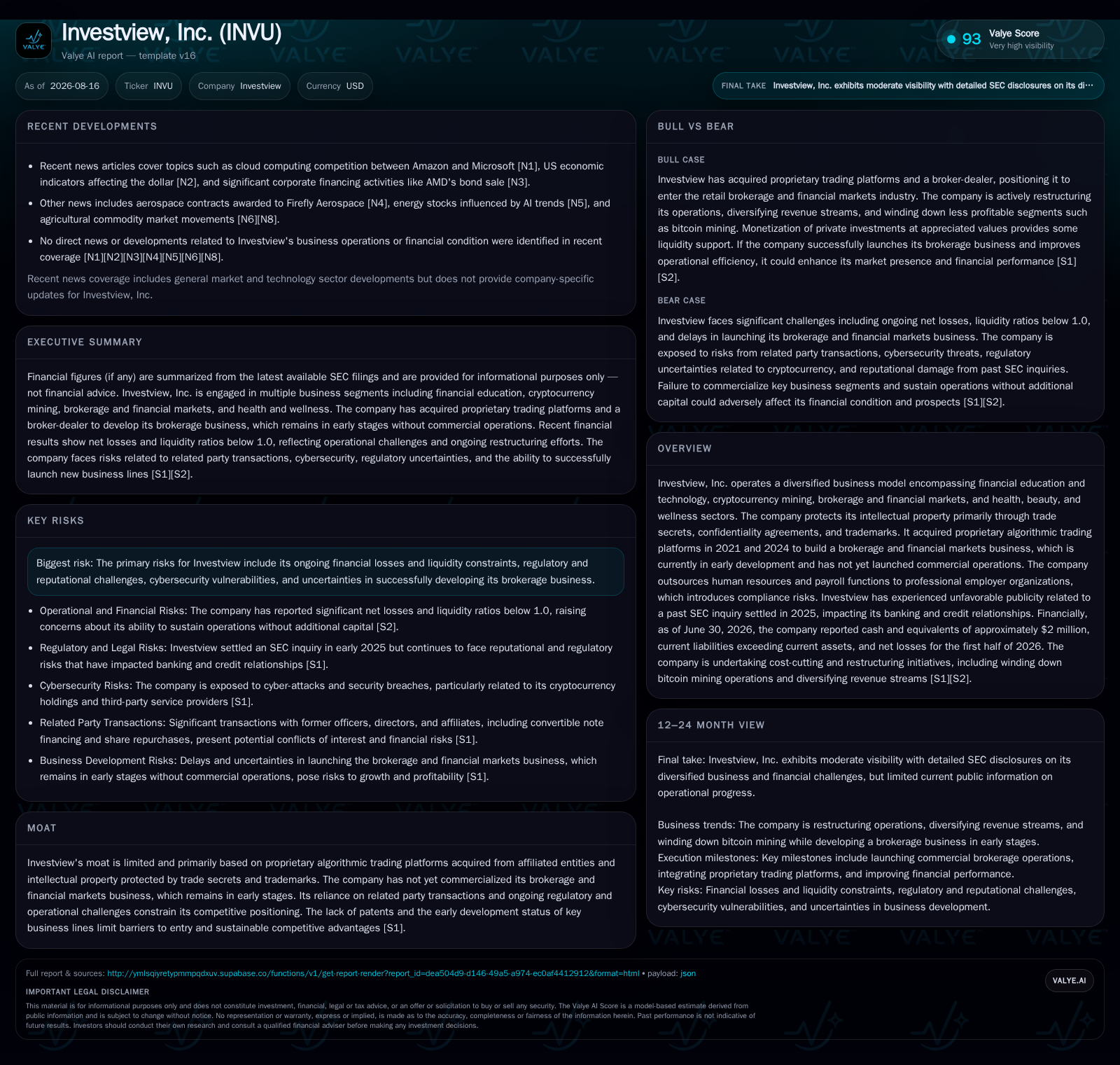
Investview’s latest quarterly report reveals significant operating losses driven by declines across all business segments, including a strategic exit from cryptocurrency mining and ongoing delays in launching its brokerage platform. Despite owning proprietary algorithmic trading software acquired through related-party transactions, the company has yet to generate brokerage revenues or transaction commissions. Regulatory headwinds, notably a $4 million fine and operational restrictions on its direct selling model in Poland, compound execution risks. Liquidity remains tight with a current ratio below 1.0, underscoring near-term going concern considerations mitigated only by recent monetization of private investments.
Quarterly Operating Pressures Highlight Urgency Around Going Concern Risks
In its latest quarterly filing for the period ending June 30, 2026, Investview disclosed a consolidated net loss from operations amounting to $4.3 million over the first half of the year—a sharp reversal from the $0.6 million profit reported during the same period in 2025 [S2][S4]. This deterioration reflects simultaneous headwinds across all business segments without sufficient offset from cost reductions or operational improvements.
The company’s liquidity position is strained with current assets of approximately $4.6 million against current liabilities near $5.5 million, yielding a current ratio of just 0.84 as of mid-2026 [F1]. Cash and cash equivalents stood at roughly $2 million, providing limited buffer against near-term obligations amid ongoing negative cash flows. Management flagged potential going concern issues if operating losses persist without access to additional capital or successful monetization of private investments—recently realized at appreciably higher values—as mitigating factors [S2][S4]. This fragile financial footing constrains Investview’s ability to invest aggressively in growth initiatives.
Proprietary Algorithmic Trading Platforms Form Core Technology but Face Integration Challenges
Investview’s strategic plan centers on leveraging proprietary algorithmic trading platforms acquired from MPower in September 2021 and from Opencash in March 2024 to establish a differentiated retail brokerage offering [S1]. These platforms embody the technological foundation intended to support automated trading capabilities aimed at retail investors.
However, these assets are protected primarily through trade secrets and confidentiality agreements rather than formal patents or registered intellectual property rights, which limits enforceable competitive barriers beyond internal controls [S1]. The technical complexity involved in integrating MPower’s codebase with Opencash’s broker-dealer infrastructure remains substantial. Without disclosed KPIs such as user numbers or transaction volumes, it is difficult to assess early adoption or platform stability compared to established competitors who publicly track such metrics.
Brokerage Commercial Launch Delayed Amid Regulatory Complexities
Since initiating its brokerage development efforts in 2021, Investview has encountered persistent delays in launching commercial securities trading operations despite multiple acquisitions aimed at building requisite technology and infrastructure [S1]. Achieving regulatory approvals, securing clearing arrangements, onboarding customer support teams, and executing marketing strategies constitute critical milestones yet to be fully realized.
The protracted timeline reflects inherent operational risks typical for early-stage broker-dealers navigating complex compliance landscapes. The absence of definitive launch dates underscores execution risk akin to peers within the FinTech sector who have faced similar hurdles during their initial rollout phases.
Cryptocurrency Mining Wind-Down Signals Strategic Refocus but Narrows Revenue Sources
Investview announced plans to wind down its bitcoin mining operations starting July 2026—a move likely driven by diminishing profitability amid volatile cryptocurrency markets and rising operational costs such as energy consumption [S2][S4]. This exit curtails revenue diversification by eliminating what may have been a recurring but variable income stream tied to mining rewards influenced by hash rate productivity.
While specific mining KPIs are undisclosed, industry trends suggest that shrinking crypto margins have pressured operators broadly. Consequently, this shift increases reliance on nascent brokerage revenues and existing direct selling channels currently under pressure.
Direct Selling Legal Challenges in Poland Present Compliance Risks
Regulatory scrutiny intensifies following an administrative decision by Poland’s UOKiK competition authority imposing a PLN ~14.7 million (approximately $4 million) fine on Investview’s direct selling business for purported violations related to pyramid scheme prohibitions [S1]. The order also seeks cessation of these activities pending appeal.
Though enforcement actions are stayed during judicial review, this unresolved legal matter poses reputational risk that could elevate customer acquisition costs or depress retention rates in affected markets. It exemplifies broader regulatory challenges FinTech firms face when employing multi-level marketing models within financial product distribution frameworks.
Growth Outlook Hinges on Brokerage Launch Execution and Platform Adoption Metrics
Investview’s pathway toward sustainable revenue growth depends heavily on transitioning from developmental losses toward scalable brokerage operations generating transaction commissions. Key performance indicators likely to drive value creation include active user counts onboarded onto the platform post-launch, transaction volume growth fueling fee income, algorithmic trading performance differentiators enhancing revenue per user (RPU), churn rate management reflecting customer retention quality, and platform uptime ensuring service reliability.
Seamless integration between acquired algorithmic trading technology and broker-dealer infrastructure will be critical alongside effective marketing execution capable of overcoming reputational challenges stemming from regulatory inquiries and direct selling controversies.
Investor focus should monitor announcements clarifying launch timing alongside incremental adoption data that validate scalability prospects—paralleling scrutiny applied historically to early-stage peers within retail brokerage sectors.
Watchpoints: Key Milestones Will Define Near-Term Trajectory
Upcoming developments warrant close monitoring:
- Confirmation or revision of timelines for commercial launch of retail brokerage services including successful clearing arrangements;
- Progress updates on Polish regulatory appeals impacting direct selling fines enforcement and operational permissions;
- Execution status of cryptocurrency mining wind-down plans evidenced through asset divestitures or operational cessations;
- Evolution of liquidity metrics balancing ongoing cash burn against proceeds from monetized private investments;
- Initial post-launch customer acquisition benchmarks indicating traction amid regulatory oversight.
These markers will provide clearer insight into whether Investview can overcome current operational challenges to achieve viable revenue generation.
Financial Profile Discussion: Liquidity Constraints Amid Diversified Segment Pressures
As of June 30, 2026, Investview held approximately $2.0 million in cash against current liabilities exceeding $5.4 million resulting in a working capital deficit reflected by a sub-1.0 current ratio (0.84) [F1]. Ongoing operating losses totaling $4.3 million over the first half of 2026 underscore persistent negative cash flow trends challenging financial sustainability absent successful monetization events or capital raises [S2][F1]. While management expresses confidence in sustaining operations over the next twelve months supported by recent private investment realizations at appreciated valuations [S2], this represents near-term relief rather than long-term certainty.
Therefore, achieving revenue scale upon brokerage launch coupled with disciplined expense management remains essential for restoring financial health amid regulatory headwinds impacting reputation-driven cost structures.
Disclaimer: This analysis is provided solely for informational purposes without any investment advice. Readers should independently evaluate company filings and disclosures before drawing conclusions.
Disclaimer: This is research-only, informational analysis and not investment advice. It may include AI-generated interpretation and general industry context. Always verify important details using primary sources.

Comments