
Emmaus Life Sciences' Q2 2026 Results Spotlight Liquidity Challenges and Biotech Operating Realities
The company's latest quarterly report reveals tight liquidity alongside modest net income, reflecting the challenges of sustaining clinical-stage biotech operations without robust commercial revenue.
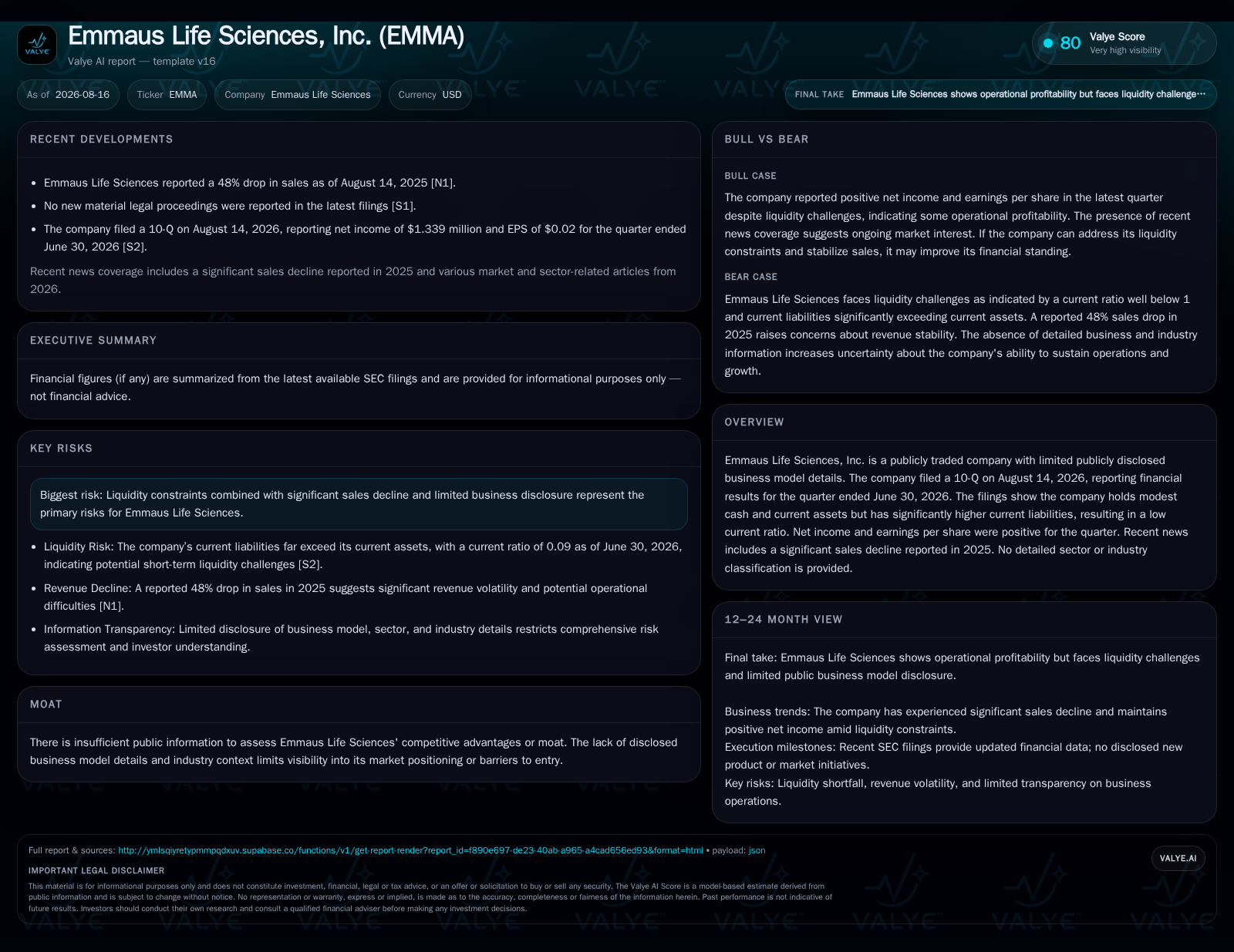
Emmaus Life Sciences posted positive net income in Q2 2026 but faces significant liquidity pressure, with a current ratio of only 0.09 indicating current liabilities vastly exceed current assets. The company's business model aligns with early-stage biotech firms reliant on milestone payments and pipeline development rather than stable product sales, complicating cash flow visibility. Industry-wide dynamics, including long R&D cycles, regulatory hurdles, and dependency on licensing agreements, underscore the operational and financial risks Emmaus confronts. Upcoming clinical or licensing milestones will be critical for improving financial sustainability and unlocking value.
Q2 Highlights Expose Liquidity Squeeze Despite Positive Earnings
Emmaus Life Sciences’ August 14, 2026 quarterly filing (10-Q) presents a nuanced operating snapshot: the company reported positive net income for the quarter ended June 30, 2026, yet this earnings gain contrasts sharply with its liquidity position [S2],[F1]. Cash and equivalents stand at only $2.8 million while current liabilities balloon to $66.1 million, resulting in a perilously low current ratio of approximately 0.09 [F1].
Revealing Emmaus’s Biotech Business Model amid Limited Public Disclosure
While direct details about Emmaus’s proprietary drug candidates or product commercialization remain sparse in public filings [S1], its naming convention and operating patterns align it broadly with clinical-stage biotechnology firms. Such companies primarily monetize through a combination of milestone payments tied to clinical trial progress or regulatory achievements and royalties from licensing agreements rather than recurring commercial sales.
Emmaus likely invests heavily in research and development (R&D) activities aimed at advancing a pipeline of novel therapeutics or biologics targeting unmet medical needs [S1]. This archetype inherently experiences lengthy development timelines—often surpassing a decade before FDA approval—and is characterized by calibrated collaboration strategies involving pharmaceutical partners who provide upfront payments, ongoing funding, and milestone incentives upon reaching development goals.
From a business-model perspective, Emmaus’s revenue mechanics would therefore depend significantly on successfully negotiating and realizing such milestones alongside eventual royalty streams once products reach commercialization stages [S1]. This model diverges from large commercial biotechs like Amgen or Gilead Sciences that benefit from established product portfolios generating consistent top-line cash flow. The absence of detailed disclosures prevents conclusive statements on Emmaus’s competitive advantages but also implies limited scale and commercial traction at present
Industry Dynamics Frame Emmaus's Operational Challenges: R&D Intensity and Commercial Dependencies
In the broader biotech industry context, Emmaus operates within a high-risk environment defined by intense R&D expenditure requirements and elongated clinical trial phases; these factors delay revenue generation while inflating burn rates [S2]. The sector broadly confronts long FDA approval cycles punctuated by extensive regulatory reviews that can cause costly delays or outright rejections.
Companies similar to Emmaus typically face negative net income profiles through most of their lifecycle due to disproportionate spending on pipeline advancement before product sales mature [S1],[S2]. Furthermore, milestone payments are generally lumpy and unpredictable as they hinge upon often binary developmental events such as Phase II/III trial completion or submission acceptances. These dynamics complicate forecasting revenue flows and put liquidity constraints front-and-center for management.
Peer groups along this continuum include small-cap clinical-stage biotechs reliant on partner financing; these often run operating losses offset sporadically by non-dilutive inflows but routinely require equity capital raises. Regulatory developments affecting drug approval pathways—such as expedited FDA review programs—can materially shift outlooks but also heighten volatility.
Growth Potential Hinges on Pipeline Progress and Licensing Opportunities
For Emmaus to reverse its liquidity pressures sustainably, progress must manifest in accelerating its drug candidates successfully through pivotal clinical trials. Positive outcomes serve as gatekeepers unlocking significant milestone payments from licensing entities poised to commercialize products post-approval [S2]. Expansion of the pipeline either via internal R&D efforts or strategic acquisitions could also broaden future revenue bases.
Moreover, licensing deal count enhancement remains critical; each partnership expands royalty potential streams that once commercialized translate into longer-term margin-enhancing revenues disassociated from intensive lab-based R&D costs [S1]. In this regard, Emmaus’s qualitative growth hinges closely upon two intertwined KPIs common across biotech firms: tangible clinical trial advancements reflected by increased number or phase progression of active studies, coupled with favorable partnership negotiations enhancing deal pipeline richness.
Given the lack of specific candidate disclosures publicly available for Emmaus it is not possible to pinpoint exact programs acting as near-term catalysts; however industry norms dictate these levers form the backbone for future operating leverage improvement.
Risks Remain Elevated: Liquidity Constraints, Sales Decline, and Sector Volatility
Liquidity emerges as the most salient risk factor given Emmaus’s imbalance between cash resources and liabilities [F1]. With net debt approximating $26 million (total debt minus cash), servicing obligations alongside funding ongoing operations without reliable milestone inflows places the company under considerable financial duress.
Coupling this with the previously reported significant sales decline in prior periods exacerbates uncertainty around scaling eventual product-related revenues sufficient to buffer balance sheet stresses,[S3]. This constraint aligns with typical biotech sector headwinds where failure-to-launch scenarios or delay-induced cost overruns frequently force dilutive equity raises reducing existing stakeholder value.
Additional common risks include potential clinical trial failures or regulatory rejections that would derail expected milestones essential for alleviating funding pressures. Competitive advancements by peers may erode potential market share if Emmaus’s drug candidates do not differentiate effectively though specifics here are unavailable due to disclosure limits.
“Watchpoints” Near-Term: Upcoming Milestones and Financial Sustainability Signals
Immediate near-term markers to watch involve official announcements signaling successful progression through critical regulatory gateways or new licensing agreements finalized reflecting partner confidence. Such developments would provide more concrete evidence of shifting demand dynamics supporting higher valuations and improved cash flow outlooks.
Quarterly filings tracking cash burn rates relative to evolving asset base will further evidence management’s ability to sustain operations absent new capital injections. Delays in securing partnership deals or trial breakthroughs could extend liquidity constraints further raising solvency concerns.
Operational updates clarifying pipeline status remain pivotal checkpoints given their direct correlation with milestone payment timelines—the lifeblood of many early-stage biotechs’ revenue models.
Financial Profile Discussion: Contextualizing Cash Position and Leverage in Biotech Terms
The company’s June 30 balance sheet revealed $2.8 million in cash against $28.8 million total debt resulting in approximately $26 million net debt outstanding [F1]. This outsize leverage relative to liquid holdings starkly underscores a compressed cash runway situation uncommon among more established biotech peers who typically sustain multiple years of R&D spend ahead through larger capital buffers or recurring revenues.
Emmaus’s severely depressed current ratio of about 0.09 signals an inability to cover near-term obligations organically—highlighting dependency on either fresh financing rounds or milestone payments triggered by clinical progressions [F1]. While positive net income may notionally reflect some operating efficiencies or one-time gains within the quarter’s P&L statement, it fails to obviate the fundamental challenge faced: converting thin operational gains into durable financial stability supporting continued innovation investment.
Disclaimer: This analysis is based exclusively on publicly available SEC filings and general biotechnology industry context as of August 2026. No proprietary information was considered. The content herein does not constitute investment advice nor endorsement of securities discussed.
Disclaimer: This is research-only, informational analysis and not investment advice. It may include AI-generated interpretation and general industry context. Always verify important details using primary sources.

Comments