
Chilean Cobalt Advances Chilean Cobalt-Copper Projects Amid Capital and Operational Challenges
Latest quarter updates reflect ongoing exploration and governance development as Chilean Cobalt prepares for production scaling in a geopolitically stable mining district.
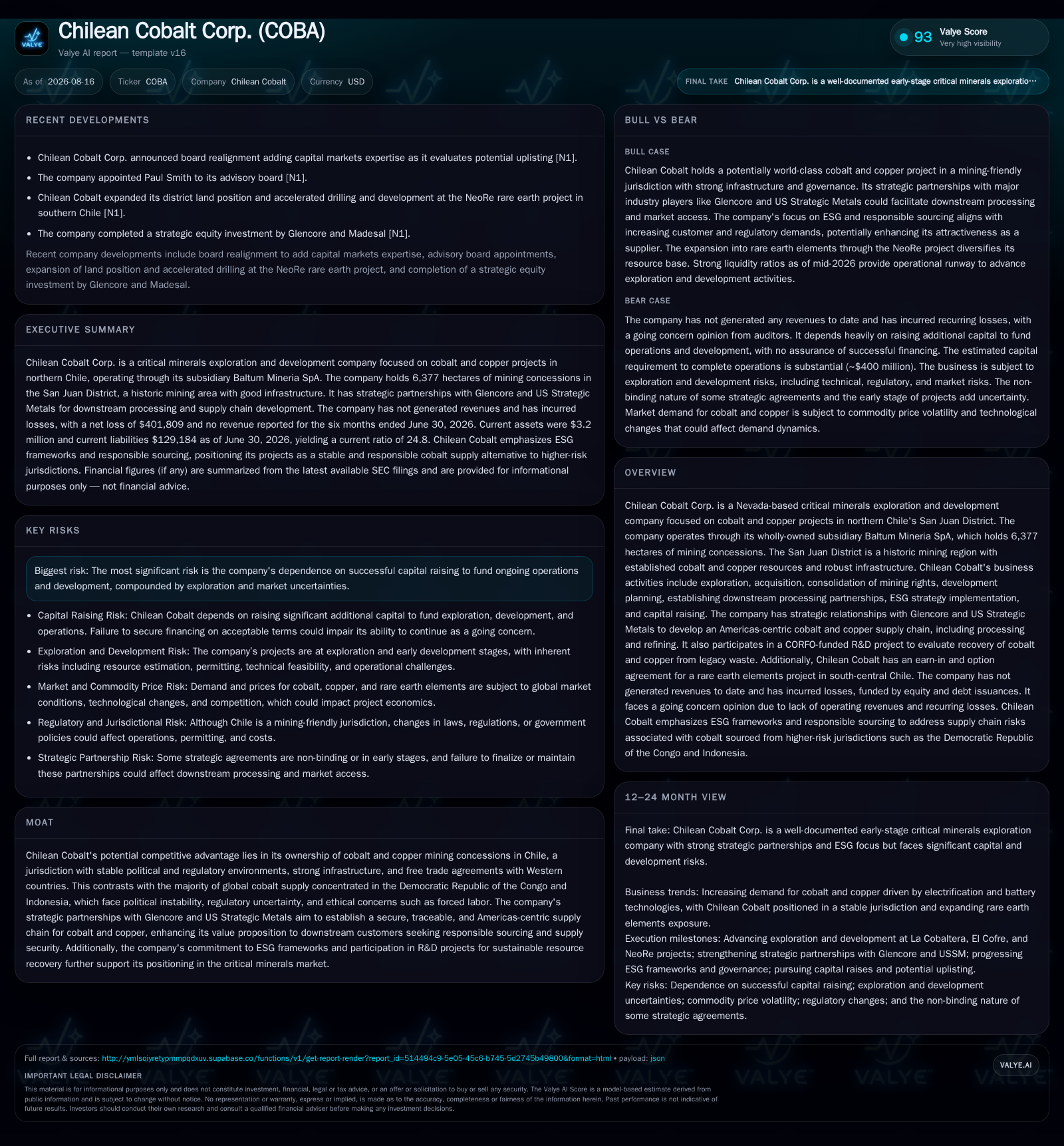
Chilean Cobalt Corp. continues to develop its cobalt and copper mining assets in Chile’s San Juan District, leveraging strategic partnerships and ESG frameworks to establish an Americas-centric supply chain. Recent quarterly disclosures show steady focus on exploration and governance enhancements, though capital raising remains critical amid operating losses and a high monthly burn rate. The company's assets, situated in a politically stable and well-infrastructured area, position it well against peers dependent on higher-risk jurisdictions. Execution risks and financing needs remain pivotal to advancing toward production.
Recent Operating Update
In its latest Form 10-Q filed August 14, 2026, Chilean Cobalt Corp. maintained continuity in its core exploration operations without material changes to risk factors since its March annual report [S2]. This steady operational posture reflects ongoing asset development rather than abrupt strategic shifts or new commercial milestones. An adjacent event filing dated August 13 confirmed modest increases in executive compensation for CEO Duncan T. Blount and CFO Jim Van Horn alongside small discretionary bonuses effective August 2026 [S3], signaling management retention efforts crucial for sustaining long-term project execution.
Business Model Overview
Chilean Cobalt operates primarily as an upstream critical minerals explorer and developer with full ownership of over 6,300 hectares of mining concessions concentrated in the San Juan District of northern Chile—a region historically known for cobalt and copper production with existing infrastructure conducive to mining activities [S1]. The company’s business model entails acquisition and consolidation of mineral rights through its subsidiary Baltum Mineria SpA; carrying out methodical exploration using geophysics, geochemistry, drilling programs plus advanced techniques like AI-assisted resource targeting; and subsequently developing mine plans aimed at producing saleable cobalt-copper concentrates [S1].
Unlike integrated miners that operate smelters or refineries themselves, Chilean Cobalt relies on strategic partnerships for downstream processing. This is evidenced by its Deed of Undertaking granting Glencore first right of refusal on products from key projects La Cobaltera and El Cofre, as well as a non-binding Letter of Intent with US Strategic Metals to process concentrate at their Missouri facility—helping bridge raw material extraction with value-added refining closer to North American battery producers [S1]. Revenue generation is expected to eventually derive from selling refined cobalt and copper products under long-term or spot contracts influenced heavily by market pricing benchmarks such as the London Metals Exchange (LME) cobalt futures [S1].
The company also emphasizes rigorous ESG implementation aligned with industry assurance schemes IRMA and Digbee—both formally adopted in 2025—and has completed independent ESG assessments to underpin sustainability governance embraced by downstream customers who increasingly demand demonstrated responsible sourcing commitment [S1][S21]. This establishes not only operational resilience but also differentiation amid cobalt suppliers predominantly from higher-risk regions like the DRC.
Industry Structure and Competitive Position
The critical minerals mining sector is marked by complex value chains that span exploration to end-product manufacturing within battery supply chains supporting electric vehicles (EVs) and renewable energy systems. Chilean Cobalt stands within this ecosystem as an early-to-mid stage developer focusing narrowly on cobalt-copper deposits—a niche driven by EV battery cathode materials demand growth but exposed to commodity cyclicalities.
Chile itself presents competitive advantages: political stability, robust infrastructure including roads/power/water access near port facilities, robust mining regulatory frameworks, free trade agreements benefiting exports to Western markets (notably the U.S.), plus governmental economic support via agencies like CORFO targeting critical minerals growth [S1][S6]. This contrasts sharply with dominant global cobalt supplies from unstable jurisdictions grappling with ethical controversies.
Peers range from junior explorers in similar stable regimes (Canada/Australia) through to major integrated miners like Glencore offering scale economies across multiple metals. Chilean Cobalt's small scale means it must leverage strategic partnerships for refining/processing logistics rather than build standalone capacity—a common approach among juniors seeking capital-efficient pathways toward commercial production. The company’s alliance with global commodities giant Glencore adds credibility while offering potential preferential marketing avenues.
Growth Drivers
Several structural trends support growth prospects:
- Expanding global EV adoption escalates lithium-ion battery production requiring secure cobalt volumes as battery chemistries remain reliant despite evolving alternatives.
- Electrification trends anchor robust copper demand due to its role in electrical wiring; Chile’s position as top global copper producer taps into this surge.
- Geopolitical realignments favor supply chains less exposed to authoritarian regimes or conflict zones; Americas-based projects thus gain strategic relevance.
- Heightened ESG scrutiny boosts demand for traceable, responsibly sourced minerals; compliance frameworks like IRMA grant competitive edge.
- CORFO’s R&D initiatives fund innovative recovery methods (e.g., waste pile cobalt extraction), potentially enhancing resource efficiency.
- Technology advances—including AI-driven exploration pilots underway—can improve drill targeting efficiency reducing time/cost per discovery.
- Consolidation efforts aim at expanding contiguous concessions within proven districts enhancing scale economics.
- Solidifying downstream refining agreements ensures smoother commercial transition once production begins.
Risks and Growth Constraints
Notwithstanding these opportunities, significant challenges persist:
- The company's survival hinges on continued successful capital raises due to absence of revenue generation so far; management notes a monthly burn rate near $404,000 requiring multi-million dollar funding injections just to sustain operations over the next year [S18][F1].
- Commodity prices remain volatile; downward pressure can undermine project economics notably given long development lead times.
- Mining permits required for transition beyond exploratory activities involve protracted regulatory processes susceptible to delays or additional constraints impacting timeline/cost.
- Technological shifts in battery chemistry reducing cobalt content may curtail medium-term demand unpredictably.
- Competition for concession acquisitions and downstream contracts intensifies as numerous players vie for strategic critical mineral assets worldwide.
- Although political risk is lower compared to many cobalt-producing countries, Chile faces occasional labor or environmental protests that could disrupt operations.
- Company remains subject to limited-scale fines related to environmental compliance dating back years; while immaterial currently (<$4k), any escalation could affect reputation or costs [S15][S22].
- Success depends heavily on assembling experienced teams capable of managing technical complexities under capital constraints [S21].
What to Watch Next
Key upcoming indicators include:
- Exploration progress measured by drilling meters completed combined with emerging resource estimates validated by independent consultants will significantly shape asset valuation.
- Milestones related to permitting approvals necessary for mine development phases will signal regulatory acceptance trajectory.
- Completion and formalization of downstream processing agreements with US Strategic Metals or others will confirm commercial pathway toward concentrate delivery/refining.
- Further ESG reports or certifications demonstrating sustained adherence will bolster credibility among investors/end customers focused on responsible sourcing.
- Capital markets activity revealing success or terms of planned $20 million+ financing rounds projected for 2026 will directly impact operational continuity and ramp plans [S18].
- Potential uplisting efforts though still undecided have implications for financing access/liquidity if executed successfully within emerging-growth-company regulatory confines [S18].
Financial Profile Discussion
Chilean Cobalt remains pre-revenue with no recorded sales through December 31, 2025 reflecting its early-stage exploration status typical among juniors focused on resource delineation prior to commercial output [F1][S18]. A net loss exceeding $3.2 million reported for that year predominantly stems from exploration expenditures coupled with administrative costs including recently adjusted executive compensation levels reflecting increased base salaries for top management plus occasional bonuses starting August 2026 [F1][S3]. The company maintains a healthy balance sheet liquidity position characterized by approximately $3.2 million in current assets against relatively minimal current liabilities approximating $130k as of June 30, 2026 resulting in a strong current ratio near 24.8—indicating sufficient short-term liquidity but over-reliance on equity/debt inflows going forward [F1].
Capital expenditure requirements are substantial: management estimates approximately $400 million needed overall from feasibility through production phases underscoring dependency on external financing that may cause dilution or leverage burdens when secured under market conditions influenced by commodity cycles [S18][S1]. Operating costs remain focused on sustaining exploration programs along with ESG framework implementation until transitioning into development stages. Cash burn rates highlight need for disciplined capital stewardship combined with timely funding events so as not to jeopardize operational continuity or stakeholder confidence.
Conclusion
Chilean Cobalt Corp.'s position as a Nevada-listed operator controlling cobalt-copper concessions in geographically advantaged northern Chile offers meaningful potential as Western industries seek resilient critical mineral sources absent geopolitical instability common elsewhere. Its strategy harmonizes upstream asset advancement complemented by partnerships addressing downstream processing needs within an ESG-conscious framework demanded by contemporary stakeholders. However, substantial execution risks tied primarily to capital availability and the lengthy path from exploration through mine commissioning dictate careful monitoring. Progress against exploration milestones intertwined with financial health indicators will remain essential signals clarifying whether Chilean Cobalt can mature toward production-market relevance amidst a dynamic market environment balancing innovation-driven demand growth against commodity price fluctuations and regulatory hurdles.
Disclaimer: This analysis is based solely on publicly available information as of August 16, 2026. It does not constitute investment advice or research view.
Disclaimer: This is research-only, informational analysis and not investment advice. It may include AI-generated interpretation and general industry context. Always verify important details using primary sources.

Comments