
BayFirst Financial Corp. Confronts Credit Resolution While Leaning into Community Banking Strengths
BayFirst’s Q2 2026 results highlight ongoing credit portfolio challenges amid steady regional banking operations and a focused technology-driven strategy.
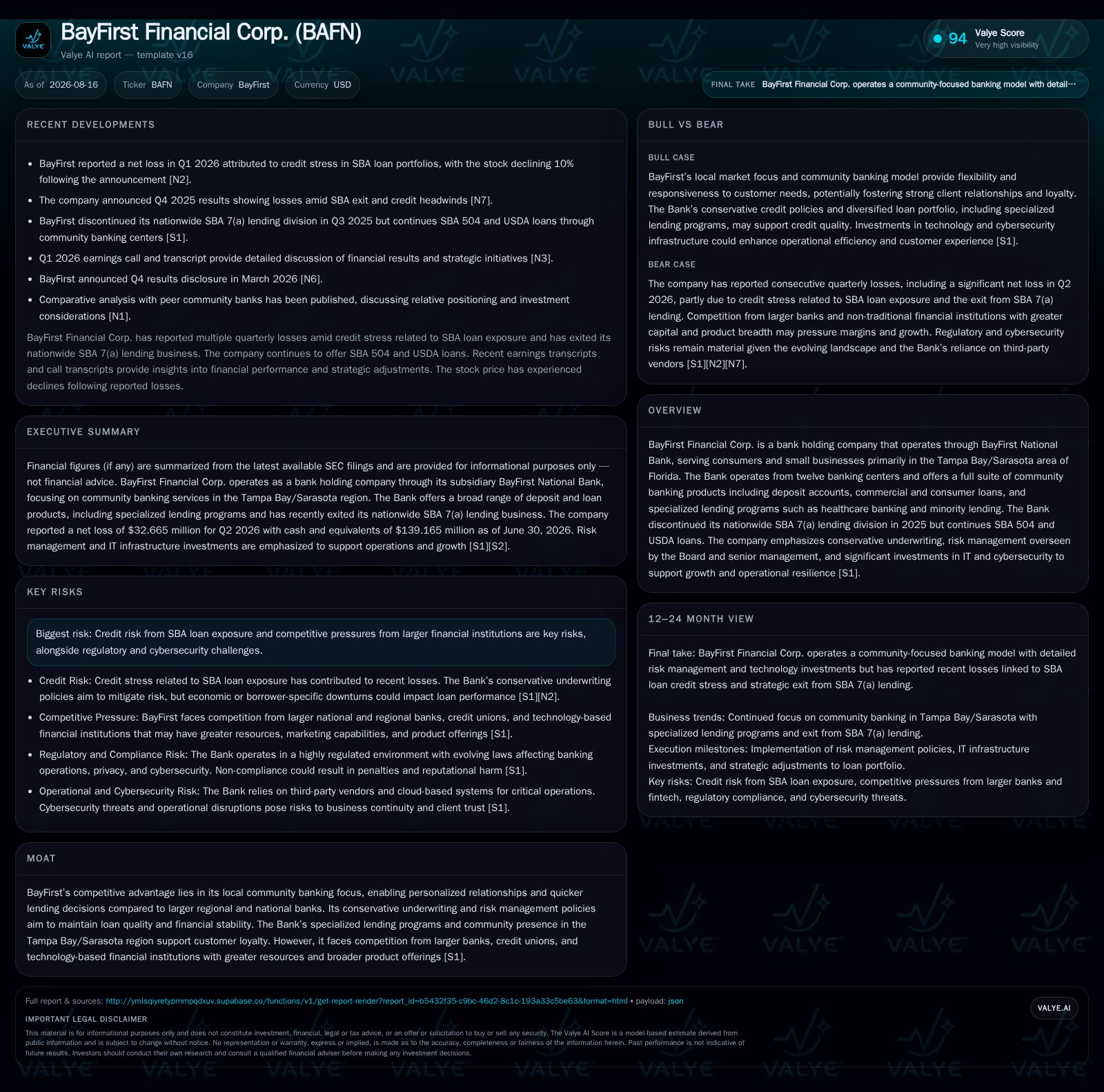
In its Q2 2026 filing, BayFirst Financial Corp. disclosed significant asset resolution efforts related to government-guaranteed loan portfolios following adjustments to prior financial statements. Despite these headwinds, the company maintains its focus on serving the Tampa Bay/Sarasota region through personalized community banking offerings. The discontinuation of nationwide SBA 7(a) lending and emphasis on conservative underwriting underscore BayFirst’s strategic pivot toward stabilizing asset quality while leveraging specialized local lending programs. Technology investments and risk management remain central to supporting growth and operational resilience.
Recent Operating Update
BayFirst Financial Corp.'s most recent quarterly filing (10-Q dated August 14, 2026) reveals material actions undertaken to address credit quality issues within its government guaranteed loan portfolio. The company’s asset resolution plan includes adjustments totaling approximately $37 million primarily related to SBA small balance loans that were either impaired or revalued to reflect updated expectations on collectability. These corrections prompted restatements of previously reported results dating back to 2024 through early 2026, indicating a sustained effort to clean up legacy underwriting issues particularly in discontinued SBA 7(a) lending [S19], [S28].
Further compounding this credit focus was impairment of $1.5 million on a non-marketable equity investment tied to the discontinued SBA business partnership, plus write-downs of unamortized premiums on at-risk USDA loans by $1.6 million [S19]. These cumulative charges weighed on second quarter earnings, signaling a phase of heightened remediation before normalization.
Business Model Overview
BayFirst operates as a community-focused bank holding company through its wholly owned subsidiary BayFirst National Bank. Concentrated geographically in Florida's Tampa Bay/Sarasota corridor with twelve branches, it generates revenue chiefly from net interest income derived from deposits deployed into commercial and consumer loans, augmented by fee income from deposit services and ancillary products [S1]
A strategic pivot away from national-scale SBA 7(a) lending—discontinued in late 2025—reflects a deliberate narrowing of risk exposure; the bank continues its specialized SBA 504 and USDA lending tailored toward local commercial borrowers [S1]. This move aligns with BayFirst’s conservative underwriting philosophy underpinned by direct board-level oversight of risk governance.
Investment in technology infrastructure and cybersecurity safeguards has been explicitly prioritized to enhance customer experience while ensuring operational resilience—a critical differentiator against both traditional competitors and fintech disruptors increasingly active in the region [S1].
Industry Structure and Competitive Position
BayFirst sits within the community banking segment where personalized service models leverage local knowledge and footprint advantages against broad regional or national banks such as Regions Financial Corporation or Synovus Financial Corp., which operate scaled platforms but with less localized agility. The bank also competes with non-bank fintech lenders offering efficient digital origination capabilities alongside local credit unions that attract similar customer profiles via competitive rates or membership benefits.
Its competitive moat is primarily anchored in deep community banking relationships facilitating quicker loan decisions and bespoke underwriting standards geared toward local economic realities rather than standardized national playbooks. Specialized niche lending offerings—such as healthcare sector funding or minority business programs—further differentiate BayFirst within its core market [S1].
However, the competitive landscape exerts pressure on deposit gathering due to pricing competition from well-capitalized peers with broader product suites, suggesting BayFirst must sustain operational efficiency and customer loyalty through service excellence alongside digital enhancements.
Growth Drivers
Regional economic growth in Tampa Bay/Sarasota provides an organic foundation for demand in small business financing and consumer banking products central to BayFirst’s revenue model [S1]. Local real estate development trends also influence loan book composition given continued residential activity despite prior curtailment of direct residential mortgage origination nationally since Q3 2022
Government-backed loan programs continue playing a role despite curtailed SBA offerings: USDA loans represent a competitively priced alternative leveraging federal guarantees to support rural business investments—an underserved niche strategically fit for smaller community banks like BayFirst.
Technology investments improving digital banking access reduce friction for depositors while enhancing cash management solutions attract commercial clients reliant on efficient treasury operations. These factors combine to support gradual deposit growth necessary for scaling the loan portfolio prudently without undue concentration risks.
The company’s well-structured risk management framework seeks to enable measured loan growth by controlling asset quality deterioration risks—a critical consideration given recent impairment developments.
Risks and Watchpoints
Credit risk remains paramount stemming primarily from government-guaranteed portfolios where historical underwriting lapses manifest as impairments requiring active resolution plans. Loan loss provisioning will be a key metric to monitor going forward as it directly influences net interest income stability.
Interest rate fluctuations pose typical net interest margin (NIM) risks for community banks reliant on spreads between deposit costs and lending yields; rapid rate hikes or declines could compress profitability absent opportunistic repricing strategies.
Cybersecurity threats require continuous mitigation effort given growing digitization; failure here could erode customer trust or invite costly compliance penalties.
Regulatory environment complexities—especially heightened capital classification thresholds—could restrict flexibility around brokered deposits or expansion initiatives pending prior approvals.
Competitive pressures from larger banking franchises equipped with economies of scale and fintech entrants able to rapidly deploy new product innovations may strain BayFirst’s market share unless customer service differentiation holds firm.
What To Watch Next
Investors should monitor upcoming amended filings completing restatement processes for transparency on credit loss impact trajectories. Key operating metrics include non-performing loan ratios post-resolution plan implementation, loan-to-deposit ratio movement indicating prudent growth pacing, NIM trends reflecting market repricing effectiveness, and efficiency ratio shifts linked to operational expense control amid IT investment cycles.
Management commentary during upcoming earnings calls will be essential for insights into how successfully BayFirst balances asset quality improvements against targeted expansion strategies within its geographic footprint. Regulatory communications concerning capital adequacy status or any enforcement developments will also influence near-term outlook.
Growth signals may emerge from quarterly deposit inflows data reflecting increasing local market traction or uptake of specialized business lending amid broader economic conditions.
Financial Profile Discussion
Contractual obligations grew notably due to increase in time deposits which rose by roughly $92 million year-over-year at December-end 2025 signaling stable funding albeit with maturity concentrations necessitating active liquidity management [S24]. Capital adequacy ratios remain critical watchpoints given regulatory implications tied to classification status impacting permissible activities such as accepting brokered deposits without prior approval.
This analysis reflects information available as of mid-August 2026 with no investment research views intended or implied. Readers should consider publicly filed documents directly when making any financial assessments regarding BayFirst Financial Corp.
Disclaimer: This is research-only, informational analysis and not investment advice. It may include AI-generated interpretation and general industry context. Always verify important details using primary sources.

Comments