
SCWorx Corp Seeks Nasdaq Compliance Amid Data Normalization Growth Challenges
Recent SEC filings reveal SCWorx’s attempt to maintain Nasdaq listing through a reverse stock split amid ongoing financial pressures and operational hurdles.
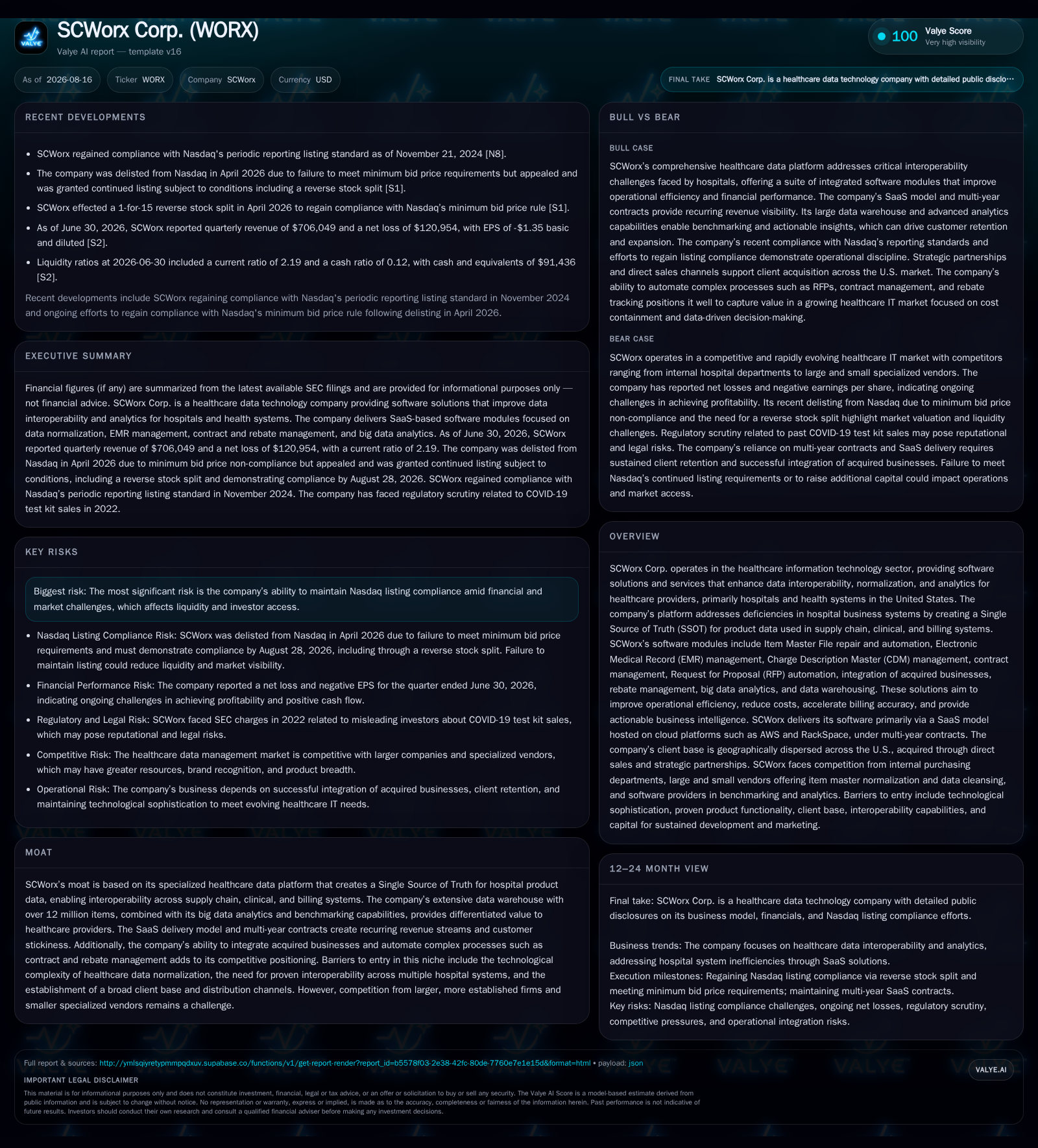
SCWorx Corp remains focused on its niche healthcare IT SaaS platform that offers normalized data interoperability and analytics solutions critical to hospital operational efficiency. However, the company faces significant near-term challenges related to maintaining Nasdaq listing compliance due to persistently low share price and market value of publicly held shares, necessitating a 1-for-12 reverse stock split completed in August 2026. Despite its competitive moat centered on a large normalized product data warehouse and multi-year contracts, SCWorx is contending with stagnant revenue growth, ongoing operating losses, and uncertainties around liquidity and capital access. Key metrics such as annual recurring revenue growth, contract renewals, and data warehouse expansion will be important indicators of the company’s ability to execute its turnaround.
Nasdaq Compliance Drive Shapes Near-Term Viability Outlook
SCWorx Corp’s most urgent near-term concern crystallized in the August 14, 2026 quarterly filing which followed its July event filings disclosing a pivotal reverse stock split (1-for-12), effective August 3, 2026 [S2][S3]. This corporate action was explicitly aimed at meeting Nasdaq’s minimum bid price rule requiring a $1.00 per share closing price sustained for at least twenty consecutive trading days [S8]. The company had experienced a prior delisting determination after failing to maintain the minimum bid price in early 2026 resulting in suspension of trading on April 14, 2026; an appeal to the Nasdaq Hearings Panel temporarily reinstated listing subject to strict compliance conditions [S1][S16][S18].
However, even if the bid price condition is met post-reverse split, SCWorx continues to fall short of Nasdaq’s $1 million market value of publicly held shares (MVPHS) threshold—the other key listing criterion—and has yet to present a plan addressing this deficiency [S3][S24]. The panel retains discretion over final listing status placing the company in a precarious position where failure could result in delisting with subsequent OTC market trading exposing shareholders to lower liquidity and potentially wider bid-ask spreads [S8][S13]. Furthermore, because this is the company’s second significant reverse split within two years (cumulative ratio now effectively about 180:1), its ability to cure future bid price deficits by additional splits is severely restricted per Nasdaq rules [S20].
This regulatory pressure casts immediate uncertainty over the stock's trading dynamics—reverse splits often reduce public float substantially which can exacerbate volatility and reduce liquidity despite an artificially elevated per-share price [S3]. The company must also obtain shareholder approval for this split arrangement as mandated by July's annual meeting vote results signaling some internal governance alignment but vigorous opposition existed as well [S29].
SCWorx’s SaaS Platform Model Anchored on SSOT-Driven Healthcare Integration
SCWorx operates a subscription-based software-as-a-service platform that specializes in providing healthcare providers—primarily hospital systems across the U.S.—with software solutions reliant on data normalization and interoperability principles grounded on a Single Source of Truth (SSOT) architecture [S1]. Their platform centers around cleansing and harmonizing critical hospital product databases like the Item Master File (IMF) – cataloging all known consumables used clinically or administratively – ensuring integrity across supply chain management systems, electronic medical records (EMR), billing platforms including Charge Description Master (CDM) maintenance, and contract/rebate management modules.
By maintaining and enriching one of the industry’s largest centralized normalized product warehouses — reported at approximately 12 million distinct items — SCWorx supports complex workflows while enabling benchmarking against peer institutions for cost optimization [S1]. This scale positions them competitively among peers like Health Catalyst and McKesson who also emphasize big data analytics within healthcare supply chains.
Further automation capabilities include request-for-proposal (RFP) process streamlining and integration management for acquired businesses. These features enhance hospital procurement efficiencies while reducing errors driving billing accuracy improvements essential in today’s increasingly regulated environment where accurate charge capture is mandated.
Revenue derives primarily from multi-year subscription contracts underpinned by SaaS delivery models creating sticky customer relationships supported by steady contractual recurring revenue streams [S1]. Such agreements also imply negotiation complexity tied to contract renewals and expansions as hospitals weigh switching costs and integration risks against vendor alternatives
Healthcare IT Environment Frames Key Competitive Moats and Industry Pressure Points
The healthcare IT landscape imposes substantial barriers for entrants owing to complex technological requirements around standardizing heterogeneous hospital IT systems spanning EMR vendors like Epic Systems or Cerner Corporation. SCWorx counters these barriers leveraging its specialized domain expertise enabling interoperable middleware functionality that spans clinical data flows and downstream financial workflows—a niche not easily replicated without demonstrated interoperability credentials aligned with industry standards.
While larger peers dominate EMR provisioning or end-to-end IT ecosystems (e.g., Epic with integrated hospital systems), SCWorx's differentiated focus is interoperability centered on product data normalization with extensible analytics layers facilitating benchmarking—a critical source of competitive advantage since hospitals constantly seek cost reductions via efficient supply chain management while complying with billing regulations.
Customer behavior in this sector heavily favors proven solutions that minimize operational disruptions while delivering measurable efficiency gains; thus SCWorx's moat depends not only on technology but also contractual tenure evidenced through multi-year agreements supporting high retention potential if execution holds steady [S1]
Growth Catalysts Rooted in Digitization and Regulatory Data Mandates
Macro trends underpinning SCWorx's addressable market include widespread adoption of EMRs coupled with regulatory mandates compelling hospitals toward transparent accurate billing practices. Increasing digitization accelerates demand for interoperable software that can assimilate disparate data sources into coherent platforms driving insights through big data analytics.
Furthermore, evolving healthcare supply chain complexities alongside reimbursement model shifts heighten reliance on sophisticated contract management automation including rebate tracking—areas quintessentially served by SCWorx’s modular offerings providing workflow efficiencies essential for resource-constrained hospital administrators.
Despite these secular tailwinds favoring platform adoption across U.S. health systems broadly, actual revenue growth at SCWorx showed slight contraction—revenues decreased from roughly $2.99 million in 2024 to $2.88 million in 2025—while operating losses remained substantial at just under $960K annually reflecting challenges converting macro opportunities into profitable expansion [F1][S1]. The extent to which these sectoral demand drivers translate into tangible subscription bookings or renewals will be pivotal going forward.
Risks Center on Financial Sustainability and Market Listing Uncertainty
SCWorx has endured years of operating losses accumulating an aggregate deficit exceeding $35 million as of December 31, 2025 highlighting persistent profitability struggles despite a clearly articulated business strategy leveraging specialized healthcare SaaS offerings [F1][S1]. This pattern raises material doubt regarding its viability as a going concern absent significant improvement.
The recent reverse stock split episode precipitated by Nasdaq's bid-price rule violations underscores acute financial distress manifesting externally through diminished market valuation relative to listing standards resulting in heightened exposure to delisting risks affecting capital market access as well as investor liquidity preferences [S3][S8][S18]
Additionally, constrained capacity for additional reverse splits due to cumulative ratios impedes future corrective options should share prices again dip below threshold levels limiting strategic flexibility on this front [S20]. Operationally, scaling up contract renewals amidst intense competition from entrenched incumbents combined with integration complexities inherent in diverse hospital IT ecosystems introduces further execution risks impacting growth momentum.
"Looking Ahead": Milestones and Metrics to Signal Execution Success or Failure
Near-term indicators critical for assessing SCWorx's recovery prospects hinge primarily upon its ability to sustain a post-reverse split share price above $1.00 consistently through August’s deadline as stipulated by Nasdaq Hearings Panel demands—failure would precipitate delisting confirming severe market confidence erosion [S8][S24].
Operational KPIs such as annual recurring revenue trajectory including new bookings versus churn rates during contract renewals will illuminate traction within hospital client bases—a proxy for product-market fit endurance amid competitive headwinds [S2][S1]. Expansion or stability of the normalized data warehouse size alongside growing breadth of interoperated hospital systems could serve as corroborating evidence of platform entrenchment fueling incremental revenue opportunities.
Finally, improvements in software deployment efficiency (time-to-value), utilization statistics within client installations alongside service-level responsiveness could provide early signals supporting future margin improvements indispensable for eventual profitability.
Financial Profile Discussion: Liquidity Buffer Against Persistent Operating Losses
As of June 30, 2026, SCWorx reported current assets totaling approximately $1.7 million against current liabilities near $776 thousand yielding a robust current ratio of circa 2.19 indicating adequate short-term liquidity coverage [F1][S2]. Cash reserves stand modestly at about $91 thousand as last reported end-2023 suggesting limited cash buffer strictly available excluding receivables or other current assets which may be less liquid.
Total debt figures hover near $192 thousand (last confirmed Q3 2019 point) producing an estimated net debt burden just over $100 thousand relative to cash holdings though updated leverage details remain sparse given dated disclosures [F1]. Continued operating losses measured close to $958K annually alongside accumulated deficits exceeding $35 million escalate concerns over sustainable capital structure without fresh equity infusions or positive cash flow inflections [F1][S1].
In summary, while current asset/liability positioning temporarily mitigates near-term solvency risks allowing operational continuity at least through immediate compliance deadlines; long-term survival depends heavily on reversing revenue declines coupled with consistent improvement toward profitability benchmarks underpinned by scalable SaaS economics.
Disclaimer: This is research-only, informational analysis and not investment advice. It may include AI-generated interpretation and general industry context. Always verify important details using primary sources.

Comments