
Eline Entertainment Group's Transition Challenges Amid Ongoing Developmental Stage Status
Eline Entertainment Group, Inc. remains a developmental stage entity seeking business combinations amid limited capital and operational setbacks.
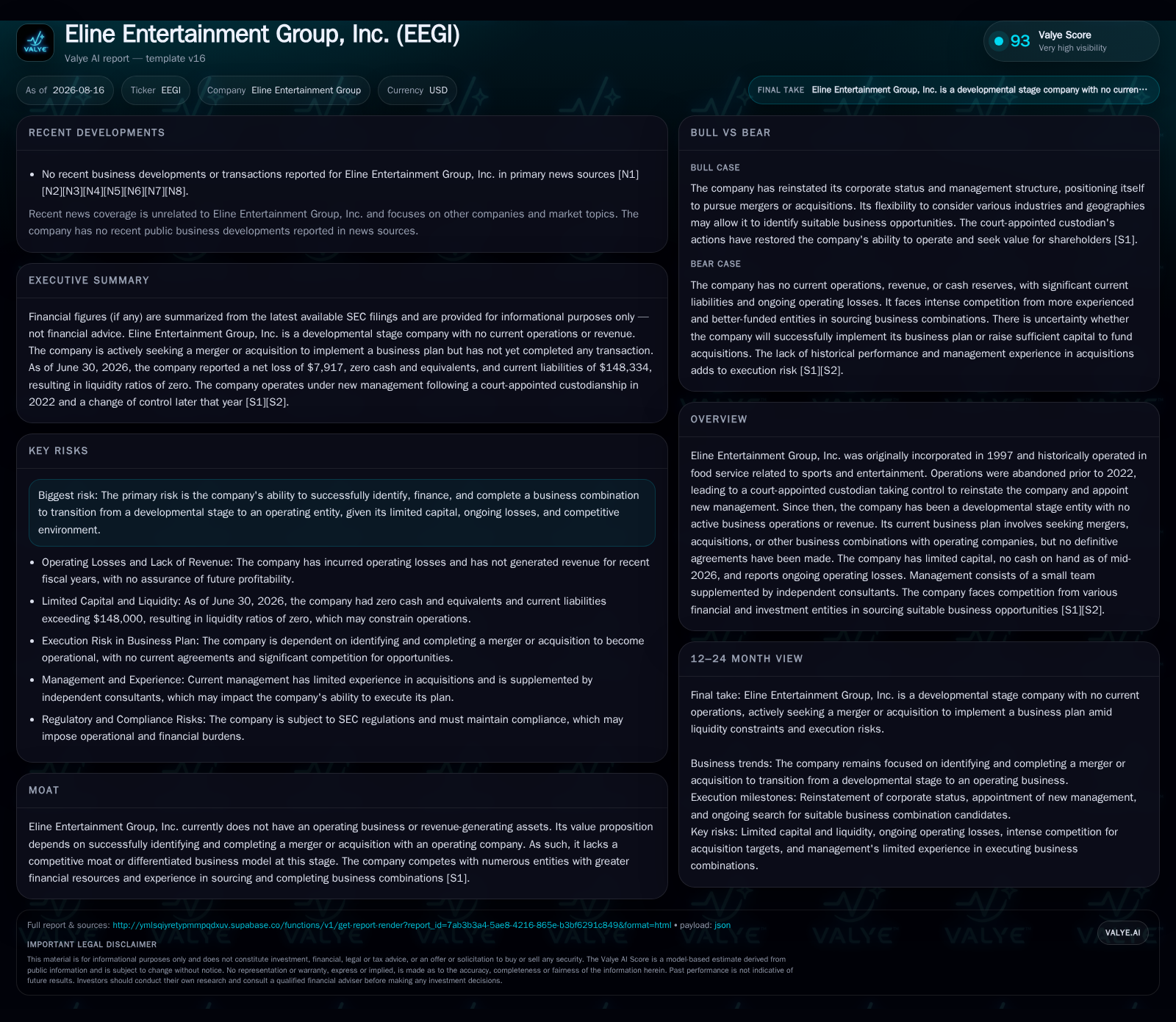
Eline Entertainment Group, Inc. (EEGI) currently operates as a developmental stage holding company with no active revenue-generating operations. Following custodianship appointment in 2022 due to abandoned operations and governance failures, the company is focused on identifying and consummating a merger or acquisition to transition into an operating entity. However, EEGI lacks capital resources and a management track record in deal-making, facing intense competition from better-funded financial intermediaries. The nearest-term value hinges on successfully completing a transaction that brings operational revenues. Key risks include ongoing operating losses without capital infusion and regulatory complexity related to potential acquisitions in China.
Recent Operating Update: Developmental Stage Status Continues during Financial Strain
As of its latest quarterly filing dated August 14, 2026, Eline Entertainment Group, Inc. (EEGI) remains without active business operations or generated revenue, consistent with its designation as a developmental stage company focused on sourcing a suitable merger or acquisition candidate [S2]. The custodian-appointed management team continues to seek viable operating businesses for strategic combinations but has yet to enter into any definitive agreements. The company's current financial position remains precarious: it holds zero cash or equivalents as of the end of 2024 and reports current liabilities exceeding $148,000 as of June 30, 2026 [F1], highlighting constrained liquidity that may impede proactive pursuit of targets. Importantly, no material legal proceedings are ongoing or anticipated to impact its current course [S2]. This status quo evidences a company still in transition with limited near-term operational markers beyond progressing its transaction pipeline.
Business Model: Financial Intermediary Awaiting Transaction Completion
Historically rooted in food service linked to sports and entertainment production and distribution, EEGI’s prior operations were abandoned by former leadership leaving the company dormant until court-appointed custodianship was established in 2022 due to governance collapse and charter revocation [S1][S5]. Since reinstatement under Custodian Rhonda Keaveney — who assumed key officer roles — the company shifted from active operations to a blank-check style entity whose only purpose is identifying an operating company merger or acquisition target [S5][S7]. Revenue generation depends entirely on consummating such a transaction; absent this, EEGI incurs administrative and due diligence costs generating operating losses with no offsetting income [S1][S8]. The monetization mechanics at this stage involve potential capital raises through issuing equity or convertible securities post-transaction announcement and approval, though funding capacity remains highly uncertain.
This business archetype places EEGI upstream in the financial intermediary value chain — it neither produces goods nor services directly but seeks to deploy capital through corporate restructuring transactions that create publicly traded operating entities. Return generation rests on selecting targets with strong growth profiles or operational improvement potential sufficient to drive future profits after combination completion. However, EEGI currently lacks any such assets or operational capabilities itself.
Industry Structure and Competitive Position
EEGI faces substantial competitive pressures within the SPAC/developmental holding company ecosystem. It competes against a broad array of financial intermediaries including well-capitalized Special Purpose Acquisition Companies like Churchill Capital Corp and Social Capital Hedosophia, private equity firms adept at M&A execution, venture capital groups with sector-specific expertise, investment banks playing advisory roles in deal origination, as well as independent financial advisory firms. Many rivals outmatch EEGI both in capital availability and experienced deal teams capable of expediting pipeline transactions while navigating regulatory complexity.
Moreover, EEGI’s management openly acknowledges limited experience in acquisitions and reliance on adding qualified personnel once capital is raised to start executing its business plan effectively [S3]. This lack of seasoned leadership reduces confidence in swiftly sourcing feasible targets amid crowded deal markets. Further complicating matters is EEGI's small operational footprint — only two officers/directors reported as of end-2025 — supplemented by consultants rather than full-time employees substantiating limited organizational capacity for sustained M&A activity without funding expansion [S16][S24].
Growth Drivers
The sole pathway for growth is successful identification and completion of a business combination yielding operational revenue streams superior to ongoing costs [S13]. Drivers enhancing these prospects include expanded capital availability through private placements or equity issuance enabling comprehensive due diligence; improved search capabilities via industry contacts or financial intermediation support; favorable capital market conditions facilitating fundraising efforts; and regulatory environments supportive of cross-border transactions particularly involving China-based potential targets
Additionally crucial is shareholder approval for proposed transactions given typical governance mechanics in SPAC models where existing owners often lose majority control post-merger issuance blocks [S12]. Effective management networking also plays a critical role in uncovering off-market opportunities not readily accessible via formal channels.
Risks and Watchpoints
EEGI confronts significant risks common among developmental holding companies but compounded by unique challenges outlined below:
- Capital Adequacy: With zero cash reserves recorded at end-2024 and reported current liabilities surpassing $148k mid-2026 [F1], there exists pronounced liquidity risk impairing operational sustainability even before consummating business combinations. Failure to secure additional funding would likely force cessation of activities.
- Deal Execution Risk: The company's unproven management track record combined with intense competition from more experienced acquirers clouds timely target acquisition prospects. Lack of definitive agreements after several years heightens uncertainty around transformation plans [S3][S15].
- Regulatory Complexity: Potential Chinese target acquisitions expose EEGI to evolving PRC regulations impacting foreign investment approvals, anti-monopoly scrutiny, currency controls, legal enforcement uncertainties, and geopolitical tensions between US-China relations [S13][S19][S25][S27].
Given that no definitive agreements exist yet per latest filings [S1], unambiguous milestones such as LOIs or merger announcements will meaningfully alter the company's profile.
Disclaimer: This is research-only, informational analysis and not investment advice. It may include AI-generated interpretation and general industry context. Always verify important details using primary sources.

Comments