
Apyx Medical: Innovation, Cost Discipline, and the Stakes of Expanding Body Contouring Markets
Apyx Medical’s proprietary Helium Plasma Technology underpins its differentiated position in the growing body contouring space, but persistent net losses and the challenge of scaling adoption test the sustainability of its business model.
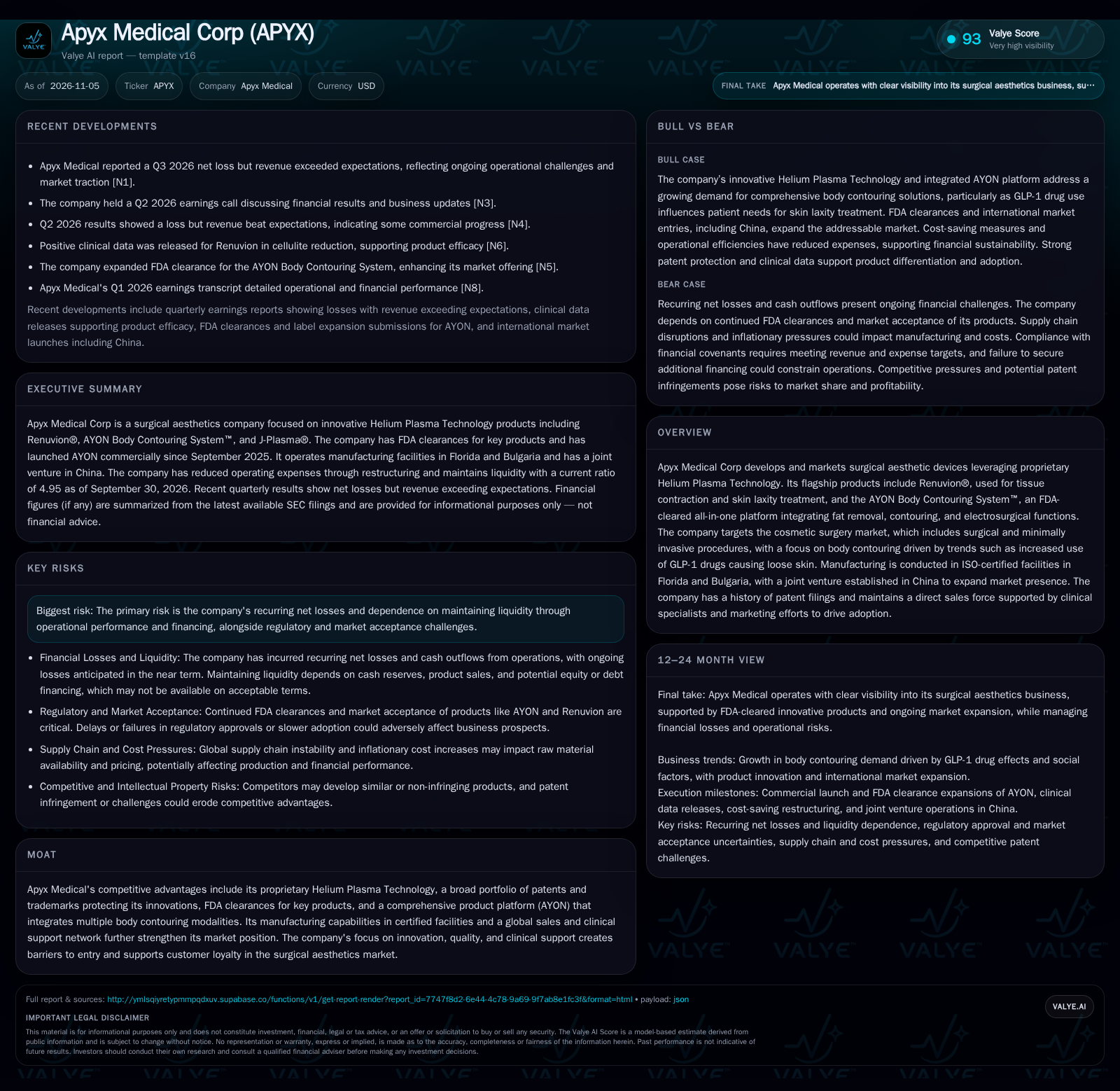
Apyx Medical is expanding in the surgical aesthetics market with Helium Plasma-based devices like Renuvion, targeting rising demand for body contouring—especially as GLP-1 drugs drive new patient needs. While the company has trimmed costs and entered new geographies, recurring losses and the need for broader clinical and market acceptance remain key hurdles. Strategic international moves and strong patent protection provide potential upside, but financial and competitive risks are material. [S2] [N1]
Apyx Medical Corp has positioned itself at the intersection of surgical innovation and shifting patient demand in cosmetic procedures, leveraging its patented Helium Plasma Technology to address the growing body contouring market. The company’s cost discipline, evidenced by a significant reduction in operating expenses, and its push into China reflect an ambition to scale globally. However, recurring net losses and the challenge of translating clinical differentiation into broad commercial adoption pose critical questions for the durability of its growth story and financial model. [S2] [N1]
Recent Performance, Cost Cuts, and Market Expansion Shape the Operating Backdrop
Apyx Medical reported a net loss of $1.785 million for Q3 2026, while revenue exceeded analyst expectations—an outcome that suggests commercial traction but ongoing profitability challenges. [N1] [S2] The company’s 2024 restructuring reduced annual operating expenses below $40 million in 2025, reflecting a disciplined approach to managing cash amid persistent losses. [S2] Notably, a joint venture in China with 51% Apyx ownership began manufacturing and sales in Q2 2025, marking a meaningful step toward international market penetration. [S2] As of September 30, 2026, Apyx held $25.8 million in cash, reported liquidity-ratio trends of 4.95, and continued to operate at a loss. [S2] These facts frame a company that is innovating and expanding, but still seeking sustainable scale and profitability.
How Apyx’s Technology and Cost Structure Influence Profit Potential
Apyx Medical’s economics hinge on leveraging its Helium Plasma Technology across a range of surgical and minimally invasive aesthetic procedures. The company’s product suite—including Renuvion, the AYON Body Contouring System, and J-Plasma—addresses both core surgical markets and the growing demand for skin laxity treatments, particularly as GLP-1 drugs lead to more patients with loose skin. Revenue is likely driven by a mix of capital equipment sales, consumables, and potential service or training fees, though the precise commercial mechanics are not disclosed. If a razor/razor-blade model is in play, recurring consumable sales could offer attractive gross margins and revenue visibility.
The significant reduction in operating expenses following the 2024 restructuring demonstrates that Apyx can flex its fixed cost base, which is critical given its historical losses. Manufacturing in ISO-certified facilities in the US and Bulgaria suggests a balance between quality control and cost management. However, the need to fund ongoing R&D, support clinical trials, and expand sales and marketing—especially in new geographies—keeps capital needs high. Operating leverage is plausible if sales growth accelerates, but recurring net losses indicate that current volumes are insufficient to cover fixed costs. Financial sustainability will likely depend on expanding the installed base, boosting consumable utilization, and achieving broader clinical and regulatory acceptance.
Defensible Technology, but Competitive and Regulatory Hurdles Remain
Apyx’s competitive advantage rests on its proprietary Helium Plasma Technology, protected by a substantial patent portfolio (41 US and 61 foreign patents as of late 2025), and by being the only FDA-approved solution for treating skin laxity after liposuction. This creates a differentiation point in a crowded field of aesthetic device makers, which include both established surgical equipment companies and new entrants focused on minimally invasive procedures.
However, the market is characterized by rapid innovation, evolving patient preferences, and aggressive marketing by competitors. Regulatory hurdles are significant: ongoing FDA clearances and positive clinical data are essential for both market acceptance and defending against competition. The company’s focus on direct sales, supported by clinical specialists, may enable deeper customer engagement, but it also requires substantial investment in education and support to drive adoption. Internationally, the Chinese joint venture offers access to a large and growing market, but also exposes Apyx to local competition, regulatory risk, and possible intellectual property challenges.
If Clinical Adoption Accelerates, Margin Expansion and Global Scale Become Achievable
A favorable future for Apyx hinges on a reinforcing cycle: clinical data and FDA clearances (such as for Renuvion’s unique indications) drive increased physician and patient adoption, which in turn boosts equipment placement and recurring consumable usage. As the installed base grows, operating leverage kicks in—fixed costs are spread over a larger revenue base, and margins expand. The international push, especially in China, could accelerate volume growth and diversify revenue streams.
What would confirm this scenario? Sustained sequential revenue growth, especially in international markets; an inflection in gross margins signaling better consumable mix or pricing power; and evidence of improved operating profitability (shrinking or reversing net losses). Additional FDA clearances for new indications, or robust, peer-reviewed clinical data supporting superior outcomes, would further solidify the commercial case and defend against competitors. If Apyx can demonstrate durable growth in both capital equipment and consumable sales while controlling costs, the business could transition from cash burn to self-sustaining profitability.
Incremental Progress: Growth in Niche Indications, But Operating Losses Persist
The most plausible outcome is that Apyx continues to grow its revenue base in surgical aesthetics, primarily through its differentiated position in post-liposuction skin laxity and body contouring, but does so at a pace that only gradually chips away at operating losses. The company’s cost discipline enables it to extend its cash runway, but ongoing investments in sales, marketing, and R&D are needed to support adoption and regulatory progress.
Evidence for this scenario would include modest sequential revenue increases, continued net losses (albeit at a manageable level), and periodic positive clinical or regulatory updates. International expansion, particularly in China, may contribute but will likely take time to scale meaningfully. Risks from supply chain pressures, regulatory delays, or competitive responses could periodically disrupt momentum. In this scenario, Apyx’s future depends on steady execution and continued access to capital, rather than a rapid inflection in adoption or profitability.
Commercial Adoption Lags, Forcing Costly Financing or Strategic Retrenchment
In a negative scenario, adoption of Apyx’s devices stalls—either due to slow physician uptake, insufficient clinical differentiation, regulatory setbacks, or aggressive competitor responses. Sales growth fails to materialize at the required pace, and fixed costs remain high relative to revenue. Cash burn accelerates, forcing the company to seek additional financing under unfavorable terms or to further cut operating expenses, which could impair sales and R&D capacity.
This scenario would be confirmed by flat or declining revenue, deteriorating gross margins (suggesting discounting or adverse product mix), and persistent or widening net losses. Delays in obtaining new FDA clearances, negative clinical data, or signs of compliance issues in international operations (such as in China) would reinforce downside risk. Under these conditions, Apyx could be forced to retrench to core markets or explore strategic alternatives, such as partnerships, asset sales, or even exit.
Milestones That Will Test Apyx Medical’s Path to Sustainable Growth
Sustained sequential revenue growth in both the US and international markets, particularly China, would indicate successful adoption and market penetration.
Gross margin trends—improvement would suggest a favorable mix of consumables and capital equipment sales or increased pricing power.
Progress in FDA clearances for new indications or expanded use of Helium Plasma Technology would validate the company’s innovation and regulatory execution.
Net loss trajectory—shrinking or achieving breakeven would signal operating leverage and improved business fundamentals.
Cash burn and liquidity: Monitoring quarterly cash flow from operations and cash balance is critical given ongoing net losses.
Evidence of recurring consumable revenue, if disclosed, would clarify the durability and scalability of Apyx’s business model.
Clinical data releases and peer-reviewed publications supporting superior patient outcomes would help drive adoption and defend against competitors.
Updates on the performance and growth of the China joint venture, including revenue contributions and local regulatory milestones, would test the international expansion thesis.
Disclaimer: This is research-only, informational analysis and not investment advice. It may include AI-generated interpretation and general industry context. Always verify important details using primary sources.

Comments