
SunocoCorp’s Global Expansion: Infrastructure Scale, Acquisition Integration, and the Stakes of Energy Transition
SunocoCorp’s aggressive acquisition strategy has transformed its operational reach across three continents and deepened its infrastructure footprint, but legal exposure, integration complexity, and shifting energy sector economics challenge the durability of its cash flow model.
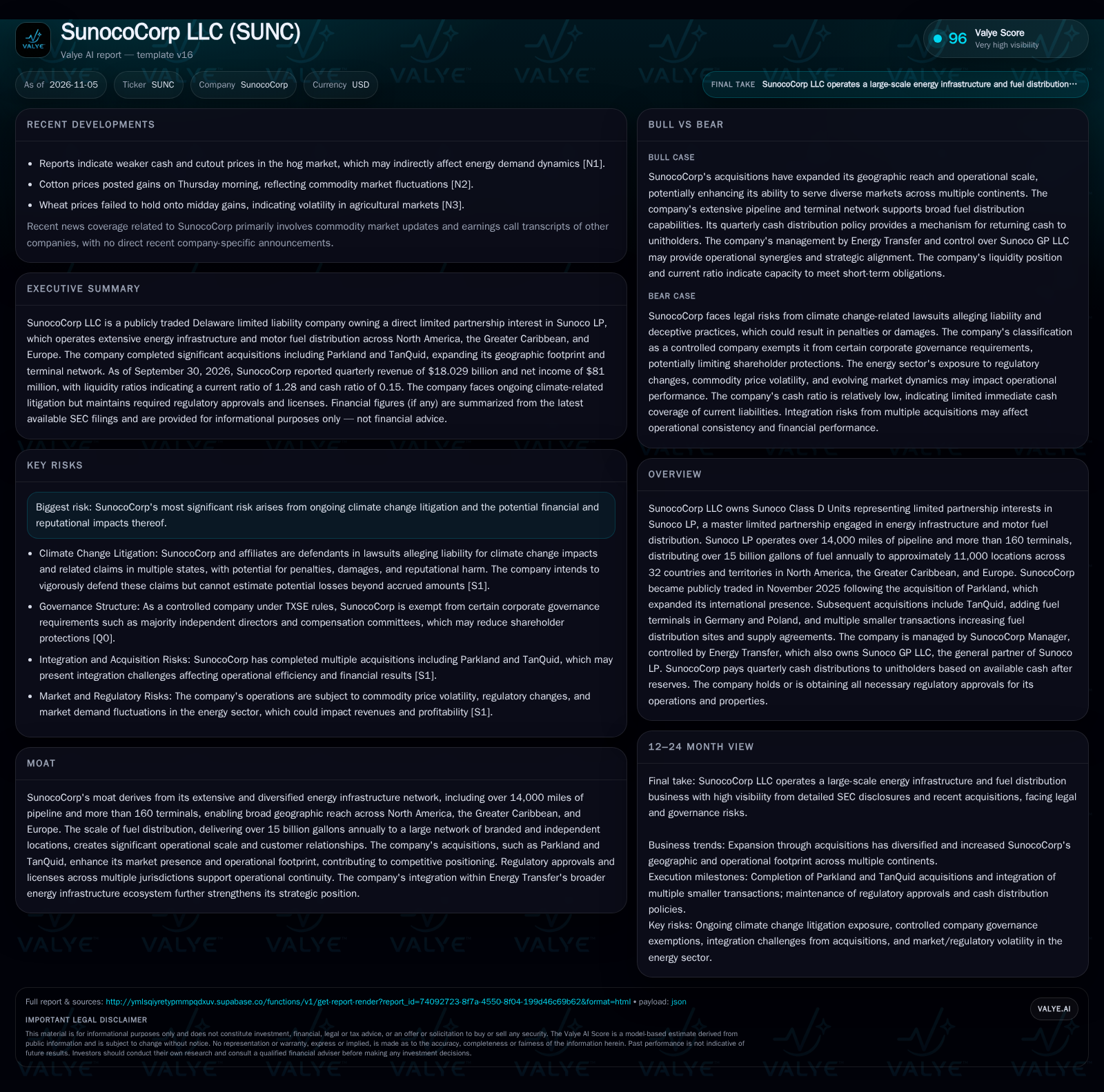
SunocoCorp has rapidly expanded its international operations through major acquisitions, now distributing over 15 billion gallons of fuel annually and operating more than 160 terminals across 32 countries. While the company reported $18 billion in quarterly revenue post-acquisitions, legal and integration risks, a modest net margin, and evolving energy demand complicate the outlook. The ability to sustain cash distributions and realize acquisition synergies will be tested by climate litigation and energy market volatility. [S1] [S2]
SunocoCorp’s transformation into a global fuel distribution powerhouse has been fueled by a series of large-scale acquisitions, notably Parkland and TanQuid, which have broadened its terminal, pipeline, and retail presence across North America, the Caribbean, and Europe. This expansion has driven impressive top-line growth, but the company’s modest net profitability and exposure to climate litigation create uncertainty about the sustainability of its cash distribution policy and long-term value creation. The next phase will hinge on SunocoCorp’s ability to integrate its sprawling network, defend against legal headwinds, and adapt to the volatile economics of the energy sector.
Recent Acquisitions Reshape SunocoCorp’s Scale and Exposure
SunocoCorp’s operational landscape has changed dramatically following the completion of two major acquisitions: Parkland in October 2025, which expanded its fuel distribution and convenience retail operations across 26 countries in the Americas, and TanQuid in January 2026, which added 15 fuel terminals in Germany and one in Poland. These moves, along with several smaller asset and supply agreement transactions, have extended SunocoCorp’s reach to 32 countries and territories, supporting the distribution of over 15 billion gallons of fuel annually to approximately 11,000 locations. [S1]
Financially, the company reported revenue of $18.029 billion and net income of $81 million for the quarter ended September 30, 2026, with a basic EPS of $1.57. While these results reflect significant scale, the thin margin highlights the challenge of converting operational breadth into profitability. [S2]
SunocoCorp faces climate change litigation in multiple US states, with potential penalties and damages. The company intends to defend these claims vigorously, but the outcome and financial impact remain uncertain. [S1]
How SunocoCorp’s Distribution Model Drives Revenue—and Its Limits
SunocoCorp’s business model centers on large-scale motor fuel distribution, underpinned by control of over 14,000 miles of pipeline and 160+ terminals. Revenue is primarily driven by the volume of fuel distributed to branded locations, independent dealers, and commercial customers, with the economics shaped by a combination of fuel margins, throughput, and ancillary non-fuel income streams such as convenience retail and terminal leasing. [S1]
The company’s recent acquisitions have increased its operational leverage by expanding fixed infrastructure costs across a broader revenue base. However, fuel distribution is typically a high-volume, low-margin business—evidenced by the reported net income of $81 million on $18 billion in revenue for the quarter, or a net margin below 0.5%. [S2]
Variable costs include wholesale fuel procurement, logistics, and operating expenses at terminals and retail sites. While scale can yield purchasing power and some efficiency, gross margins remain sensitive to commodity price swings and competitive pressures. Integration of acquired operations may create opportunities for cost savings, but also introduces risks of redundancy, system incompatibility, and cultural friction. Funding needs for acquisitions have been met through a mix of cash and credit facility borrowings, increasing the importance of consistent cash generation.
SunocoCorp’s policy of paying quarterly cash distributions is contingent on available cash after reserves. Sustaining these payouts will depend on effective acquisition integration, margin management, and the company’s ability to navigate regulatory and legal headwinds.
Infrastructure Scale, Regulatory Breadth, and Competitive Vulnerabilities
SunocoCorp’s competitive position is anchored by its extensive pipeline and terminal network, which enables a broad geographic reach and the ability to serve diverse markets across three continents. This infrastructure scale can create logistical efficiencies, strengthen relationships with major retail and commercial customers, and provide some resilience against localized disruptions. [S1]
However, the fuel distribution sector is characterized by intense competition from other large integrated fuel distributors, regional wholesalers, and, increasingly, alternative energy providers. The company’s expansion into Europe and the Americas through Parkland and TanQuid has increased exposure to new regulatory regimes, market structures, and competitors, potentially diluting operating focus.
A key vulnerability is the sector’s exposure to commodity price volatility and evolving demand for petroleum-based fuels as electrification and decarbonization accelerate. While SunocoCorp’s network and relationships could provide switching cost advantages, these are largely dependent on the stickiness of branded dealer and commercial contracts, the terms of which are not fully disclosed. Regulatory complexity also raises compliance costs and the risk of operational disruption.
Acquisition Synergies and Market Stability Unlock Higher Cash Flows
If SunocoCorp successfully integrates its recent acquisitions, it could realize substantial cost and revenue synergies—such as optimized logistics, consolidated procurement, and expanded cross-selling in convenience retail. Scale efficiencies may allow for improved fuel margins and better negotiating leverage with suppliers and customers. The broadening of geographic exposure could also enable SunocoCorp to balance regional demand fluctuations and regulatory risks.
A favorable scenario would require stable or strengthening fuel demand in key markets, manageable integration costs, and a benign legal and regulatory environment. Sustained cash generation could support regular cash distributions to unitholders and fund further strategic investments.
Evidence confirming this scenario would include: sequential margin improvement, declining integration-related costs, successful cross-market product launches, and updates on favorable legal outcomes or settlements that limit the impact of climate litigation.
Integration, Margin Pressure, and Legal Uncertainty Define the Medium Term
The most plausible trajectory is one in which SunocoCorp manages steady but modest growth, with incremental benefits from its expanded network partially offset by integration complexity, competitive pressure, and ongoing legal uncertainty. Margins may remain thin due to the structural economics of fuel distribution and the costs of harmonizing systems and operations across acquired networks.
Periodic legal expenses and settlements related to climate litigation could act as a drag on profitability, while changing energy demand patterns—driven by efficiency gains and the gradual adoption of electric vehicles—may limit volume growth in certain regions.
This scenario would be confirmed by stable revenue with limited margin expansion, recurring legal and integration costs, and continued but cautious cash distributions. Falsification would come from either a sharp improvement in net income margins (implying successful integration and/or pricing power) or a material deterioration linked to legal or regulatory shocks.
Legal Liabilities and Integration Failures Erode Value Creation
A more adverse scenario would see SunocoCorp’s climate litigation exposure result in substantial penalties, damages, or costly settlements, undermining both profitability and cash available for distribution. Integration missteps—such as failure to harmonize systems, loss of key personnel, or customer attrition—could lead to operational inefficiencies and margin compression.
Further downside could stem from regulatory tightening in key jurisdictions, accelerated shifts toward lower-carbon transport fuels, or commodity price shocks that squeeze margins and reduce volumes. In this environment, SunocoCorp might be forced to curtail distributions, take on additional debt, or divest assets to maintain liquidity.
Evidence supporting this scenario would include rising legal reserves or payouts, persistent integration-related disruptions, declining cash distributions, and negative trends in volume or margin metrics.
Milestones That Will Reveal SunocoCorp’s Resilience and Strategic Trajectory
Quarterly trends in net income margin: Sustained improvement would indicate successful integration and operating leverage; persistent weakness would signal structural challenges. [S2]
Legal disclosures and updates on climate litigation outcomes or settlements: Material new developments would shift the risk profile. [S1]
Volume growth or decline in fuel distribution across major geographies: A useful metric would be regional volume breakdowns, if disclosed, to assess demand resilience.
Integration cost reporting and identified synergies from Parkland, TanQuid, and other acquisitions: Progress updates would help test the thesis.
Cash distribution announcements and payout ratios: Any changes in policy or payout levels would indicate management’s confidence in sustainable free cash flow.
Changes in debt levels or refinancing activity: Increases could indicate stress or aggressive expansion; reductions would suggest improved potential financial flexibility.
Updates on regulatory changes in core markets, especially regarding fuel standards or decarbonization mandates, which could impact long-term demand.
Disclaimer: This is research-only, informational analysis and not investment advice. It may include AI-generated interpretation and general industry context. Always verify important details using primary sources.

Comments