
Sunoco LP: Expansion, Integration, and the Distribution Economics of a Transatlantic Fuel Giant
Sunoco LP’s transformative acquisitions of Parkland and TanQuid have reshaped its geographic reach and operational complexity, but the company now faces integration, legal, and governance challenges that will test its ability to sustain cash distributions and defend its market position in the evolving energy landscape.
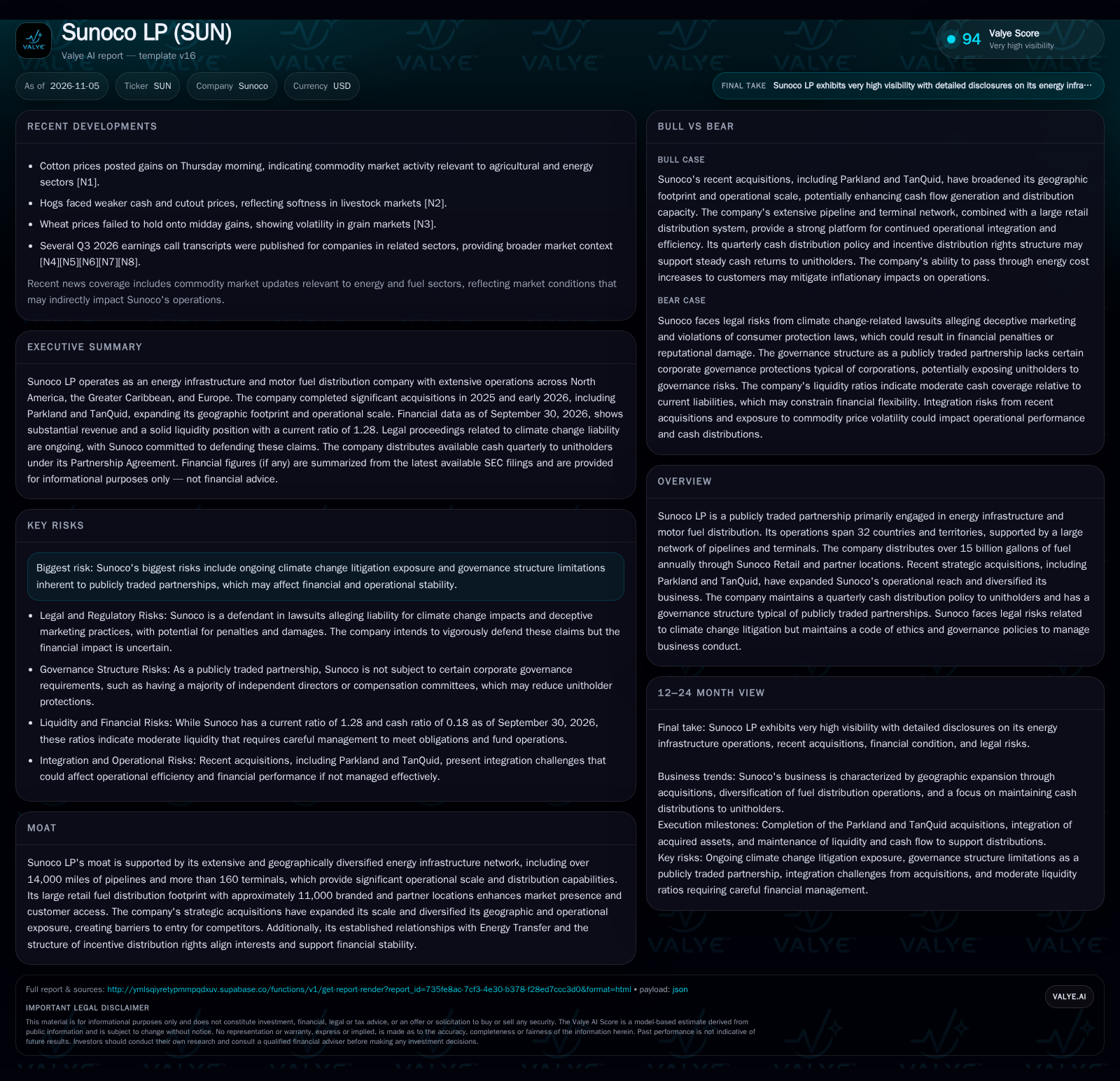
Sunoco LP has rapidly expanded its energy infrastructure and fuel distribution footprint through the acquisitions of Parkland and TanQuid, creating a diversified network spanning 32 countries. The next phase will be defined by Sunoco’s ability to harmonize its newly acquired operations, manage legal exposures, and maintain its disciplined cash distribution policy to unitholders. [S2]
The past year marks a structural turning point for Sunoco LP. Through the $2.6 billion acquisition of Parkland and the €465 million TanQuid deal, Sunoco has transformed from a primarily North American fuel distributor into a transatlantic energy logistics platform spanning 32 countries. This expansion brings not only scale and geographic diversification, but also new integration complexities and heightened legal exposure—particularly as climate change litigation intensifies. The company’s ability to harmonize these new assets, manage litigation risk, and maintain its disciplined distribution policy will define its next chapter.
Acquisitions Recast Sunoco’s Scale and Exposure
Sunoco LP’s operational profile has dramatically shifted in the past year, defined by two major acquisitions: Parkland, acquired for $2.6 billion in cash and 51.5 million SunocoCorp units, and TanQuid, purchased for €465 million (about $540 million) including assumed debt. Parkland alone expanded Sunoco’s reach to 26 countries in the Americas, while TanQuid added 16 fuel terminals in Germany and Poland. These moves have pushed Sunoco’s fuel distribution to over 15 billion gallons annually and extended its infrastructure network to more than 14,000 miles of pipeline and 160+ terminals across 32 countries and territories. [S2]
Financially, Sunoco reported $18.03 billion in revenue for the first nine months of 2026 and ended 2025 with $891 million in cash. As of September 30, 2026, its current ratio stood at 1.28 and cash ratio at 0.18, reflecting reported liquidity position relative to its expanded operational commitments. [S2]
The company now faces lawsuits in multiple U.S. states alleging liability for climate change impacts and deceptive marketing, creating a new dimension of legal and reputational risk. [S2]
Distribution-Driven Economics and the Challenge of Scale Integration
Sunoco’s core business model relies on the economics of bulk fuel distribution, leveraging scale to secure favorable supply terms and maximize throughput across a vast network of terminals and retail partners. Revenue is primarily driven by fuel volume sold and distributed, with margins influenced by the degree to which Sunoco can capture value between wholesale procurement and retail or dealer pricing.
The recent acquisitions have likely introduced greater geographic and product diversity, opening up cross-border arbitrage opportunities and operational efficiencies in logistics, storage, and procurement. However, these benefits are contingent on effective integration: realizing synergies across procurement, inventory management, and network optimization. If Sunoco can harmonize its systems and processes across the newly acquired platforms, it could unlock operating leverage, with incremental volumes flowing through largely fixed infrastructure.
On the cost side, fuel distribution is highly working-capital intensive, with significant outlays required for inventory and receivables. The company’s current and cash ratios suggest that while Sunoco has adequate coverage for day-to-day obligations, any disruptions—such as integration delays, litigation settlements, or commodity price shocks—could strain its ability to fund operations or make distributions without additional financing.
Capital needs are likely to remain elevated in the near term, given the integration of Parkland and TanQuid, potential investments in terminal upgrades, and the ongoing requirement to maintain a large and aging infrastructure footprint. The partnership’s quarterly cash distribution policy further constrains retained earnings, making prudent balance-sheet management critical.
Network Density, Customer Lock-In, and the Threat of Disruption
Sunoco’s competitive position rests on its extensive infrastructure, network density, and distribution relationships. The combination of pipelines, storage terminals, and branded retail sites creates significant barriers to entry for new fuel distributors and offers some insulation from pure commodity pricing competition.
The recent acquisitions increase Sunoco’s relevance to both upstream suppliers and downstream customers, potentially improving negotiating leverage and customer retention. In energy distribution, switching costs can be moderate—dealers and commercial customers may have alternatives, but integrated supply contracts, branded programs, and logistical advantages can create stickiness, especially in less commoditized or geographically fragmented markets.
However, Sunoco faces competitive pressure from other major fuel marketers, integrated oil companies, and, increasingly, alternative energy providers and electrification trends—particularly in Europe, where regulatory and consumer pressure for decarbonization are accelerating. The scale and scope of Sunoco’s network could help it adapt by incorporating alternative fuels or services, but this transition would require capital, operational flexibility, and regulatory engagement.
The relationship with Energy Transfer, which holds significant incentive distribution rights and a 20.8% stake, further shapes Sunoco’s strategic flexibility and capital allocation priorities.
Integrated Platform Unlocks Synergies and Cash Flow Growth
In a favorable scenario, Sunoco successfully integrates Parkland and TanQuid, harmonizing procurement, logistics, and IT systems to capture cost synergies and optimize fuel flow across its expanded footprint. Improved operational efficiency could translate into higher EBITDA margins, while increased scale may enable better terms with suppliers and customers.
If Sunoco can leverage its infrastructure to offer value-added services (such as fuel inventory management, logistics optimization, or alternative fuels) to its dealer and commercial base, it could further differentiate itself and solidify recurring revenue streams. Sustained execution would likely support the continuation or growth of cash distributions, reinforcing investor confidence.
Evidence confirming this scenario would include margin expansion, reduced integration-related costs, stable or increasing distribution coverage ratios, and new commercial wins or contract extensions in newly acquired geographies.
Integration Delivers Scale but Raises Complexity and Exposure
The most plausible trajectory is that Sunoco achieves moderate integration success: realizing some operational efficiencies and revenue synergies, but facing ongoing challenges harmonizing systems, cultures, and regulatory compliance across 32 countries. The company continues to generate substantial cash flow from its core distribution business, but incremental gains are tempered by integration costs, legal expenditures, and macroeconomic headwinds.
Cash distributions remain a central part of the Sunoco value proposition, but growth is modest as the company balances capital needs for maintenance, debt service, and legal reserves. The evolving legal landscape—especially climate litigation—introduces ongoing uncertainty and may require higher reserves or insurance costs.
Confirmation of this scenario would come from steady, but not accelerating, margin trends, stable revenue in core geographies, and ongoing references to integration and legal costs in company disclosures.
Integration Disruptions and Legal Liabilities Pressure Cash Flow
In a less favorable outcome, Sunoco encounters significant integration setbacks—such as IT failures, cultural clashes, or regulatory compliance issues—resulting in higher-than-expected costs and operational inefficiencies.
Commodity price volatility, supply chain disruptions, or regulatory changes (especially in Europe) could further erode margins and test the resilience of Sunoco’s business model. In this scenario, the company may be forced to draw on credit facilities, delay growth investments, or reduce distributions to preserve liquidity.
Evidence supporting this scenario would include rising SG&A and integration costs, declining coverage ratios for distributions, legal settlements or reserves materially impacting net income, and negative commentary from management regarding operational or regulatory headwinds.
Testing Sunoco’s Expansion: What Will Reveal Success or Stress
Integration cost trends and synergy realization: Monitoring disclosed integration expenses and management commentary on synergy capture will indicate whether Sunoco is on track with its post-acquisition plans.
Distribution coverage ratio: If disclosed, the ratio of distributable cash flow to actual distributions will reveal the sustainability of Sunoco’s cash return policy.
Legal reserve disclosures and climate litigation updates: Increases in legal reserves, new settlements, or adverse rulings would materially affect the risk profile.
Margin trends in newly acquired geographies: Segment-level margin data (if disclosed) from Parkland and TanQuid operations will provide insight into integration progress and competitive positioning.
Capital spending and maintenance capex: Rising capex requirements relative to historical norms could signal infrastructure stress or regulatory adaptation costs.
Net leverage and debt service metrics: Changes in leverage ratios or interest coverage, if disclosed, would highlight potential financial flexibility or strain.
Customer retention and contract renewal rates: Data on dealer or commercial customer churn, if provided, would help assess the durability of Sunoco’s expanded network.
Disclaimer: This is research-only, informational analysis and not investment advice. It may include AI-generated interpretation and general industry context. Always verify important details using primary sources.

Comments