
Viatris at an Inflection: Portfolio Reshaping, Cost Actions, and the Next Phase of Value Creation
Viatris is navigating a pivotal period, marked by major restructuring, targeted acquisitions, and continued portfolio streamlining. With significant cost actions underway, a high-profile acquisition in specialty pharma, and a diverse pipeline, the company’s ability to deliver sustainable growth will hinge on execution amid persistent pricing and regulatory pressures.
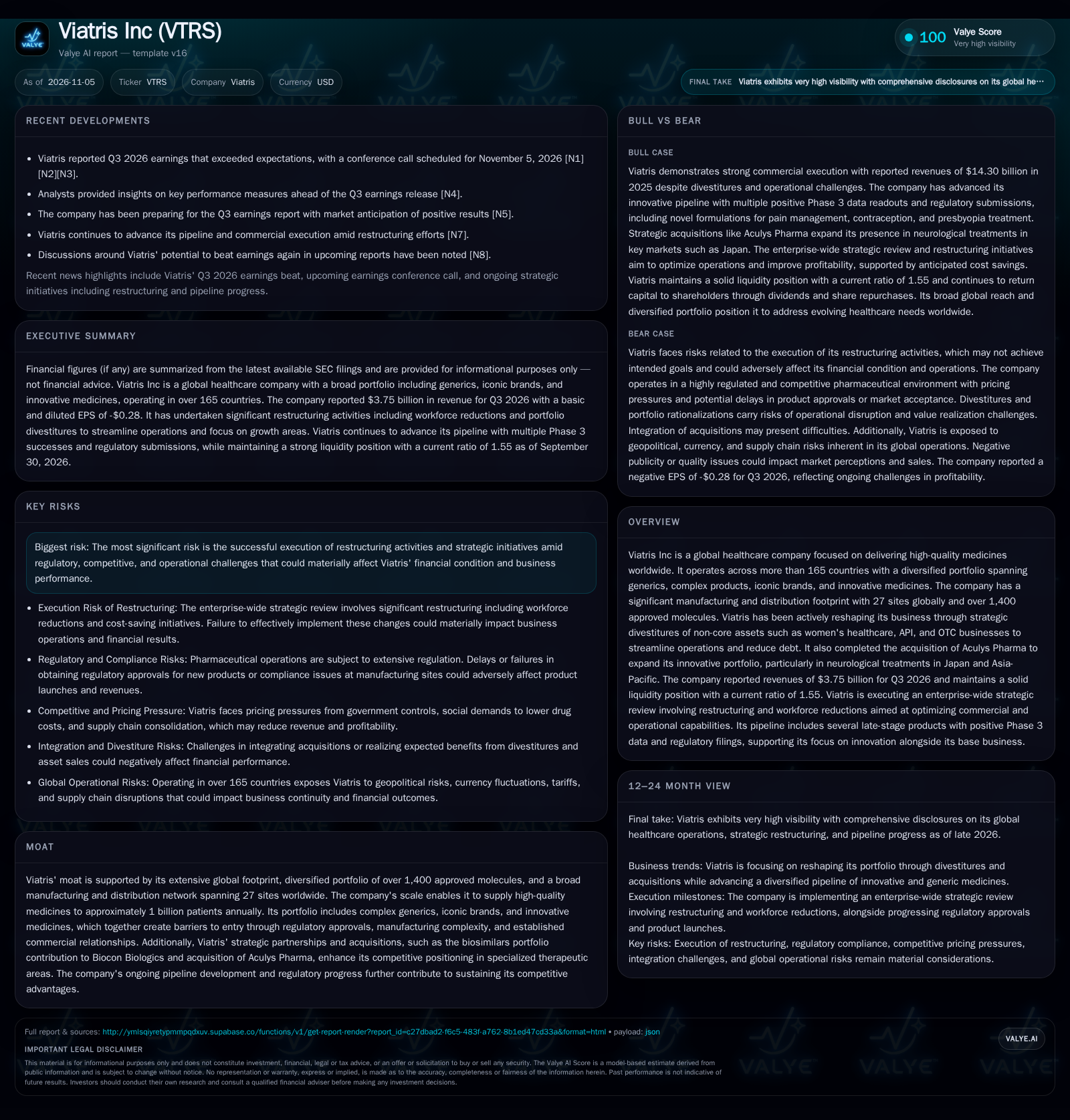
Viatris reported $3.75 billion in Q3 2026 revenue but posted a negative EPS, reflecting ongoing restructuring and divestitures. The company is acquiring Pacira for $1.65 billion to expand in higher-margin, patent-protected products, while seeking substantial cost savings from workforce reductions. Execution of these strategic shifts, along with regulatory and competitive headwinds, will determine whether Viatris can deliver improved profitability and growth in the coming years. [S1] [S2]
Viatris is amid a strategic transformation, balancing the streamlining of its core portfolio with bold moves into higher-margin specialty pharmaceuticals. Recent divestitures and a sweeping restructuring are designed to improve efficiency and sharpen focus, but these actions have weighed on short-term earnings. The pending $1.65 billion acquisition of Pacira signals a pivot toward branded, patent-protected assets that could support profitability if successfully integrated. Against the backdrop of persistent pricing pressure and global regulatory complexity, Viatris’ next chapters will be defined by its ability to execute on cost savings, realize value from acquisitions, and deliver on its late-stage pipeline.
Strategic Shifts: Acquisitions, Divestitures, and Restructuring Take Center Stage
Viatris entered into a definitive agreement in October 2026 to acquire Pacira for $1.65 billion, adding two established, high-margin, patent-protected products—EXPAREL and ZILRETTA—to its U.S. portfolio. This move represents a major step into specialty pharmaceuticals, aiming to offset the pressures on its traditional generics business and capture more durable cash flows [S2].
Q3 2026 financials show $3.75 billion in revenue but an EPS of -$0.28, reflecting the combined impact of restructuring charges and revenue lost from recent divestitures, including the women’s health, API, and OTC businesses [S2].
The company is implementing an enterprise-wide restructuring, targeting annual savings of $600–700 million, with charges of $700–850 million and a workforce reduction of up to 10% [S1].
As of September 30, 2026, Viatris reported $1.789 billion in cash and a current ratio of 1.55, providing reported liquidity position as it undertakes portfolio and operational changes [S2].
How Viatris Generates Value: Fixed Costs, Portfolio Mix, and the Economics of Scale
Viatris’ revenue model is built around a blend of high-volume, lower-margin generics and select branded or patent-protected products, which typically offer higher margins but require significant investment in R&D, regulatory approvals, and lifecycle management. The company’s global manufacturing and distribution footprint supports economies of scale, but also creates high fixed costs—making cost discipline and asset utilization critical to profitability.
The restructuring and divestitures are intended to reweight the portfolio toward higher-margin assets and reduce exposure to commodity-like, price-sensitive segments. However, the transition period is likely to create operating leverage volatility: as revenues from divested segments fall off before new contributions ramp, fixed costs can squeeze margins. If the Pacira acquisition delivers on its promise, Viatris could see an improved mix of recurring, defensible cash flows from specialty pharmaceuticals, but integration costs and the risk of overpayment are material considerations.
Capital needs remain considerable, especially given the scale of the Pacira transaction and ongoing investment in late-stage pipeline assets. The company’s ability to generate meaningful free cash flow post-restructuring will depend on realizing cost savings, stabilizing revenues, and extracting value from both legacy and newly acquired products.
Competitive Pressures: Generics, Specialty Pharma, and Evolving Barriers to Entry
Viatris’ historical strength lies in its global reach and broad portfolio—over 1,400 approved molecules and 27 manufacturing sites give it scale advantages in sourcing, production, and regulatory navigation [S1]. In generics, scale and supply reliability matter, but pricing is relentlessly competitive, with government tenders and payer consolidation driving down margins.
The shift toward specialty and patent-protected products via Pacira and the Aculys Pharma acquisition reflects a strategic bid for higher barriers to entry. Patent protection, complex formulation know-how, and established prescriber relationships can provide temporary pricing power and reduce direct competition from commodity generics.
However, these advantages are not unassailable: specialty drugs face their own risks from biosimilar/generic entry post-patent expiry, evolving regulatory scrutiny on pricing, and the need for ongoing clinical and real-world data to defend value. Viatris’ position in the middle ground—large enough for global execution, but not a pure-play innovator—means it must carefully manage transitions and defend its share against both traditional generics giants and branded pharma incumbents.
What Could Unlock Durable Value: Successful Integration and Pipeline Execution
If Viatris executes a smooth integration of Pacira, leverages its global infrastructure to expand EXPAREL and ZILRETTA into new markets, and realizes the full targeted $600–700 million in annual cost savings, the company could achieve a structurally higher margin profile. Additional upside may come from the late-stage pipeline, particularly if positive Phase 3 data and regulatory submissions translate into successful product launches in high-need areas such as presbyopia and contraception [S1].
Key evidence would include rapid realization of cost synergies, sequential improvement in operating margins, successful regulatory approvals and market uptake of new drugs, and sustained growth in specialty product sales. A return to positive EPS and robust free cash flow generation post-restructuring would further validate the upside scenario.
Navigating Transition: Gradual Margin Recovery Amid Persistent Headwinds
The most plausible path is one of gradual improvement as restructuring charges abate, cost savings materialize, and the Pacira assets are integrated, but offset by ongoing pricing pressure in generics and the time lag before new specialty products contribute meaningfully. Revenue may remain flat or decline modestly in the near term due to portfolio pruning, but margins could slowly improve as the cost base is right-sized.
Confirmation of this scenario would come from sequential reductions in restructuring and integration costs, stabilization of core revenues (excluding divested businesses), and evidence that new specialty assets are gaining traction without major operational hiccups. Conversely, persistent negative EPS, cost overruns, or delays in product launches would suggest the transition is proving more disruptive than anticipated.
Execution Risks: Restructuring Disruption, Integration Missteps, and Margin Erosion
The downside scenario centers on failure to achieve intended cost savings, operational disruption from workforce reductions, or difficulty integrating Pacira, resulting in lower-than-expected revenue and margin compression. Additional risk comes from regulatory delays or setbacks in the pipeline, and potential competitive responses (such as aggressive discounting by peers) that erode market share in both generics and specialty segments.
Evidence of the downside would include continued negative EPS, missed synergy targets, unexpected attrition or disruption in commercial operations, regulatory setbacks for pipeline assets, or underperformance of newly acquired products. If cash flow remains weak and leverage increases post-acquisition, Viatris could face renewed pressure to divest further or restructure again.
Milestones That Will Define Viatris’ Next Chapter
Progress on the Pacira acquisition closing and early integration steps, including updates on retention of key personnel, realization of projected synergies, and initial sales performance of EXPAREL and ZILRETTA.
Quarterly operating margin trends—particularly whether cost savings from restructuring are flowing through to the P&L as planned.
Regulatory milestones and launch timing for late-stage pipeline assets, especially in presbyopia and contraception, as these could materially shift the revenue and margin mix.
Sequential trends in core revenue (excluding divested assets) to gauge the stability and growth of the re-focused portfolio.
Updates on restructuring charges versus realized cost savings, and whether the company remains on track to achieve the $600–700 million annualized target.
EPS and free cash flow trajectory post-restructuring, as these will signal the success or strain of the transition.
If disclosed, market share or sales trends for key specialty and branded products, to test whether Viatris can defend and expand its higher-margin businesses.
Any further portfolio actions—acquisitions, divestitures, or strategic partnerships—that could reshape the company’s risk/reward profile.
Disclaimer: This is research-only, informational analysis and not investment advice. It may include AI-generated interpretation and general industry context. Always verify important details using primary sources.

Comments