
Novavax’s Platform Leverage and Partnership Model: Milestones, Margin Tensions, and the Next Phase of Vaccine Commercialization
With recent milestone payments from Sanofi and licensing deals with Pfizer, Novavax is shifting from product-centric commercialization to a platform-driven, partnership-heavy model. The company’s Matrix-M™ adjuvant is validated in infectious disease and malaria markets, but ongoing losses, execution risk, and reliance on external partners test the scalability and resilience of its business model.
Novavax’s Q3 2026 results show a company at a strategic crossroads: cash-generating milestones from Sanofi’s Phase 3 combination vaccine trial and a licensing deal with Pfizer highlight the growing value of its Matrix-M™ adjuvant platform. Yet, persistent net losses, dependence on partner execution, and regulatory and market risks cloud the pathway to self-sustaining profitability. The next phase hinges on whether Novavax can convert platform validation and early-stage pipeline progress into repeatable, high-margin revenue streams—or if it remains structurally exposed to partner and market volatility.
Novavax’s 2026 snapshot reveals a company in transition from a pure-play vaccine developer to a platform innovator with a partnership-first model. Recent milestone inflows from Sanofi’s combination vaccine trial and the Pfizer licensing deal validate the commercial relevance of its Matrix-M™ adjuvant. Yet, quarterly losses and reliance on external partners for development and commercialization highlight unresolved risks in scaling this model. The critical question: can Novavax’s platform approach generate durable, high-margin revenue—or does it embed persistent exposure to partner execution and market dynamics?
Milestone Inflows and Platform Validation Define 2026 Operating Backdrop
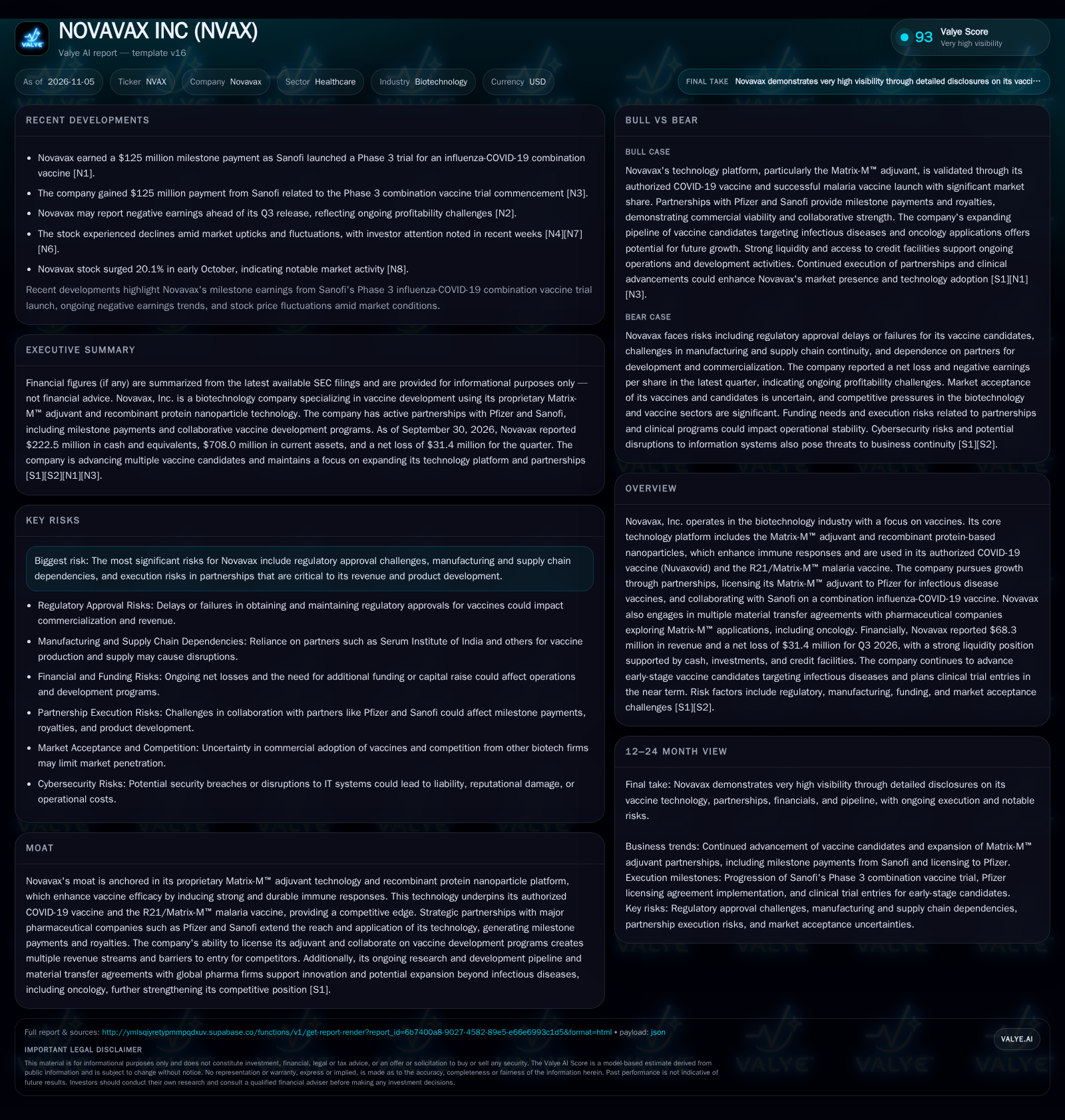
Novavax earned a $125 million milestone payment as Sanofi launched a Phase 3 trial for a combination influenza-COVID-19 vaccine, a tangible affirmation of the commercial and clinical value of its Matrix-M™ adjuvant technology [N1] [N3]. This follows the company’s $30 million upfront licensing deal with Pfizer, which could yield up to $500 million in milestones and royalties if development and commercialization progress [S1]. On the product side, the R21/Matrix-M™ malaria vaccine—manufactured by Serum Institute of India—has sold 30 million doses since mid-2024 and now claims over 80% market share in authorized countries [S1]. Despite these successes, Novavax reported Q3 2026 revenue of $68.3 million and a net loss of $31.4 million, with liquidity supported by $222.5 million in cash and further credit and equity capacity [S2]. The period marks a pivot toward monetizing platform assets through partnerships, but also underscores the tension between milestone-driven revenue and ongoing operational losses.
How Novavax’s Partnership-Heavy Model Shapes Revenue Streams and Margin Structure
Novavax’s core economics are shifting from single-product sales to a platform-leveraged, partnership-driven model. Historically, vaccine economics hinge on high upfront R&D and regulatory costs, with substantial fixed costs amortized over large-volume sales. Novavax’s Matrix-M™ adjuvant, embedded in both its COVID-19 (Nuvaxovid) and malaria (R21/Matrix-M™) vaccines, is now being monetized via licensing and supply agreements, as seen with Pfizer and Sanofi [S1]. This model provides non-dilutive capital via milestones and royalties, but also pushes downstream control and much of the commercialization economics to partners.
The company’s recent $125 million milestone from Sanofi and up to $500 million potential from Pfizer illustrate the upside of this approach. However, these inflows are inherently lumpy and tied to partners’ clinical and regulatory milestones, limiting predictability and recurring revenue. Manufacturing and supply economics are also partner-dependent: for example, Serum Institute of India produces and sells the malaria vaccine, likely resulting in lower direct margins for Novavax versus a fully owned product. The company’s lean operating model contains fixed costs, but ongoing net losses suggest that milestone and royalty streams have yet to offset R&D and SG&A outlays [S2]. If the platform is widely adopted across multiple indications, high-margin licensing and supply revenue could scale, but the current structure embeds material volatility and execution risk.
Matrix-M™ Platform as Differentiator—But Counterforces from Scale Players and Next-Gen Modalities
Novavax’s primary competitive asset is the Matrix-M™ adjuvant and recombinant protein nanoparticle platform, which has demonstrated clinical efficacy and broad immunogenicity in both COVID-19 and malaria settings [S1]. This technology differentiates Novavax from traditional inactivated or subunit vaccines, and provides a potential edge in durability and breadth of immune response. The company’s ability to license Matrix-M™ to major pharma (Pfizer, Sanofi) and place it in combination vaccine programs is a testament to its platform relevance.
However, Novavax faces formidable counterforces. Large incumbent vaccine players—such as those pursuing mRNA, viral vector, and next-generation protein technologies—have global distribution, manufacturing scale, and regulatory experience. The company’s dependence on partners for manufacturing, clinical development, and commercialization means it cedes control over timelines, market access, and pricing. Meanwhile, mRNA and other rapidly adaptable platforms continue to attract pharma and public health investment, potentially eroding the relative advantage of Matrix-M™ unless Novavax’s platform can demonstrate superior efficacy, safety, or durability in new indications. The company’s material transfer agreements in oncology and infectious disease may open new verticals, but competitive intensity and switching costs remain high.
Platform Adoption Accelerates—What Would Confirm a Self-Sustaining Royalty Model?
The most favorable outcome for Novavax is broad, multi-indication adoption of Matrix-M™ as a preferred adjuvant, driving sustained, high-margin royalty and supply revenue. This would require partners like Pfizer and Sanofi successfully commercializing combination and new infectious disease vaccines with Matrix-M™, triggering downstream milestones and establishing recurring royalties. Expansion of material transfer agreements into full licensing deals—particularly in oncology or high-value infectious disease indications—would further diversify and stabilize revenue.
Confirmation of this scenario would come from sequential milestones achieved by partners, observable royalty revenue growth, and announcements of new, commercial-stage partnerships or product launches featuring Matrix-M™. A visible pipeline of Matrix-M™-enabled products across multiple pharma partners, coupled with margin expansion and declining dependence on equity or debt financing, would signal the platform’s transition to a durable royalty engine. Conversely, delays in partner programs, lack of new licensing agreements, or ongoing reliance on milestone payments without recurring royalties would challenge this thesis.
Milestone-Driven Revenue with Persistent Operating Losses: The Most Plausible Near-Term Outcome
The likeliest outcome over the next 12-24 months is a continuation of milestone-driven, partnership-centric revenue streams, punctuated by periods of operating losses as Novavax invests in its pipeline and awaits downstream commercialization by partners. Some royalties may begin to flow from early Matrix-M™-enabled products, but the bulk of revenue will likely remain tied to discrete development and regulatory milestones. The malaria vaccine’s strong market share provides a foundation, but with manufacturing and commercial control held by Serum Institute of India, direct margin capture is limited.
Evidence for this middle path would be further milestone announcements, incremental progress on early-stage pipeline candidates, and disclosure of new material transfer agreements or exploratory partnerships. Persistent net losses, periodic capital raises, and limited royalty revenue would reinforce the structural challenges of the current model. A shift toward self-sustaining profitability would require visible royalty growth outpacing R&D and SG&A, which is not yet apparent in the current financial profile [S2].
Execution Slippage, Regulatory Delays, and Partner Dependency Undermine Platform Monetization
The adverse scenario for Novavax involves slippage in partner-led development (e.g., trial delays, regulatory setbacks), weak market uptake of Matrix-M™-enabled vaccines, or failure to convert material transfer agreements into commercial licensing. These factors could produce prolonged periods with no milestone inflows, limited or delayed royalties, and continued net losses. If new vaccine modalities outcompete Matrix-M™ for partner adoption or public health procurement, the platform’s relevance and pricing power could erode.
Confirmation of this scenario would include missed or postponed milestone triggers, increased working capital usage, drawdowns on the term loan or ATM equity program, and a shrinking pipeline of disclosed partnerships. Worsening net losses without offsetting revenue growth, or public disclosures of partner deprioritization of Matrix-M™ programs, would further validate the downside risk.
Milestones and Metrics That Will Shape Novavax’s Platform Trajectory
Progress on Sanofi’s Phase 3 combination influenza-COVID-19 vaccine trial, including potential additional milestones and eventual regulatory submission outcomes.
Milestone and royalty payments from Pfizer as its Matrix-M™-enabled programs advance through development and (if successful) toward commercialization.
Growth in recurring royalty and supply revenue, as opposed to lumpy milestone payments—if disclosed, this would be a strong indicator of platform durability.
Further licensing deals or expansion of material transfer agreements into commercial-stage partnerships, especially in non-infectious disease indications such as oncology.
Advancement of Novavax’s early-stage internal pipeline (e.g., clinical trial starts for C. difficile, varicella-zoster, RSV candidates), which could provide future product or licensing value.
Disclosure of new or expanded manufacturing and supply agreements for Matrix-M™ in additional geographies or indications.
Operating expense trends and net loss trajectory relative to milestone and royalty inflows, as a marker of progress toward self-sustaining profitability.
Partner disclosures or public health guidance that clarify the competitive positioning of Matrix-M™ versus alternative adjuvants and vaccine platforms.
Disclaimer: This is research-only, informational analysis and not investment advice. It may include AI-generated interpretation and general industry context. Always verify important details using primary sources.

Comments