
Distribution Solutions Group: Multi-Segment Distribution at Scale Amid Acquisition Integration and Sector Pressures
Distribution Solutions Group, Inc. (DSGR) leverages a diversified segment structure, recent acquisition activity, and expanded credit capacity to drive growth in the fragmented industrial MRO and supply chain markets. However, rising input costs, margin variability, and the challenges of integrating new assets underscore the complexity of achieving sustainable profitability.
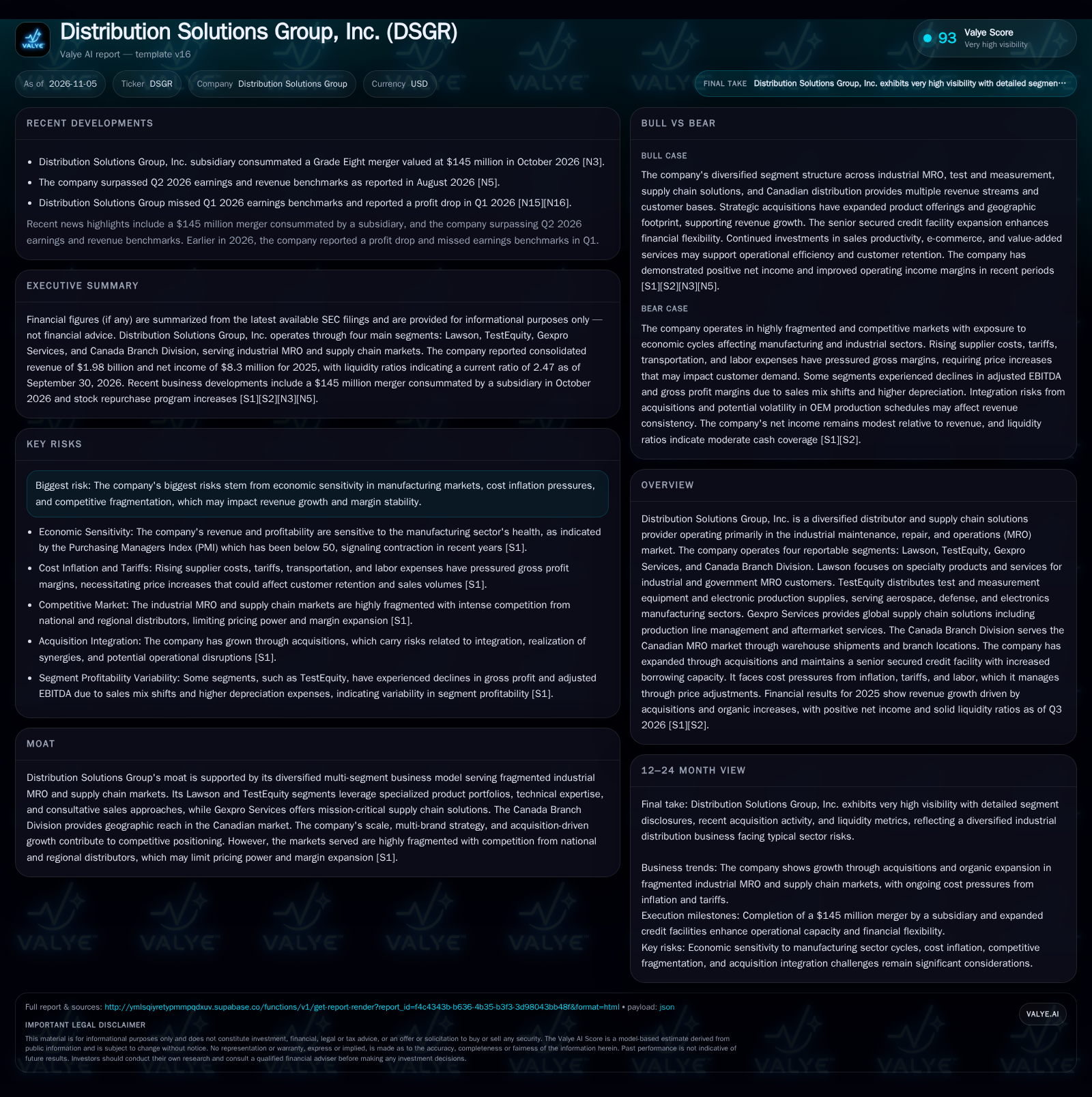
DSGR reported $1.98 billion in 2025 revenue, with growth fueled by both acquisitions and organic expansion. Operating income and net income turned positive, but segment-level margin pressure and integration demands remain. A $145 million subsidiary merger and expanded credit facilities provide capacity but raise the stakes for execution and capital allocation [S1] [N3] [S2].
Distribution Solutions Group, Inc. operates at the intersection of industrial MRO, electronic test equipment, and supply chain solutions, aggregating multiple distribution businesses under a single umbrella. Recent results show solid top-line growth driven by both acquisition and organic channels, with operating and net income turning positive after a period of investment and integration. However, the company faces persistent cost inflation, margin variability at the segment level, and the challenge of integrating a $145 million merger completed by a subsidiary in late 2026. These dynamics highlight both the opportunities and operational complexities inherent in scaling a multi-segment industrial distributor.
Recent Performance and Strategic Moves Define the 2026 Landscape
In 2025, Distribution Solutions Group reported consolidated revenue of $1.98 billion, a $175.9 million increase versus 2024, with $121.5 million of that growth coming from acquisitions and $54.4 million from organic expansion [S1]. Operating income rose to $78.3 million (4.0% margin), up from $56.0 million (3.1%) in 2024, and net income turned positive at $8.3 million after a prior-year loss [S1]. The company completed a $145 million merger via a subsidiary in October 2026, continuing its acquisition-driven strategy [N3]. [S2] Segment-level results were mixed, with Lawson and TestEquity posting higher revenues but lower adjusted EBITDA, suggesting cost and mix challenges [S1].
How DSGR’s Revenue Engines and Cost Structure Shape Profitability
DSGR’s business model is built around distributing industrial MRO supplies (Lawson, Canada Branch), test and measurement equipment (TestEquity), and supply chain management services (Gexpro Services). Revenue depends on a mix of recurring MRO demand, OEM production cycles, and expansion into adjacent verticals. Pricing power is limited by the fragmentation of its end markets and the presence of national and regional competitors. Organic growth is driven by salesforce productivity, product line expansion, and e-commerce in the Lawson and Canada segments, while TestEquity relies on technical expertise, brand portfolio, and acquisitions for customer stickiness [S1].
Variable costs (purchasing, logistics, labor) are subject to inflation and tariffs, often requiring price increases to protect gross margins. Fixed costs are driven by warehouse infrastructure, IT, and SG&A. Recent years have seen gross margin stability at the group level, but segment results show vulnerability to mix shifts and depreciation, as seen in TestEquity’s margin compression despite revenue growth [S1]. Operating leverage is possible if organic sales accelerate or acquired businesses are integrated efficiently, but margin expansion is constrained by input cost volatility and competitive pricing. The company’s capital needs are amplified by its acquisition strategy, with increased term debt and a larger credit facility ($700 million term, $400 million revolver as of December 2025) providing potential financial flexibility but also increasing interest expense and execution risk [S1].
Fragmented Markets and the Challenge of Differentiation
DSGR competes in highly fragmented industrial and test equipment distribution markets. Its main national and regional competitors include both diversified industrial distributors and specialized niche players. The company’s multi-brand, multi-segment structure enables it to serve a wide range of customers—from large OEMs needing global supply chain solutions (Gexpro Services) to localized MRO buyers (Lawson, Canada Branch). However, this breadth also exposes the business to disparate cycles and price-driven competition.
Potential sources of differentiation include technical expertise in TestEquity, consultative selling in Lawson, and geographic reach in Canada. However, switching costs for customers remain low, and most value-added services are replicable by peers. The persistent need for price increases to offset cost inflation highlights limited pricing power. Acquisitions may offer scale and cross-selling opportunities, but also create integration risk and complexity, especially as the company grows through large transactions such as the recent $145 million merger [S1] [N3].
Acquisition Synergies and Operating Leverage Drive Margin Expansion
The most favorable scenario for DSGR is one in which recent and future acquisitions are integrated smoothly, unlocking cross-segment synergies and enabling operating leverage. If the company can harmonize procurement, logistics, and IT systems across its segments, it may realize cost efficiencies that boost gross and operating margins. Ongoing price discipline, combined with digital sales growth and consultative value-added services, could improve customer retention and enable selective pricing power.
Confirmation would come from sustained increases in segment-level adjusted EBITDA, group operating margin expansion above the current 4.0%, and organic revenue growth outpacing inflation and sector benchmarks. Evidence of successful integration would include reduced SG&A as a percentage of sales, improved working capital turnover, and positive contributions from recent acquisitions such as the Grade Eight merger [S1] [N3]. Falsification would be seen if integration costs escalate, segment margins deteriorate, or acquired revenue fails to translate into incremental profitability.
Acquisition-Fueled Growth with Persistent Margin Constraints
The most plausible trajectory is that DSGR continues to deliver revenue growth through a blend of bolt-on acquisitions and organic expansion, but faces ongoing margin pressure from input cost inflation and competitive pricing. While operating income and net income remain positive, margin improvement is limited by volatility in segment performance and the need to pass through supplier cost increases to customers.
This scenario would be confirmed by continued revenue gains in the low- to mid-single digits, stable to slightly improving operating margins, and incremental growth in adjusted EBITDA. Segment results would likely remain mixed, with some units absorbing cost headwinds better than others. Evidence against this scenario would be either a sharp decline in organic sales (suggesting loss of competitiveness or customer defection) or a step-change improvement in group margins that suggests integration and synergy capture are ahead of schedule.
Integration Complexity, Cost Inflation, and Economic Headwinds Erode Value
A negative outcome would see DSGR hampered by post-merger integration challenges, persistent inflation in supplier and labor costs, and a weak manufacturing cycle. Failure to realize anticipated synergies from recent acquisitions—including the $145 million merger—could result in elevated SG&A, margin compression, and working capital inefficiencies. If competitive pressures prevent the company from passing on cost increases, gross profit margins could deteriorate further.
Adverse trends would be evident in declining segment EBITDA, negative or flat operating income, or a return to net losses. Liquidity could come under pressure if cash flow is consumed by integration costs or if revenue declines outpace expense reductions. Deterioration in the Purchasing Managers Index (PMI) or a sharp drop in OEM production schedules would further pressure top-line growth, especially in the Gexpro Services segment [S1].
Milestones That Will Test DSGR’s Acquisition Integration and Margin Ambitions
Organic revenue growth rates by segment, with a focus on whether Lawson and TestEquity can return to positive adjusted EBITDA growth (if disclosed).
Gross and operating margin trends at both the group and segment levels, especially following major acquisitions.
Realized cost synergies and SG&A as a percentage of sales post-merger, particularly from the Grade Eight integration (if disclosed).
Cash conversion cycle and working capital turnover, as indicators of integration effectiveness and inventory management.
Customer retention rates and new customer acquisition metrics, especially in the Lawson and Canada Branch segments (if disclosed).
Progress on digital sales and e-commerce penetration, which could support margin and efficiency gains (if disclosed).
Changes in the Purchasing Managers Index (PMI) and other leading manufacturing indicators, which directly affect demand in core end markets.
Disclaimer: This is research-only, informational analysis and not investment advice. It may include AI-generated interpretation and general industry context. Always verify important details using primary sources.

Comments