
Verisk Analytics: Data Dominance, Subscription Resilience, and the Stakes of Insurance Modernization
Verisk Analytics leverages scale, proprietary data, and deep insurance integration to anchor its subscription-driven business. As the P&C and life insurance markets evolve with AI and cloud adoption, the company’s ability to sustain pricing power and expand its analytics footprint will shape both upside and downside outcomes—especially as high debt levels and regulatory variables loom.
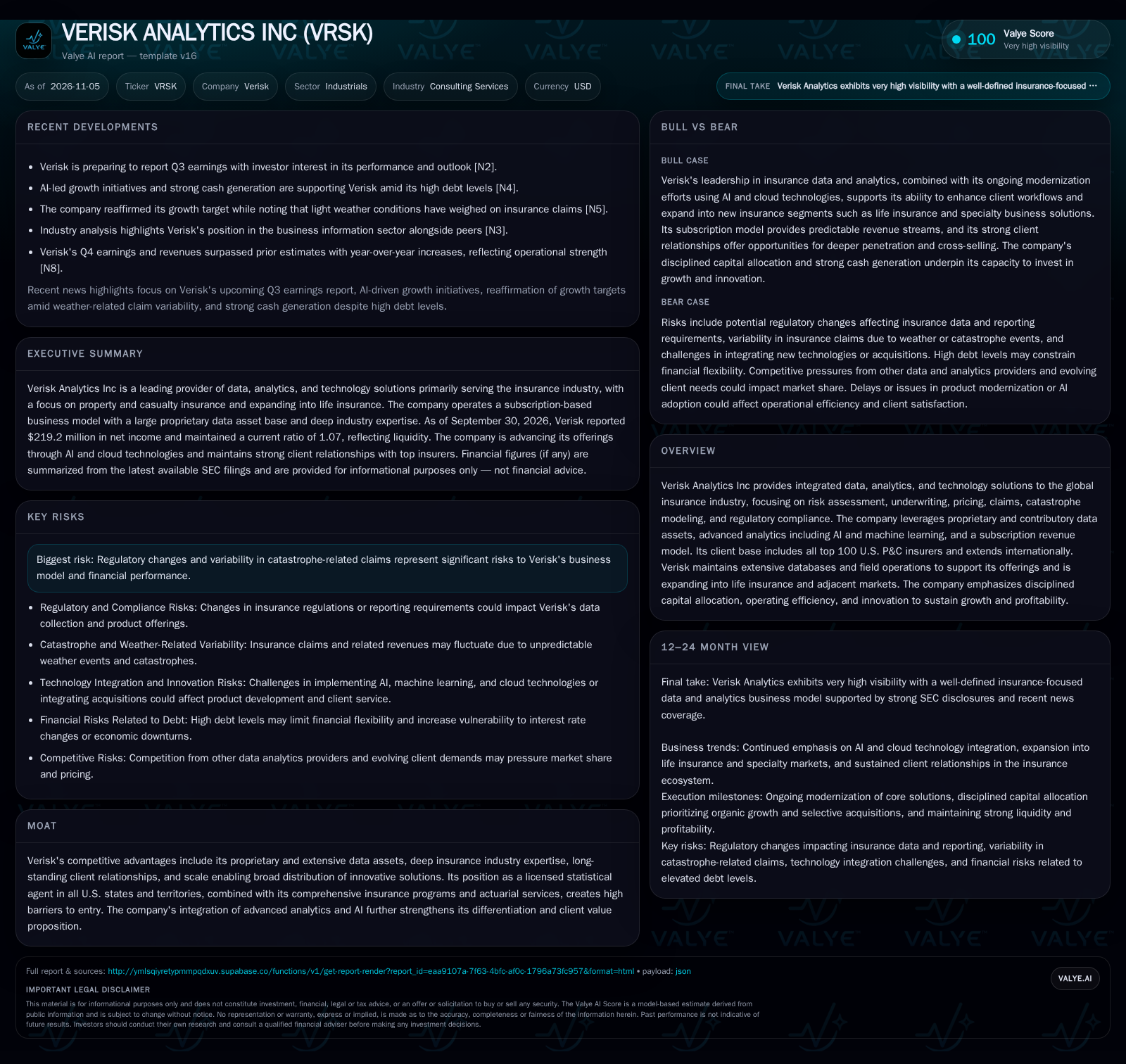
Verisk Analytics’ core strengths—vast proprietary databases, deep client entrenchment, and a subscription-heavy model—anchor stable revenue streams in insurance analytics. Current facts show robust profitability and ongoing AI-enabled modernization, but high debt and regulatory risk could challenge flexibility. The key question is whether Verisk can translate its industry leadership into durable pricing power and new growth vectors amid technology shifts and evolving insurance demands. [S1] [S2] [N4] [N5] [N8]
Verisk Analytics stands at the nexus of insurance data, predictive analytics, and technology-driven workflow transformation. With deep penetration among U.S. P&C insurers and a growing footprint in life insurance analytics, Verisk’s subscription-centric model is built on proprietary data assets and regulatory positioning. While recent financials underscore operational strength and early returns from AI-led modernization, the company’s high debt and exposure to regulatory and catastrophe-driven volatility raise critical questions about its future resilience and growth. The real test is whether Verisk’s entrenched platform can sustain its edge as insurance markets and client needs evolve rapidly.
Recent Performance and Strategic Position: What Has Changed for Verisk?
Verisk Analytics reported net income of $219.2 million for the quarter ended September 30, 2026, with basic and diluted EPS of $1.70. The balance sheet showed $556.8 million in cash and equivalents, current assets of $1.15 billion, and current liabilities of $1.07 billion, resulting in a current ratio of 1.07 and a cash ratio of 0.52. Over 80% of revenue in 2025 came from annual or long-term prepaid subscription agreements, underscoring the resilience of its recurring-revenue engine [S1] [S2].
The company reaffirmed its growth target in late 2026, even as light weather weighed on claims activity, and Q4 earnings and revenues outperformed estimates, reflecting operational momentum [N5] [N8]. At the same time, Verisk’s high debt load remains a persistent feature of its capital structure, and the company continues to emphasize AI-led growth and technology modernization as its primary strategic levers [N4].
How Verisk’s Economic Engine Converts Data Scale into Subscription Revenue
Verisk’s business model centers on monetizing its proprietary insurance data assets through subscription-based analytics, risk assessment, and regulatory workflow solutions. The vast majority of revenue is derived from annual or multi-year prepaid contracts, creating high predictability and visibility in cash flows [S1]. This model typically allows for price escalators, embedded upsell opportunities, and long-term client stickiness, especially given the complexity of client integrations and the regulatory reliance on Verisk’s programs.
Fixed costs include extensive data infrastructure, ongoing technology investment (notably in AI and cloud modernization), and a U.S. field force of about 500 for primary data collection and verification. Variable costs scale with service delivery and incremental product development. The capital intensity is moderate—substantial up-front investment in data acquisition and analytics platforms, but with high incremental margins once the fixed base is in place.
Operating leverage can be significant: incremental revenue from new data modules, analytics upgrades, or additional lines of insurance often drops through at attractive margins. However, the ongoing need for technology reinvestment and regulatory compliance expenses can limit margin expansion if not offset by pricing power or volume growth. The company’s disciplined capital allocation is focused on organic reinvestment, selective acquisitions, and returning excess capital to shareholders, but high debt levels add a layer of financial rigidity [S1] [N4].
Defensibility in Insurance Analytics: Where Verisk’s Moat Is Deepest—and Where It’s Vulnerable
Verisk’s moat is anchored by its proprietary database—nearly 39 billion records—collected over decades and augmented by regulatory mandates and client data contributions [S1]. Its status as a licensed statistical agent in all 50 states and its provision of industry-standard insurance programs further entrench its role as a core infrastructure provider for U.S. P&C insurers. Integration into client underwriting, rating, and claims workflows creates high switching frictions: replacing Verisk would require not only a technical substitute but also regulatory and operational overhaul.
Competition comes from large data analytics firms, niche insurance tech entrants, and increasingly, cloud-native and AI-first platforms that promise lower-cost or more customizable solutions. While barriers to entry are high in the core P&C market due to regulatory complexity and data scale, adjacent segments (life, specialty, international) may be more contestable.
Substitution risk is most acute if insurers or regulators shift toward open data standards, if alternative data sources become viable, or if regulatory requirements evolve to allow more competition. Verisk’s ongoing modernization—embedding machine learning and cloud delivery—aims to reinforce its value, but this is an arms race: the question is whether the company can innovate faster than new entrants or clients’ own analytics teams.
AI Modernization and Cross-Sell: Pathways to Durable Growth and Expanding Margins
A favorable scenario would see Verisk’s investments in AI, machine learning, and cloud-native platforms unlocking new analytics modules, higher-value services, and increased automation for clients. If modernization accelerates workflow integration and enables cross-selling into life insurance and specialty lines, Verisk could drive both pricing power and share-of-wallet gains. The subscription-heavy model would amplify operating leverage as incremental products are layered onto existing contracts.
Confirmation would come from sustained or accelerating revenue growth in new segments, rising average contract value, and margin expansion outpacing technology reinvestment. Evidence would also include increased client adoption of advanced analytics modules, rising attach rates for new products, and news of successful technology rollouts or major cross-segment wins. Conversely, slow uptake of AI-enabled solutions, stagnant contract values, or a lack of new segment traction would challenge this scenario.
Subscription Stability Meets Incremental Innovation: The Most Likely Trajectory
The most plausible path is that Verisk sustains its core P&C analytics franchise, with modest organic growth driven by incremental product enhancements and steady price increases, while technology modernization gradually improves efficiency and client value. Expansion into life insurance and adjacent analytics markets continues but remains a minority of total revenue. The company maintains high renewal rates and broad client entrenchment, but faces ongoing cost pressures from technology reinvestment and regulatory compliance.
The base case would be confirmed by stable or slowly improving margins, continued dominance in U.S. P&C analytics, and measured progress in new segments. Watch for consistent renewal rates, stable average contract duration, and incremental increases in product attach rates. Signs that would falsify the base scenario include material client defections, pricing concessions, or regulatory shifts that erode Verisk’s core data advantages.
Regulatory Shocks, Debt Constraints, and Erosion of Data Advantage: The Adverse Chain
The principal risks stem from regulatory changes that alter data collection/reporting mandates, disrupt Verisk’s role as a statistical agent, or foster new data-sharing requirements that lower barriers for competitors. If insurers are incentivized or required to use alternative analytics providers, or if regulators open the market to more direct or open-source solutions, Verisk’s pricing power and renewal rates could deteriorate.
High debt magnifies vulnerability: a negative shock to cash flow (from regulatory, competitive, or catastrophe-driven volatility) could constrain investment in technology or limit flexibility for acquisitions and shareholder returns. Increased competition from agile, AI-native entrants could also pressure margins and force higher R&D spend just to stay even.
This scenario would be confirmed by loss of core clients, falling renewal rates, margin compression, or adverse regulatory developments. Early warning signs include regulatory proposals targeting data monopolies, increased client churn, and difficulties in executing technology upgrades at scale.
Milestones and Metrics That Will Define Verisk’s Competitive Edge in a Changing Insurance Landscape
Annual and multi-year renewal rates across core P&C and new insurance segments—if disclosed, these would directly track client stickiness and pricing power.
Growth rate and margin profile of AI-enabled or cloud-native analytics modules—rising adoption or outsized margins would validate the modernization thesis.
Average contract value and attach rates for new solutions in life and specialty insurance—evidence of cross-sell success and expansion beyond the core franchise.
Regulatory developments or commentary impacting Verisk’s statistical agent status or data collection mandates—any change here could materially affect the data moat.
Net debt trajectory and interest coverage—monitoring whether high debt constrains capital allocation flexibility or increases risk in a downturn.
Client wins or losses among top 100 U.S. P&C insurers—material defections or major competitive inroads would be early warning signs.
Technology deployment milestones (e.g., cloud migration completion, new AI model launches)—delays or failures would challenge the product modernization story.
Trends in catastrophe-related claim volumes and their impact on insurance client budgets—since these can affect demand for analytics and risk modeling services.
Disclaimer: This is research-only, informational analysis and not investment advice. It may include AI-generated interpretation and general industry context. Always verify important details using primary sources.

Comments