
FS KKR Capital Corp: Credit Quality, Portfolio Defense, and the Stakes of Middle-Market Lending at Scale
FS KKR Capital Corp’s recent earnings volatility and $900 million unsecured notes issuance underscore the balancing act between income generation and risk management in middle-market credit. The company’s defensive portfolio strategy, access to capital markets, and active management are tested by macro headwinds and the structural realities of BDC investing.
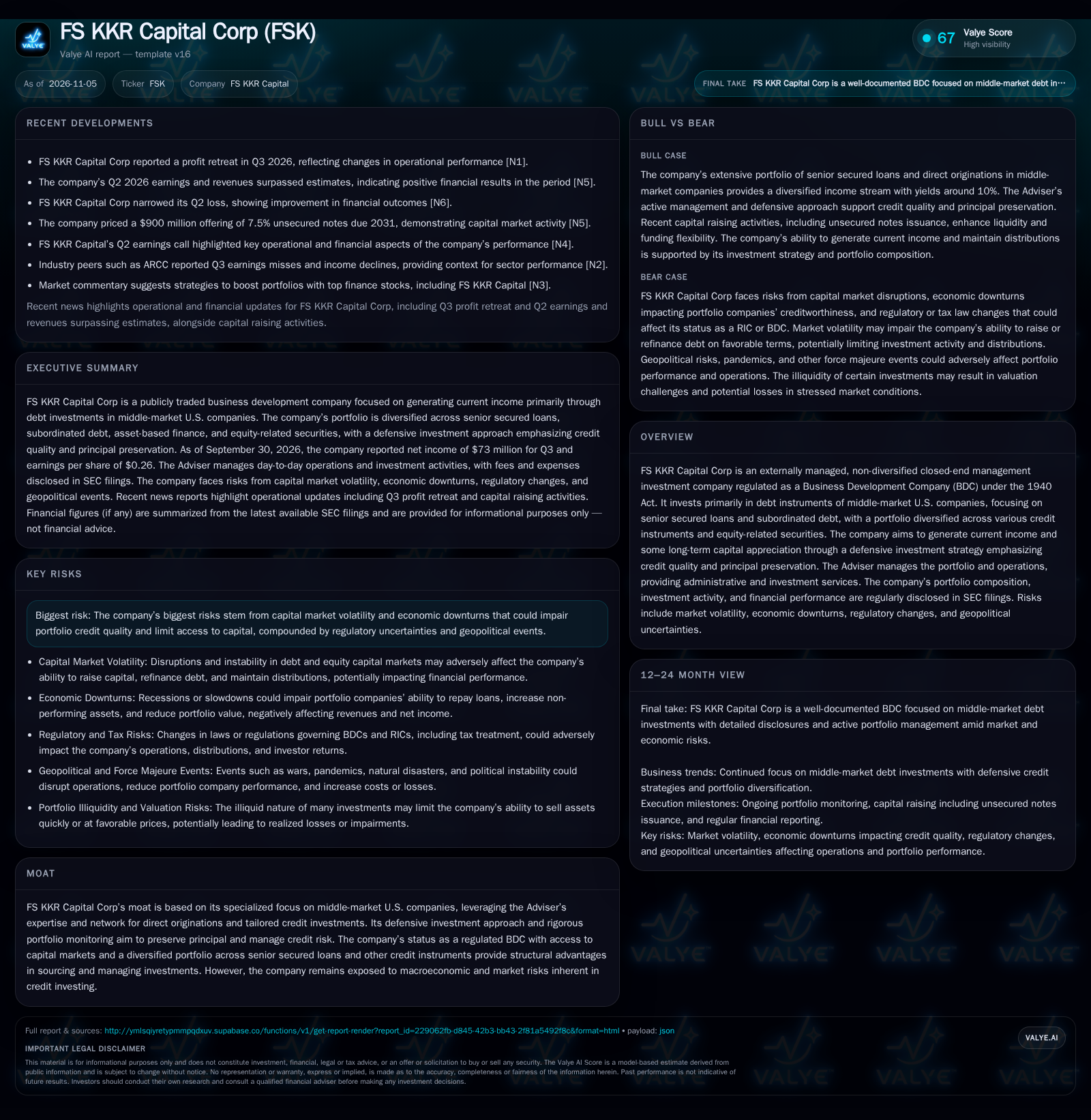
FS KKR Capital Corp, a leading middle-market BDC, reported a Q3 profit retreat after a strong Q2, reflecting earnings volatility amid shifting credit conditions. Recent capital raising via $900 million in unsecured notes highlights ongoing funding activity. The company’s diversified senior loan portfolio and defensive credit focus are central to its strategy but face persistent macro, market, and regulatory risks. The ability to maintain income and preserve principal will hinge on credit quality trends, liquidity management, and the Adviser’s execution.
FS KKR Capital Corp stands as one of the larger business development companies focused on debt investments in U.S. middle-market companies. The company’s recent Q3 profit retreat, following a Q2 period that saw earnings and revenues surpass expectations, highlights the volatility inherent in credit-focused BDCs as economic and capital market conditions shift. The core challenge for FS KKR Capital is to sustain income generation while managing downside risk, as credit quality and macroeconomic trends remain uncertain.
Recent Earnings Volatility and Capital Raising Define the Current Operating Climate
FS KKR Capital Corp reported a profit decline in Q3 2026, reversing the positive momentum from Q2, when earnings and revenues exceeded analyst estimates and the company narrowed its loss [N1] [N5] [N6]. This earnings volatility reflects the sensitivity of BDCs to shifting credit markets and underlying portfolio performance. In parallel, the company completed a $900 million offering of 7.5% unsecured notes due 2031, indicating both the need and ability to access funding beyond traditional bank lines and secured borrowings [N5]. The company reported cash and liquidity metrics for the period; these figures do not by themselves establish operating runway, investment capacity, financial flexibility, or financing capacity. [S2]
How FS KKR Capital Generates Income and the Dynamics of Its Debt-Focused Model
FS KKR Capital’s core revenue engine is the interest income from a diversified portfolio of senior secured loans and subordinated debt investments in middle-market U.S. companies [S2]. The company’s stated focus is on current income, with typical yields in this segment hovering around 10%—reflecting both credit risk and illiquidity premiums. The Adviser’s fee structure and operational costs are layered on top, meaning net income is sensitive to both portfolio performance and expense discipline [S2].
The economics of BDCs like FSK are characterized by moderate operating leverage—fixed costs of management and compliance are material, but scale in portfolio assets can improve margins, provided credit quality holds. Funding is sourced through a mix of equity, revolving credit, and unsecured notes, as evidenced by the recent $900 million capital raise [N5] [S2]. This structure means that net interest margins are tied not just to asset yields, but also to funding costs, which can fluctuate with market conditions. Losses on non-performing loans, credit impairments, or declines in fair value can quickly erode income and capital, especially in downturns [S2].
The company’s ability to maintain its distribution policy (dividends) depends on realized and distributable income, which is contingent on portfolio performance, credit losses, and the cost and availability of capital [S2]. Illiquid investments can complicate liquidity management in stressed scenarios, making proactive capital raising and portfolio monitoring essential.
Middle-Market Credit: Sourcing Advantage, But Vulnerable to Macro and Regulatory Shocks
FS KKR Capital’s competitive edge stems from its scale, the Adviser’s origination network, and its focus on direct lending to middle-market companies—a segment often underserved by traditional banks [S2]. This allows the company to negotiate tailored terms and potentially command higher yields. However, the middle-market is also more exposed to economic downturns, as these businesses generally have less access to capital and weaker bargaining power during stress.
Key competitors include other large BDCs, private credit funds, and, increasingly, institutional lenders seeking yield in a low-rate environment. While FSK’s diversified portfolio and defensive investment approach help manage risk, the company is not insulated from rising default rates, regulatory changes affecting BDC leverage or tax treatment, or a sharp deterioration in capital markets that could constrain funding [S2]. Substitution risk from banks or fintech lenders remains limited in the upper-middle market, but could increase if credit conditions ease or regulation shifts.
The Adviser’s track record and monitoring systems are critical to managing credit risk and sourcing quality deal flow. However, structural advantages are only as durable as the underlying credit cycle and the company’s ability to avoid outsized losses in periods of stress.
If Credit Quality Holds and Funding Stays Accessible, Income Stability and Distribution Continuity Could Follow
The favorable scenario for FS KKR Capital involves a stable or improving macro environment in which portfolio companies continue to service their debt, resulting in low non-accrual rates and limited credit losses [S2]. If the company can sustain high yields on new originations while keeping funding costs in check—particularly after the recent unsecured notes issuance—net interest margins could remain robust.
Confirmation of this scenario would include consecutive quarters of positive net income growth, stable or declining non-accruals, and evidence of continued access to capital markets at reasonable rates. Additional signs would be successful redeployment of capital into high-yielding assets and minimal realized credit losses. Falsification would occur if macro shocks or sector-specific stress cause a spike in defaults or if funding costs rise sharply, compressing spreads and forcing dividend cuts.
Navigating Credit Cycles: Modest Growth, Active Capital Management, and Episodic Volatility
The most plausible trajectory for FS KKR Capital involves continued fluctuations in quarterly profitability, reflecting the ebb and flow of credit markets and portfolio company performance [S2]. The company is likely to sustain a diversified portfolio of senior secured loans, with occasional periods of elevated non-accruals or fair value writedowns during economic or sector-specific slowdowns.
Distributions are maintained but may be adjusted in response to changing income levels or regulatory requirements [S2]. Regular capital raising—through both debt and, if needed, equity—remains a feature of the business model, as does active portfolio rotation. This scenario presumes no systemic credit event, but ongoing sensitivity to external shocks and funding conditions. Confirmation would come from stable credit metrics, recurring access to capital markets, and generally consistent distributions. Falsification would be a sustained loss of access to funding, a sharp rise in portfolio impairments, or regulatory shifts that force structural business changes.
A Credit Downturn or Funding Disruption Could Trigger Losses and Force Distribution Cuts
In a negative scenario, a material economic downturn or sector shock causes a spike in defaults and non-performing loans among middle-market borrowers [S2]. This would drive up non-accruals, reduce interest income, and potentially trigger fair value writedowns across the portfolio. If capital markets seize up or investor appetite for BDC debt weakens, refinancing risk could emerge, especially for unsecured notes and revolving credit lines.
These pressures could force the company to cut its dividend, sell assets at a discount to meet liquidity needs, or even breach asset coverage and regulatory requirements. Confirmation of this scenario would include a sharp increase in non-accruals, realized losses, a decline in net asset value, and difficulty or unfavorable terms in raising new capital. Falsification would require evidence of resilient credit performance and uninterrupted funding access even during broader market stress.
What Will Determine FS KKR Capital’s Resilience in a Shifting Credit Environment?
Quarterly trends in non-accrual rates and realized credit losses—if disclosed—will be critical for gauging portfolio credit quality [S2].
Net interest margin evolution, as affected by changes in asset yields and funding costs, would help test the sustainability of income generation [S2].
Regularity and pricing of capital market transactions, including future unsecured note offerings or equity raises, will indicate ongoing funding access [S2].
Portfolio concentration by sector or borrower size, and any shifts in portfolio mix, would reveal risk exposure and management’s tactical response [S2].
Trends in fair value marks and net asset value per share will reflect market sentiment and underlying portfolio health [S2].
Regulatory or tax changes impacting BDC leverage or RIC status should be monitored for structural business implications [S1] [S2].
Management commentary on credit monitoring, watchlists, and portfolio repositioning—if available—would clarify the Adviser’s proactive risk management [S2].
Disclaimer: This is research-only, informational analysis and not investment advice. It may include AI-generated interpretation and general industry context. Always verify important details using primary sources.

Comments