
Globe Life’s Margin Trajectory: Premium Growth, Underwriting Discipline, and the Stakes of Health Product Expansion
Globe Life’s recent gains in premium income and underwriting margins underscore its disciplined approach in the life and supplemental health insurance markets. The company’s mix shift toward health products, evolving distribution strategies, and reliance on capital-efficient reinsurance frame both its upside and exposure as it seeks to sustain profitable growth.
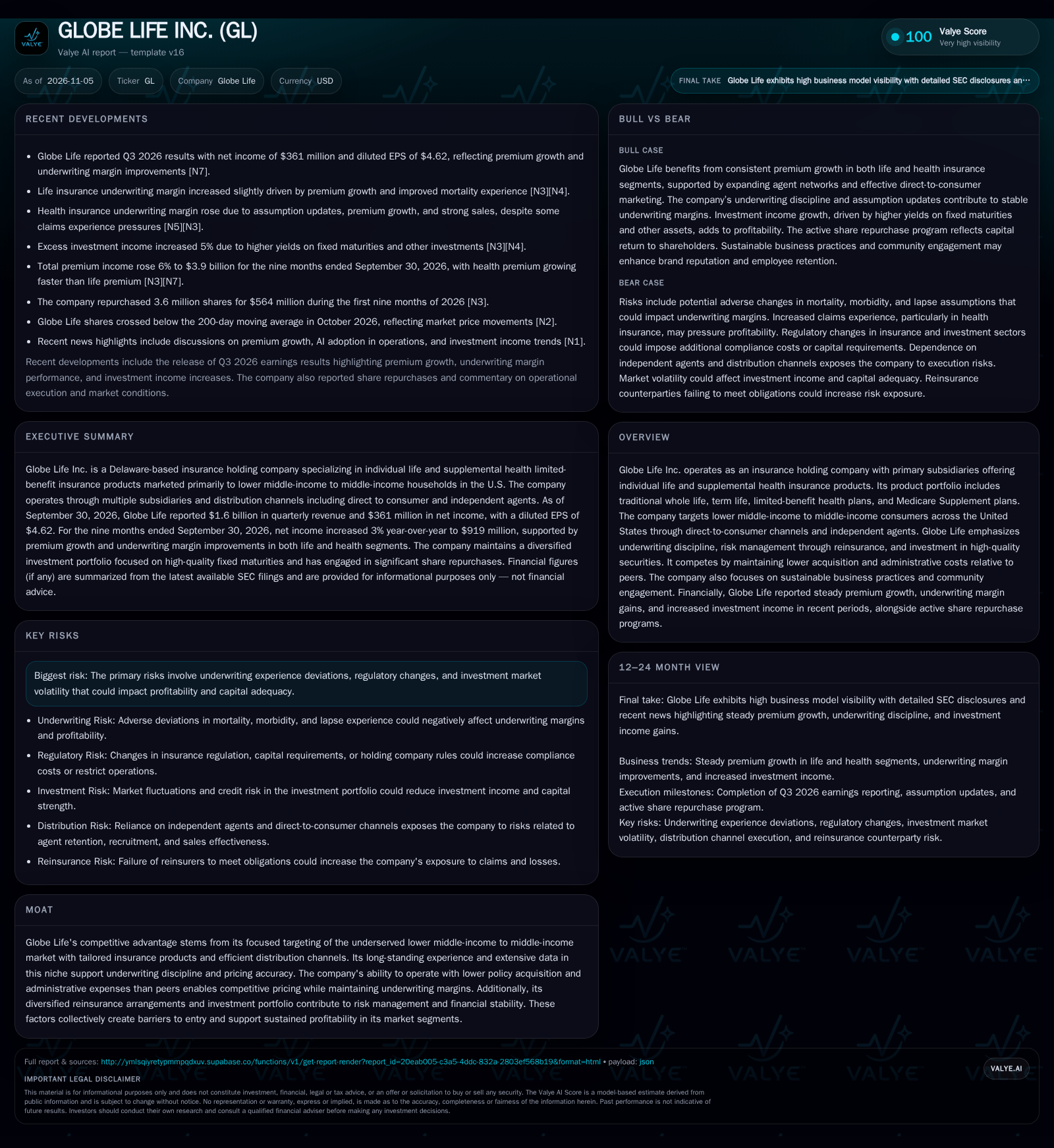
Globe Life reported steady premium growth and improved underwriting margins in both life and health insurance segments for the nine months ended September 30, 2026, with total premium income up 6% and health net sales up 31%. These results highlight the company’s disciplined underwriting, growth in health product sales, and active capital management through share repurchases. The key question is whether Globe Life can maintain underwriting quality and cost advantages as its product and channel mix evolves and as market and regulatory headwinds persist. [S2]
Globe Life Inc. has reinforced its position as a disciplined player in the U.S. life and supplemental health insurance market, with the latest results showing robust premium and net sales growth—especially in health insurance. Improvements in underwriting margin, combined with higher investment yields and ongoing share repurchases, demonstrate management’s focus on operational efficiency and capital discipline. As Globe Life leans further into supplemental health products and adapts its distribution strategy, the durability of its cost advantages and risk management approach will be tested by evolving customer needs, regulatory shifts, and market volatility.
Recent Performance Highlights: Margin Gains and Health Sales Surge
For the nine months ended September 30, 2026, Globe Life reported total premium income of $3.9 billion, a 6% year-over-year increase, with health insurance premium growth (15%) outpacing life insurance premium growth (3%). Net sales grew 10% to $727 million, and health net sales surged 31%, reflecting a strategic emphasis on health products. Underwriting margins improved in both segments: life insurance rose slightly to $1.17 billion, driven by premium growth and improved mortality, while health insurance margin reached $309 million, supported by assumption updates and sales gains. Excess investment income climbed 5% to $113 million, and the company continued active capital return, repurchasing 3.6 million shares for $564 million in the period. [S2]
Revenue Drivers: Product Mix, Distribution, and Margin Levers at Globe Life
Globe Life’s core economics rest on the spread between premiums collected and claims paid, less acquisition and administrative expenses, plus investment income earned on policyholder float. The majority of premium income comes from traditional whole life (71% of life premium in force), but health insurance is growing faster and now represents a substantial share of new sales and underwriting margin. The company’s business model is built for scale, with fixed costs spread over a large policy base and a focus on lower middle-income to middle-income segments, which may offer more stable persistence but also demand pricing discipline.
Distribution relies on a hybrid model: direct-to-consumer for efficiency and exclusive/independent agents for reach. Globe Life claims lower acquisition and administrative expenses than peers, suggesting cost advantages that support margin resilience if maintained. Underwriting discipline—leveraging detailed application reviews, medical data, and reinsurance—helps contain losses and volatility. Investment income is a key profit driver, with 86% of assets in fixed maturities as of December 31, 2025. As rates rise, reinvestment yields improve, but asset-liability matching and credit risk remain ongoing challenges.
Capital needs are shaped by regulatory risk-based capital requirements and the need to support growth. The use of affiliated Bermuda reinsurance subsidiaries for capital efficiency enables Globe Life to optimize surplus and improve returns, though this structure depends on regulatory acceptance and counterparty soundness.
Middle Market Defense: Cost Controls and Specialized Focus
Globe Life’s primary competitive edge lies in targeting the underserved lower middle-income to middle-income market with simple, affordable life and supplemental health policies. This segment is less penetrated by large national insurers, which often prioritize higher-ticket or group policies. Globe Life’s ability to operate with lower policy acquisition and administrative costs than peers enables it to price competitively while sustaining margins.
However, the company competes on multiple fronts: direct-to-consumer specialists, independent agent networks, and digital-first insurtechs all vie for the same customer base. The lack of any dominant single competitor in these markets provides Globe Life with room to maneuver, but also means sustained pressure to innovate on product design, pricing, and service. Substitutes come in the form of group policies through employers, government programs, and emerging digital insurance offerings. The company’s reinsurance arrangements and disciplined underwriting provide a buffer against adverse selection and claims spikes, but any erosion in cost advantage or underwriting quality could materially weaken its position.
Health Product Scaling and Yield Tailwinds as Margin Catalysts
If Globe Life sustains double-digit health insurance sales growth while maintaining underwriting discipline, the mix shift toward supplemental health could drive faster revenue and profit expansion. Health products tend to have higher margins if claims experience and lapse rates are well managed, and the company’s recent assumption updates suggest a proactive approach to pricing and reserving.
Additionally, continued increases in investment yields—without a corresponding spike in credit losses—would further boost excess investment income, compounding the operating leverage from premium growth. The company’s cost advantage, if preserved, could allow it to outcompete rivals even as digital entrants and larger players attempt to penetrate the middle-income market.
Confirmation of this scenario would include sustained or accelerating net sales growth in health products, stable or improving underwriting margins, above-peer return on equity, and evidence of continued cost discipline (such as stable expense ratios). Falsification would come from rising claims ratios, expense creep, or regulatory interventions that erode the economics of supplemental health offerings.
Growth Trends Reflecting Mix Changes and Competitive Dynamics
The most plausible trajectory is moderate premium growth—led by health insurance—alongside stable life insurance sales and persistent, but not expanding, underwriting margins. The mix shift to health products continues, but at a pace that does not materially alter overall risk or profitability. Investment income rises incrementally as higher-yielding assets cycle into the portfolio, offsetting modest pressures from claims volatility and administrative costs.
Distribution remains effective, but increased competition from digital channels and insurtechs puts gradual pressure on acquisition costs and agent productivity. The company continues to return capital through share buybacks, supported by steady net income and regulatory capital adequacy. This scenario would be confirmed by continued mid-single-digit premium growth, stable or slightly improving underwriting margins, and consistent investment income, with no material adverse regulatory or claims shocks.
Claims Volatility and Channel Disruption Pressure Margins
Adverse developments could include a sharp rise in health or life claims, driven by negative mortality/morbidity trends or poor lapse experience, eroding underwriting margins. If the mix shift to supplemental health outpaces the company’s ability to price and underwrite risk, the result could be margin compression or even losses in the health segment.
Distribution risk looms if the exclusive and independent agent channels lose relevance or become costlier, particularly as digital competitors accelerate customer acquisition at lower cost. Regulatory changes—such as new capital requirements for reinsurance structures or limits on supplemental health pricing—could further pressure profitability.
This scenario would be confirmed by a spike in claims ratios, declining underwriting margins, negative operating leverage, and a slowdown in net sales growth. Early warning signs would include rising administrative or acquisition expenses, negative regulatory developments, or evidence of lapses in reinsurance effectiveness.
Assessing Globe Life’s Margin Durability and Growth Potential
Trend in health insurance net sales growth and premium mix—does the company sustain or accelerate health product momentum, and how does this affect overall risk profile?
Quarterly and annual movement in underwriting margins for both life and health segments—are cost advantages and pricing discipline holding up as the mix evolves?
Expense ratio trajectory—does Globe Life maintain its claimed administrative and acquisition cost edge relative to peers?
Investment income yield and credit experience—do higher rates continue to benefit the portfolio without corresponding increases in defaults or impairments?
Lapse and claims ratios, especially in newly originated health policies—are assumptions holding, or is adverse selection emerging?
Distribution channel productivity—are agent recruitment, retention, and sales effectiveness metrics stable amid digital disruption?
Regulatory or rating agency developments related to capital requirements, reinsurance structures, or supplemental health pricing—any signs of tightening or adverse changes?
Share repurchase activity and capital adequacy—does the company continue to return capital without compromising regulatory or business growth needs?
Disclaimer: This is research-only, informational analysis and not investment advice. It may include AI-generated interpretation and general industry context. Always verify important details using primary sources.

Comments