
Kraft Heinz’s Strategic Realignment: Divestitures, Platform Focus, and the Stakes of Margin Recovery
Kraft Heinz’s latest moves—pausing its planned split, divesting North America coffee, and emphasizing emerging markets—reflect a search for sharper portfolio focus and sustainable growth. But with Q3 profits retreating even as revenues and emerging market sales rise, the company’s ability to translate scale and brand strength into margin resilience remains under scrutiny.
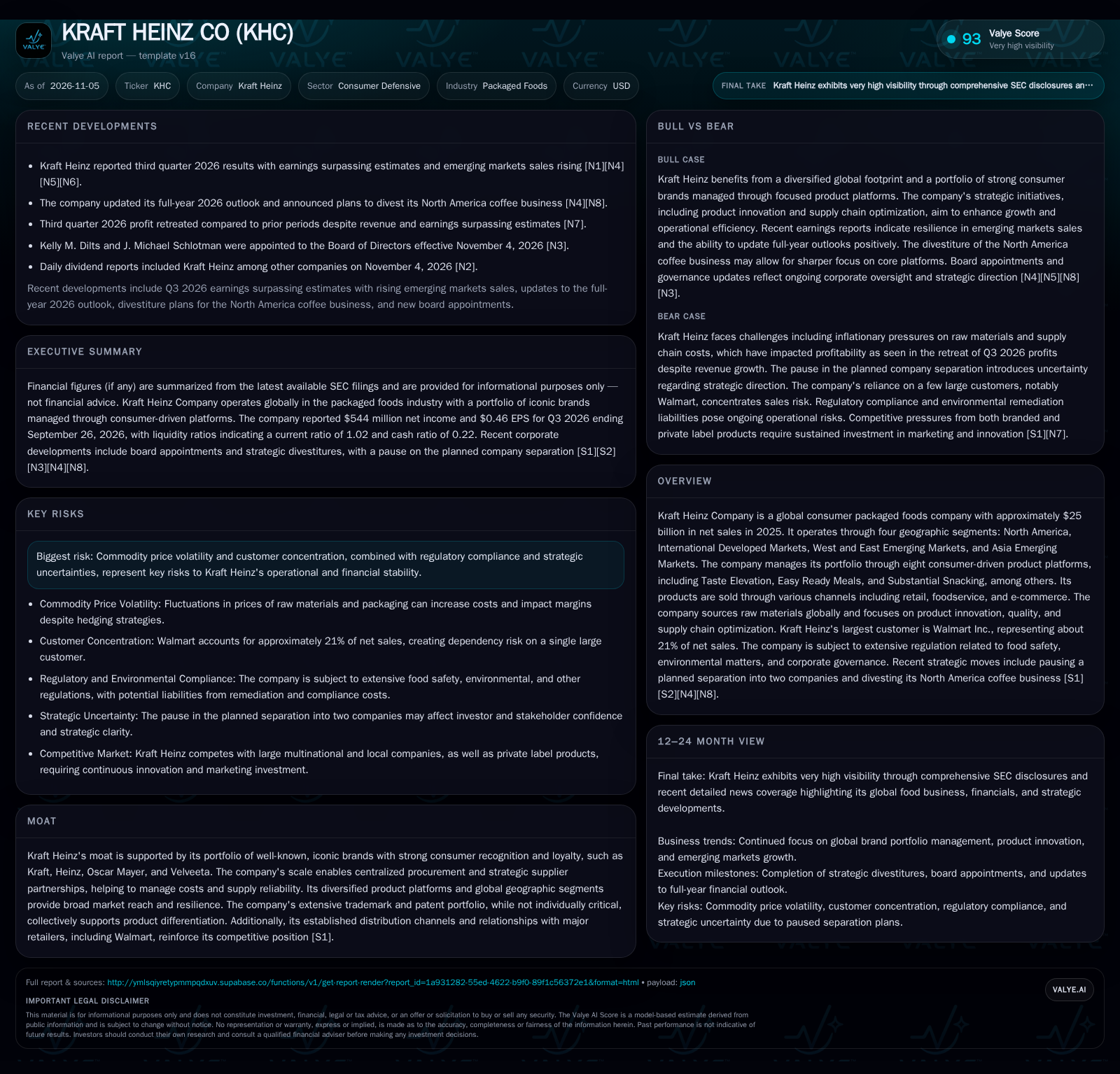
Kraft Heinz is pausing its planned separation, divesting its North America coffee business, and seeing strong emerging markets sales, even as Q3 profits retreat. The company’s $25 billion brand portfolio and global procurement scale are offset by margin pressures and customer concentration risks. The next phase hinges on whether management can drive operational improvements and margin recovery amid intensifying competition and commodity volatility. [S1] [S2] [N4] [N5] [N8]
Kraft Heinz stands at a strategic crossroads. Following a period of portfolio experimentation and operational recalibration, the company has shelved its planned separation into two public entities and is instead divesting its North America coffee business. While Q3 2026 results surpassed top-line estimates and emerging markets sales advanced, profitability retreated, highlighting persistent margin pressures. With iconic brands, global reach, and a tightly managed balance sheet, the question is whether Kraft Heinz can leverage its scale and platform focus to restore earnings momentum—or whether competition, input costs, and customer concentration will continue to erode its operating leverage.
Strategic Pause and Portfolio Shifts Define Kraft Heinz’s Present
Kraft Heinz has halted its previously announced plan to separate into two independent public companies as of February 2026, reversing course on a major structural change and signaling a preference for integrated operations at this stage. At the same time, the company is moving forward with the divestiture of its North America coffee business, which points to a sharpening focus on core platforms and brands. Third quarter 2026 results showed net income of $544 million on basic and diluted EPS of $0.46, but profits declined compared to prior periods even as revenues and earnings outpaced consensus estimates. Notably, emerging markets sales are rising, providing a growth vector amidst mature market headwinds. [S1] [S2] [N4] [N5] [N7] [N8]
The company’s largest customer, Walmart, represented about 21% of net sales in 2025, underscoring significant customer concentration and bargaining power. Recent board appointments—Kelly M. Dilts and J. Michael Schlotman—suggest ongoing governance refreshment, possibly to support execution of the new strategic direction. [S1] [N3]
How Kraft Heinz’s Business Model Converts Scale into Earnings—And Where It Breaks Down
Kraft Heinz generates revenue through the sale of packaged food and beverage products across retail, foodservice, and e-commerce channels worldwide. Its portfolio is organized into eight consumer-driven platforms, each assigned a strategic role (Accelerate, Protect, Balance) that guides resource allocation and capital deployment. Core earnings drivers include brand equity, product innovation, and distribution reach, all underpinned by centralized procurement and global supply chain management. [S1]
The company’s pricing power is uneven: iconic brands like Heinz and Kraft enjoy some insulation from private label competition, enabling selective price increases, but the broader portfolio must compete on promotional intensity and shelf space. Volume growth in mature markets is stagnant, with mix improvements and emerging markets expansion providing incremental upside. Fixed costs are substantial, particularly in manufacturing, logistics, and marketing; as a result, operating leverage is sensitive to both top-line growth and raw material inflation. Commodity cost volatility, especially in dairy, meats, grains, and packaging, can quickly erode margins unless offset by pricing or procurement strategies.
Recent margin pressures—evident in the Q3 2026 profit retreat—highlight the limits of current operating leverage. [S2]
Brand Power Versus Private Label: The Realities of Defending Shelf Space
Kraft Heinz’s competitive strength rests on its portfolio of globally recognized brands—Heinz, Kraft, Oscar Mayer, Velveeta, and others—with deep consumer loyalty and habitual purchase behavior, especially in North America and Western Europe. This brand equity, combined with scale-driven procurement and established distribution relationships (notably Walmart), creates barriers for smaller entrants and some negotiating leverage with retailers. [S1]
However, the packaged foods landscape is intensely competitive, with multinationals, regional players, and private label manufacturers all vying for share. Private label penetration continues to rise, especially as consumers trade down in inflationary environments. Product innovation and marketing are required simply to defend share, not just to grow it. Switching costs for most products are low, meaning sustained shelf presence and promotional activity are critical. The company’s centralized procurement and global supply chain offer some cost advantages, but these are not unique and can be matched by other large players.
Platform management—assigning platforms to Accelerate, Protect, or Balance—may help Kraft Heinz target investment and defend its moats where they are strongest, but this approach is only as effective as execution in product development, supply chain, and channel management. The planned divestiture of North America coffee could sharpen focus, but also reduces category breadth.
Margin Expansion and Emerging Markets: A Path to Reigniting Earnings Growth
If Kraft Heinz can successfully execute on cost discipline, innovation, and targeted platform investment, the company could restore margin expansion even in a low-growth revenue environment. The divestiture of the North America coffee business may allow management to redeploy capital into higher-growth or higher-margin categories, strengthening core platforms and accelerating innovation cycles. Growth in emerging markets—already visible in recent sales trends—could offset stagnation in developed economies, especially if the company localizes products and leverages global brands. [N4] [N5] [N8]
Confirmation of this scenario would include a return to year-over-year profit growth, gross margin expansion, and sustained emerging market sales outperformance. Further, evidence of successful price realization without volume erosion, improved inventory turns, and increased free cash flow generation would indicate that operational improvements are translating into financial results.
Falsification would involve continued margin compression despite divestitures and innovation, or loss of share in core categories due to insufficient marketing or product refreshes.
Incremental Progress Amidst Margin Pressures and Strategic Recalibration
The most plausible outcome for Kraft Heinz over the next 12-24 months is incremental improvement in operating metrics but limited headline growth. The company will likely complete the North America coffee divestiture, redirect resources to core platforms, and continue to see modest revenue growth in emerging markets. Developed market volumes may remain flat or decline, with pricing actions offsetting cost inflation only partially. [N4] [N8]
Profitability could stabilize at lower levels than pre-inflation peaks, with ongoing cost initiatives and supply chain optimization preventing further erosion but not driving dramatic margin recovery. Customer concentration—especially with Walmart—remains a structural risk, limiting pricing flexibility and increasing exposure to retailer pushback. Board refreshment may support tighter governance and incremental strategic shifts, but transformative change is less likely absent new catalysts.
Evidence confirming this scenario would include stabilization of quarterly profits, maintenance of current liquidity ratios, and steady (but not accelerating) emerging markets revenue growth. Falsification would be visible in either a sharp margin rebound (signaling upside) or continued profit declines and share losses (signaling downside).
Commodity Shocks, Retailer Pushback, and the Risk of Margin Compression
The main risk to Kraft Heinz is a combination of sustained commodity price increases and retailer-driven price resistance, especially from Walmart and other major accounts. If input costs rise faster than the company can pass them through, gross margins could compress further, eroding profitability even as revenue holds steady or grows modestly. [S1] [N7]
In this scenario, private label and smaller branded competitors could accelerate share gains, particularly in price-sensitive categories. Execution missteps in the wake of divestitures—such as supply chain disruptions or loss of category leadership—could further pressure results. Regulatory or compliance shocks, or adverse environmental events, would add to operational burdens.
Confirmation would come from further declines in quarterly profits, negative gross margin trends, or evidence of volume losses in core categories.
Benchmarks for Testing Kraft Heinz’s Margin Recovery and Strategic Focus
Monitor quarterly gross margin and operating margin trends for signs of stabilization or further compression.
Track year-over-year profit growth or decline, especially in the wake of the North America coffee divestiture.
Watch emerging markets revenue growth rates—sustained outperformance would support the upside scenario.
Assess changes in customer concentration, particularly Walmart’s share of net sales, for shifts in bargaining power or dependency.
If disclosed, review platform-level performance (Accelerate, Protect, Balance) for evidence of successful resource allocation.
Observe board and executive leadership changes for clues to potential strategic realignment or governance priorities.
A useful metric would be category-specific volume and pricing data to understand the balance between price realization and volume retention.
Disclaimer: This is research-only, informational analysis and not investment advice. It may include AI-generated interpretation and general industry context. Always verify important details using primary sources.

Comments