
Medline Inc.: Prime Vendor Model, Supply Chain Scale, and the Strategic Stakes of Integration in Medical-Surgical Distribution
Medline’s tightly integrated model—spanning manufacturing, vast product breadth, and proprietary logistics—anchors high customer retention and operational leverage, but exposes the company to regulatory, supply chain, and pricing risks as it balances branded growth with third-party distribution.
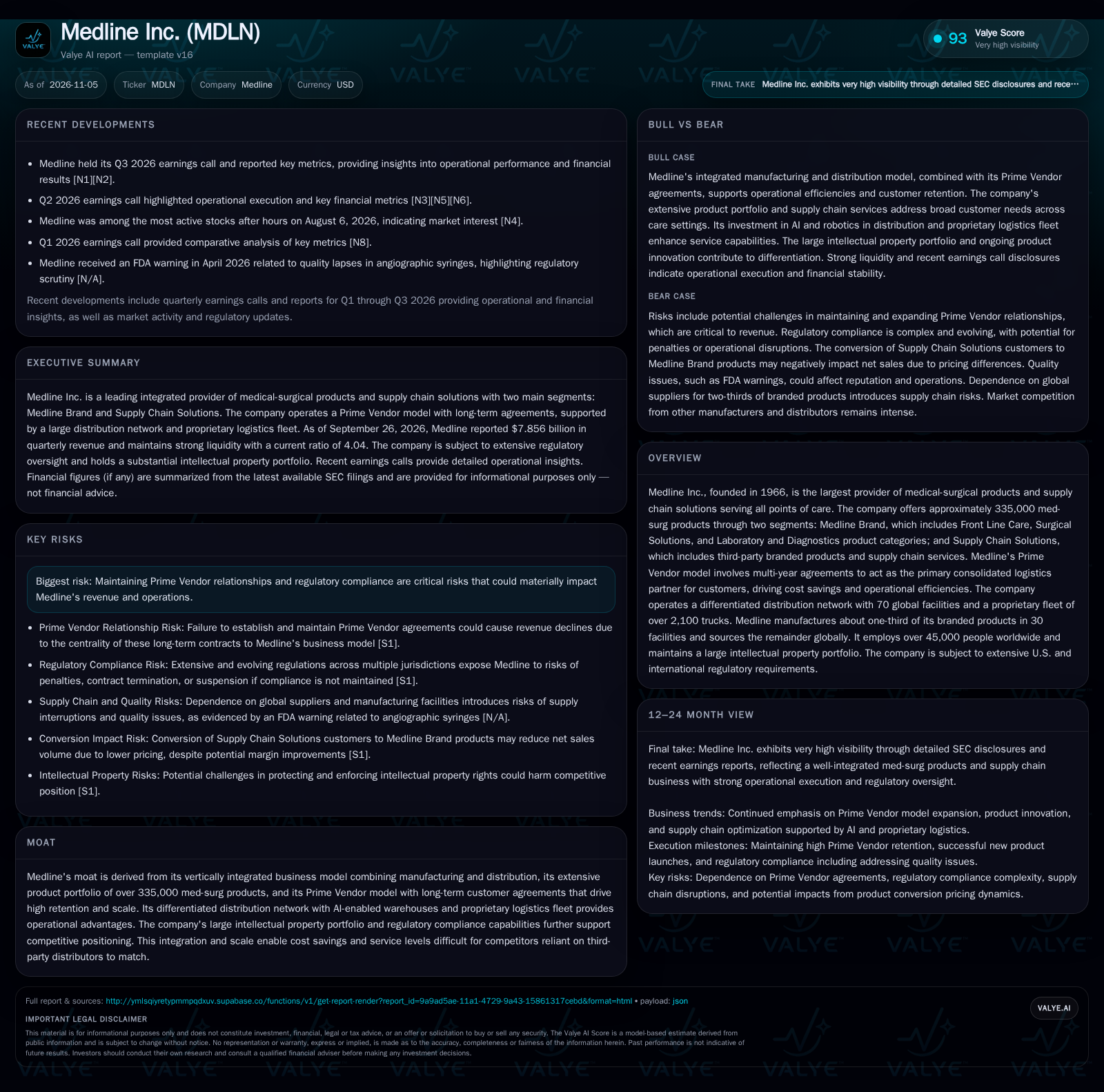
Medline Inc. is the largest provider of medical-surgical products and supply chain solutions, operating with a Prime Vendor model that delivers high customer retention and broad reach across care settings. The company’s scale, AI-enabled distribution, and proprietary fleet support operational efficiency, but its dependence on Prime Vendor relationships, regulatory compliance, and supply chain complexity remain material risks. Recent FDA scrutiny and ongoing conversion dynamics between third-party and Medline Brand products will shape future margin and revenue trajectories. [S1] [S2]
Medline Inc. stands at the intersection of scale, integration, and operational complexity in the medical-surgical supply chain. As the largest provider in its sector, Medline’s business model is anchored by multi-year Prime Vendor agreements, a vast product catalog, and a proprietary logistics infrastructure capable of next-day delivery to nearly all U.S. customers. This operational reach and service reliability have historically underpinned high customer retention and robust growth. Yet, Medline’s leadership also brings heightened exposure to regulatory oversight, supply chain risks, and pricing dynamics as it shifts product mix and manages global sourcing. The company’s ability to sustain its advantages—and avoid pitfalls of scale—will shape its next phase of value creation and competitive positioning. [S1] [S2]
Prime Vendor Contracts, Distribution Scale, and Recent Regulatory Scrutiny: What’s Shaping Medline Now
Medline Inc. currently holds the largest share of the U.S. medical-surgical distribution market, supported by a Prime Vendor model that locks in customers through multi-year agreements, typically spanning five years. This structure has yielded a reported retention rate exceeding 98% over five years, underscoring the stickiness and recurring nature of its core revenue stream. [S1]
The company’s operational backbone is its extensive distribution network—70 facilities globally (45 in the U.S.) and a proprietary fleet of more than 2,100 MedTrans trucks—enabling next-day delivery to 95% of U.S. customers. This logistical scale is further enhanced by the use of AI and robotics in warehouse operations, supporting both speed and efficiency. [S1]
On the financial side, Medline reported $7.856 billion in revenue for the quarter ending September 26, 2026, with cash and equivalents of $2.321 billion and a current ratio of 4.04, indicating a strong near-term liquidity position. [S2]
However, operational complexity has brought regulatory attention: in April 2026, Medline received an FDA warning related to quality lapses in angiographic syringes, highlighting the ongoing risk of compliance lapses in a highly regulated sector.
How Medline’s Integrated Model Drives Revenue, Margins, and Cost Structure
Medline’s economics are fundamentally shaped by its dual-segment structure: Medline Brand (own-manufactured and sourced products) and Supply Chain Solutions (third-party brands and supply chain services). The company’s Prime Vendor model incentivizes hospitals and care providers to consolidate purchasing with Medline, providing cost savings for customers and predictable, high-volume contracts for Medline. This structure enables significant operating leverage: high fixed costs in distribution and logistics are amortized over massive throughput, while variable costs scale with volume.
One-third of Medline Brand products are manufactured in-house, primarily Class I and II medical devices, with the remainder sourced from over 600 global partners. This hybrid approach balances margin capture (through proprietary manufacturing and IP) with breadth and flexibility (via global sourcing). However, the economics of conversion—when Supply Chain Solutions customers shift to Medline Brand products—are nuanced: while Medline Brand sales may offer higher gross margins, they often come at lower price points, potentially reducing net sales even as profitability per unit rises. [S1]
The proprietary logistics fleet and advanced warehousing (AI and robotics) drive efficiency, but also require ongoing capital investment and technology upgrades. The company reported cash and liquidity metrics for the period; these figures do not by themselves establish operating runway, investment capacity, financial flexibility, or financing capacity. [S2]
Medline’s scale allows it to negotiate favorable terms with both suppliers and customers, but the complexity of managing 335,000 SKUs and multi-jurisdictional compliance imposes significant overhead and risk.
Integrated Scale as Moat—But Vulnerable to Regulatory, Supply Chain, and Digital Disruption
Medline’s competitive edge is rooted in its vertical integration: it combines manufacturing, a massive product catalog, proprietary logistics, and long-term customer contracts. This could increase switching costs for customers, as migrating away from the Prime Vendor model would disrupt supply reliability and potentially raise costs.
However, this moat is not unassailable. Competitors—including other national distributors, specialized manufacturers, and logistics-focused entrants—are increasingly investing in digital supply chain solutions, automation, and alternative procurement models. The rise of group purchasing organizations (GPOs), direct-to-provider models, and digital marketplaces could erode traditional distributor advantages by increasing price transparency and lowering switching costs.
Regulatory scrutiny—intensified by recent FDA warnings—can also weaken Medline’s position if compliance issues damage reputation or trigger contract penalties. Additionally, Medline’s dependence on global sourcing for two-thirds of its branded products exposes it to supply chain disruptions, geopolitical risk, and potential cost inflation.
Intellectual property (2,300+ patents) and proprietary brands provide some insulation, but the durability of this advantage depends on ongoing product innovation and effective enforcement.
If Supply Chain Optimization and Brand Conversion Outpace Industry Trends
A favorable scenario for Medline sees the company leveraging its AI-enabled distribution and proprietary logistics to further reduce delivery times, cut costs, and improve service levels—deepening customer reliance and making the Prime Vendor model even more attractive. If Medline can successfully convert a greater share of Supply Chain Solutions customers to higher-margin Medline Brand products without materially eroding net sales, overall profitability and cash flow could rise.
This scenario also assumes successful navigation of regulatory headwinds—proactively addressing quality issues, avoiding further FDA warnings, and maintaining a clean compliance record. Continued investment in new product development and digital supply chain capabilities could yield incremental share gains, especially as health systems seek integrated, tech-enabled partners.
Evidence that would confirm this scenario includes sustained or rising customer retention rates, improving gross/operating margins, and increased penetration of Medline Brand products within existing accounts. New multi-year Prime Vendor wins, successful product launches, and absence of major regulatory setbacks would also support the case.
Prime Vendor Retention Offsets Margin Pressures Amid Regulatory and Supply Chain Complexity
The most plausible trajectory for Medline is one of steady, incremental growth driven by continued high Prime Vendor retention, modest expansion of its product catalog, and ongoing operational investments in logistics and technology. Revenue growth may be tempered by pricing pressures from GPOs and digital channels, as well as by the mixed impact of converting third-party customers to Medline Brand products (potentially lower sales volume but higher margins).
Regulatory and quality risks are likely to remain a persistent management focus, with periodic issues (such as the recent FDA warning) contained without triggering broad operational or reputational fallout.
Confirmation of this scenario would come from stable top-line growth, consistent margin performance, ongoing Prime Vendor renewals, and manageable levels of regulatory and quality incidents. Any material uptick in regulatory penalties, contract losses, or supply chain failures would challenge this outlook.
Breakdown in Vendor Relationships or Regulatory Lapses Undermine Scale Advantages
The adverse scenario is driven by a breakdown in the core Prime Vendor model—whether from contract non-renewals, intensified competition, or procurement model shifts by major health systems. Loss of key accounts would rapidly erode Medline’s scale-driven operating leverage, leaving fixed logistics and distribution costs underabsorbed and crimping margins.
Compounding this, a significant regulatory event—such as a product recall, expanded FDA action, or systemic quality lapse—could lead to contract terminations, penalties, or reputational damage, further weakening customer relationships and supplier confidence. Global supply chain shocks (e.g., geopolitical events, pandemic-driven shortages) could disrupt product availability and spike input costs, especially for the two-thirds of branded products sourced externally.
Evidence supporting a downside trajectory would include a decline in customer retention rates, loss of major Prime Vendor contracts, sharp drops in gross or operating margins, or a string of regulatory or quality-related setbacks. Material supply chain disruptions or working capital strains would also be red flags.
Operational Signals and Strategic Milestones That Will Shape Medline’s Competitive Trajectory
Prime Vendor contract renewal and win rates: Changes in the frequency, size, or duration of new and renewed agreements would directly test the sustainability of Medline’s core model.
Customer retention rates by segment: If disclosed, tracking retention separately for Medline Brand and Supply Chain Solutions would clarify the stickiness and revenue quality across the portfolio.
Gross and operating margin trends: Movements in these metrics—especially in relation to product mix shifts—would reveal the economic impact of conversion from third-party to Medline Brand products.
Incidence and resolution of regulatory actions: The frequency, severity, and remediation of FDA or other regulatory warnings would test Medline’s operational discipline and risk management.
Supply chain resilience metrics: A useful metric would be on-time delivery rates, inventory turns, or supplier concentration, especially during periods of global disruption.
Product innovation pipeline: The pace of new product launches, patent filings, and commercial adoption rates would help gauge the competitive durability of the Medline Brand portfolio.
AI and automation adoption in distribution: Progress metrics on warehouse robotics or logistics AI deployment would indicate ongoing productivity and service-level improvements.
Disclaimer: This is research-only, informational analysis and not investment advice. It may include AI-generated interpretation and general industry context. Always verify important details using primary sources.

Comments