
Arq, Inc.: Regulatory Tailwinds, Customer Concentration, and the Stakes of Operational Execution in Mercury Control
Arq, Inc. is navigating a high-stakes market defined by regulatory mandates for mercury removal in coal-fired power, persistent operational hurdles, and acute customer concentration. Recent profitability and revenue outperformance highlight execution gains, but the business remains exposed to fluctuating coal demand, import price dynamics, and the operational reliability of its production footprint.
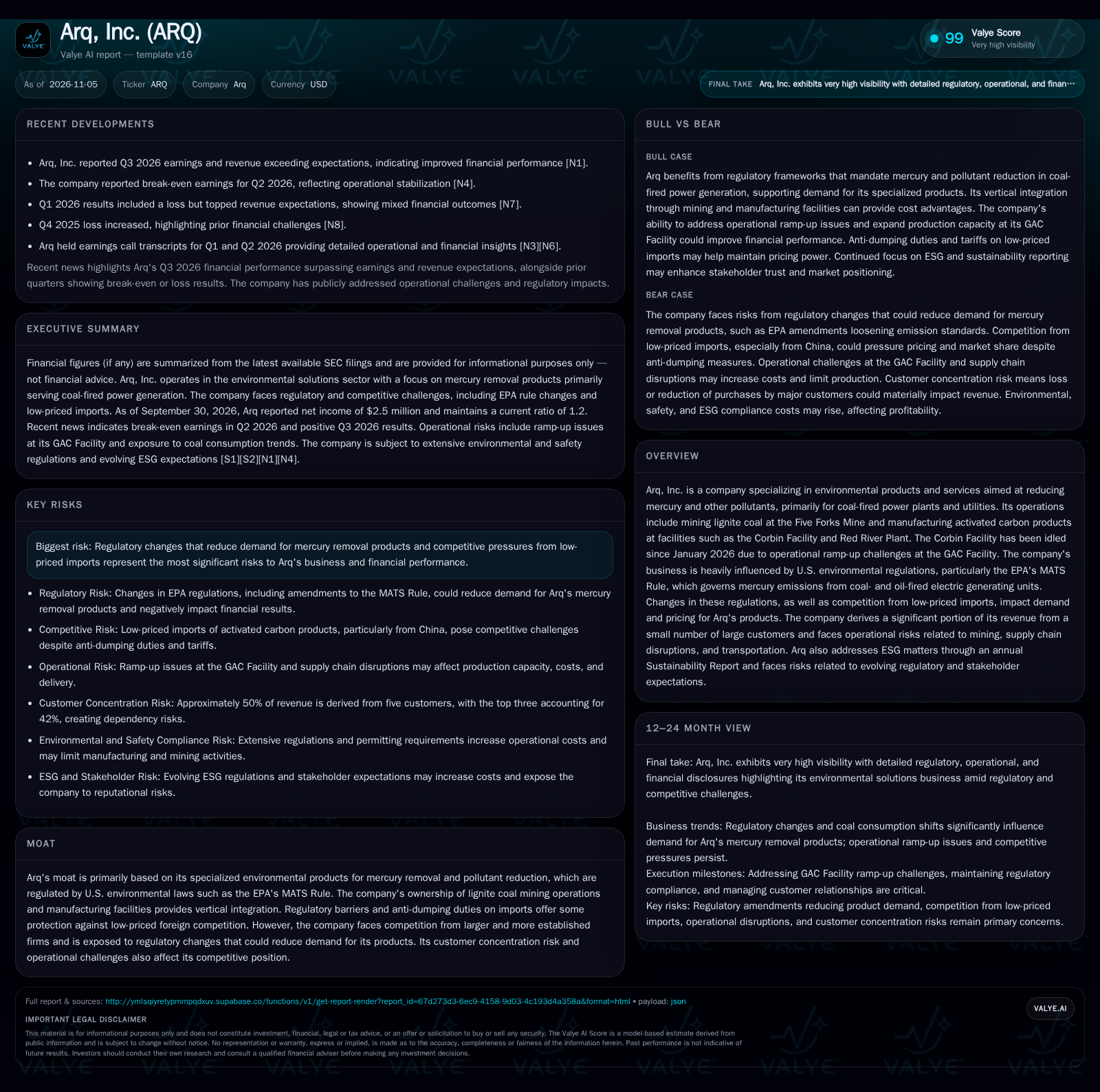
Arq, Inc. exceeded Q3 2026 earnings and revenue estimates, reflecting improvements in operational execution despite an idled facility and continued ramp-up challenges. The company’s reliance on a handful of customers and the ongoing threat of low-priced imports underscore persistent risks, while future performance hinges on regulatory stability and resolving production bottlenecks. [S2] [N1]
Arq, Inc. stands at a critical juncture in the environmental solutions sector, where regulatory mandates and coal-fired power trends directly shape its market opportunity. Q3 2026 profitability signals progress on execution, but the company’s fortunes are tightly bound to a concentrated customer base, volatile coal demand, and its ability to resolve operational bottlenecks at key facilities. As regulatory scrutiny on mercury emissions persists, Arq’s success will depend on maintaining production reliability, navigating import competition, and securing durable customer relationships in a market facing both structural headwinds and policy-driven tailwinds.
Recent Profitability, Facility Status, and Customer Exposure: What’s Changed for Arq?
Arq, Inc. reported net income of $2.5 million and basic/diluted EPS of $0.06 for Q3 2026, reversing a pattern of prior losses and beating consensus estimates. This marks a notable shift in operational performance compared to break-even Q2 2026 results and previous quarters of red ink. [S2] [N1] [N4]
The company’s Corbin Facility has been idled since the start of 2026, a direct result of ongoing ramp-up challenges at its GAC Facility. This reduction in available capacity has implications for both cost structure and revenue scalability. [S2]
Customer concentration remains acute: approximately 50% of 2025 revenue came from just five customers, with the top three accounting for 42%. This concentration amplifies revenue volatility and bargaining risk if any large customer reduces purchases. [S1]
Arq’s business continues to be shaped by the EPA’s Mercury and Air Toxics Standards (MATS) Rule, which governs demand for its mercury removal products. Any regulatory shift—tightening or loosening standards—could directly impact market size and pricing. [S1]
How Arq’s Revenue Engine Works: Regulatory Demand, Capacity Leverage, and Cost Dynamics
Arq’s core business model is anchored in supplying activated carbon and related products that enable coal-fired utilities to comply with mercury emission regulations. Demand is fundamentally regulatory-driven: as long as the EPA’s MATS Rule remains stringent, utilities must invest in mercury control, supporting a baseline of addressable demand. However, the company’s exposure to the coal-fired power sector creates a double bind: while regulation supports its market, declining coal generation in North America could gradually erode the customer base.
Arq’s vertical integration—owning both mining and manufacturing assets—has the potential to improve cost control and responsiveness. However, this also increases operational leverage: fixed costs are relatively high, and disruptions at facilities (such as the GAC Facility ramp-up issues) can quickly swing margins negative.
Pricing power is conditional. Anti-dumping duties on Chinese imports offer some buffer, but global commodity pricing for activated carbon and potential oversupply from abroad can cap margins. The company’s limited customer base could mean pricing negotiations are customer-driven, especially if competitors are able to undercut on price or if regulatory enforcement is inconsistent.
Operating leverage may work in Arq’s favor if the GAC Facility can reliably scale output, converting fixed costs into incremental margin. Conversely, persistent production bottlenecks or underutilization could keep margins thin or negative.
Competitive Landscape: Specialized Solutions Meet Import Pressures and Regulatory Barriers
Arq competes in a niche but highly regulated segment of the environmental solutions market, where the primary alternatives are other activated carbon suppliers and, potentially, alternative mercury control technologies. The most direct competitive threat comes from low-priced imports, particularly from China, which are subject to anti-dumping duties but still exert downward pressure on pricing. [S1]
The company’s moat is partially regulatory: EPA mandates create entry barriers for unproven or non-compliant suppliers, and anti-dumping measures help level the playing field. However, these protections are only as durable as the underlying regulations and trade policy.
Larger, more diversified competitors may enjoy economies of scale, broader product portfolios, or greater customer reach. Arq’s vertical integration provides some cost and supply security, but its smaller scale and concentrated customer base are strategic vulnerabilities.
Switching costs for utility customers are likely moderate: while qualifying new suppliers can be time-consuming due to regulatory compliance, price remains a key driver, and utilities may switch if competitors offer lower-cost or more reliable solutions.
What Could Drive Sustained Outperformance? Regulatory Certainty and Operational Turnarounds
A favorable scenario for Arq would be characterized by continued or tightening EPA mercury regulations, ensuring stable or growing demand for its core products. If the company successfully resolves ramp-up issues at the GAC Facility and brings the Corbin Facility back online, it could leverage fixed cost absorption, improving gross margins and overall profitability.
Further, if anti-dumping duties are maintained or strengthened, and if low-priced imports are effectively kept at bay, Arq could see improved pricing stability. Expansion of its customer base—reducing concentration risk—would also provide more predictable revenue streams.
Confirmation of this scenario would include: several consecutive quarters of positive net income and margin expansion; disclosure of new or renewed multi-year customer contracts; evidence of increased facility utilization rates; and regulatory signals that reinforce the need for mercury control in coal-fired generation.
Falsification would occur if: regulatory rollbacks reduce the compliance burden for utilities; GAC Facility issues persist or worsen, leading to further capacity underutilization; or if customer concentration increases due to lost accounts.
Stabilization with Ongoing Volatility: Navigating a Narrow Channel
The most plausible scenario is a continuation of current dynamics: Arq remains profitable but exposed to quarterly volatility due to dependent customer relationships, operational reliability issues, and coal demand trends. The company manages to keep its head above water with the current regulatory regime in place, but growth is constrained by the slow secular decline of coal-fired generation and persistent import competition.
Marginal improvements in operational execution—such as incremental gains in facility throughput or modest customer wins—are offset by the ongoing risk of losing a major customer or facing unexpected regulatory or supply chain shocks.
This scenario would be confirmed by a pattern of modest profitability or break-even quarters, with cash and liquidity metrics remaining stable but not improving significantly. Customer concentration would remain high, and facility utilization would show only gradual improvement. Regulatory environment would remain largely unchanged.
It would be falsified if either a major regulatory change (positive or negative) or a significant operational breakthrough/shortfall altered the current balance.
How Could Things Unravel? Regulatory Rollbacks, Customer Loss, and Persistent Operational Strain
The bear case is driven by one or more of the following: a loosening of EPA mercury rules, a significant loss or reduction in purchases by a major customer, continued or worsening ramp-up problems at the GAC Facility, or a new wave of low-priced imports overwhelming anti-dumping protections.
In this scenario, Arq would face declining demand, shrinking margins, and underutilized capacity, with fixed costs becoming an increasing drag on profitability. Customer losses would be especially acute given the high concentration, potentially leading to negative operating leverage and cash burn.
Watch for: reported contract losses or non-renewals; negative cash flow trends or rising current liabilities; regulatory signals of relaxed mercury standards; or further facility downtime or impairment charges.
The downside would be confirmed by several consecutive quarters of losses, sharp declines in revenue, further facility idling, and a deteriorating liquidity position. Falsification would require visible stabilization or reversal of these trends.
Milestones and Metrics That Will Test Arq’s Mercury Control Thesis
Facility utilization rates at the GAC Facility and any updates on the reactivation of the Corbin Facility; higher throughput would indicate operational progress.
Quarterly revenue concentration by customer—if disclosed; a reduction in the share of revenue from the top three/five customers would signal diversification.
Gross margin trends and cost per unit of activated carbon produced, if disclosed; margin expansion would suggest improved operational leverage.
Updates on EPA MATS Rule enforcement or amendment activity, as any regulatory relaxation would directly threaten demand.
Volume and pricing trends for activated carbon imports, especially from China; a surge could pressure Arq’s pricing power.
Disclosure of new multi-year contracts or wins outside the current customer base, which would reduce revenue volatility.
Cash flow from operations and changes in working capital—persistent negative trends would be a warning sign.
Progress on ESG and sustainability reporting, as regulatory and stakeholder scrutiny on environmental performance increases.
Disclaimer: This is research-only, informational analysis and not investment advice. It may include AI-generated interpretation and general industry context. Always verify important details using primary sources.

Comments