
Cytokinetics: Navigating Commercial Launch, Royalty Complexity, and Clinical Expansion in Cardiac Therapeutics
Cytokinetics stands at a pivotal moment as MYQORZO commercialization and aficamten’s pivotal trials proceed alongside a layered capital structure. The company’s future hinges on clinical outcomes, market adoption, and the careful management of royalties and debt.
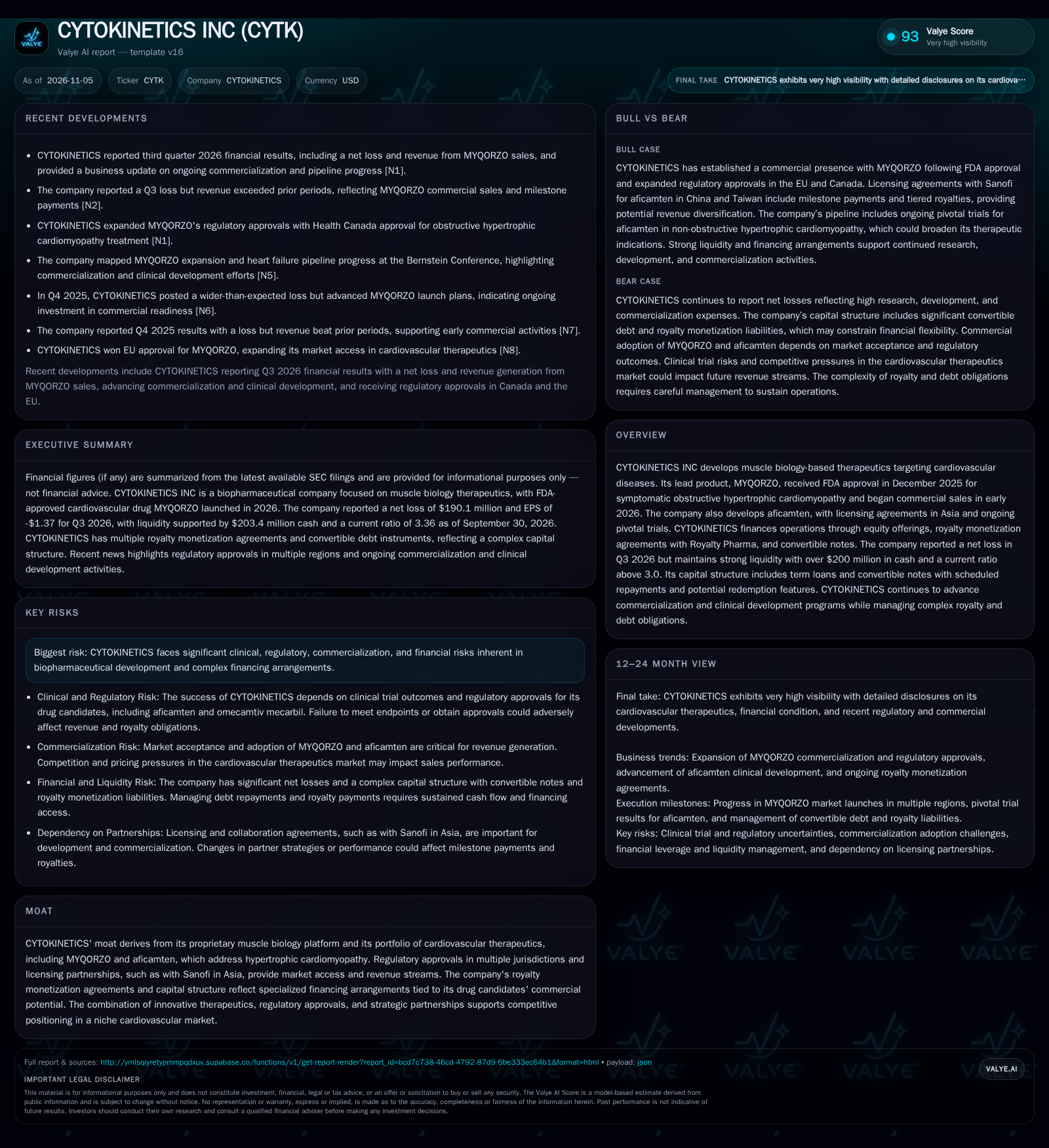
Cytokinetics is advancing MYQORZO commercial sales and aficamten pivotal trials while operating with a complex mix of royalty monetization, convertible debt, and licensing deals. Execution on commercialization, clinical progress, and effective management of royalty/debt obligations will determine future value. [S2] [N1] [N2]
Cytokinetics is at a critical juncture as it transitions from a development-focused biopharma to a commercial-stage company with MYQORZO’s launch and aficamten’s pivotal clinical trials. Backed by over $200 million in cash but encumbered by net losses and substantial royalty and debt obligations, the company’s near-term fate depends on the interplay of clinical progress, commercial execution, and adept capital management. The next 12–24 months will reveal whether Cytokinetics can convert scientific promise and global partnerships into sustainable value amid the high-stakes landscape of cardiovascular therapeutics.
MYQORZO Sales, Aficamten Trials, and the Weight of Capital Structure
As of September 30, 2026, Cytokinetics reported $203.4 million in cash and a current ratio of 3.36, indicating a reported liquidity position. However, the company continues to report net losses in the most recent quarter, despite generating revenue from MYQORZO commercial sales and milestone payments. The launch of MYQORZO marks Cytokinetics’ shift into commercial operations, while aficamten is progressing through pivotal trials targeting non-obstructive hypertrophic cardiomyopathy (nHCM). The company’s capital structure is layered with $750 million in convertible notes (due 2031), term loans, and royalty monetization agreements with Royalty Pharma, resulting in ongoing repayment and royalty obligations. Licensing agreements, particularly with Sanofi for aficamten in China and Taiwan, offer milestone and royalty payment potential but also introduce dependency on partner execution. [S2] [N1] [N2]
The interplay between Cytokinetics’ capital structure and its operational execution is critical to understanding its potential financial flexibility. The convertible notes and term loans impose fixed repayment obligations that reduce cash available for reinvestment, particularly in R&D and commercial scaling. This dynamic necessitates prioritizing near-term revenue-generating activities to service debt while balancing long-term pipeline development. Moreover, the royalty monetization agreements, while providing upfront liquidity, create a recurring obligation that can constrain free cash flow as sales grow. The company’s ability to optimize this capital structure—potentially through refinancing or renegotiation—will be pivotal in maintaining operational agility amid evolving market conditions and clinical milestones.
How Cytokinetics’ Revenue Model and Cost Base Could Evolve
Cytokinetics’ revenue streams are transitioning from a reliance on milestone payments and licensing fees to include direct product sales, beginning with MYQORZO. As a specialty biopharma, gross margins on such therapeutics are typically high, but the fixed costs of commercialization—sales infrastructure, launch marketing, and post-market studies—are substantial. The company’s cost base remains dominated by R&D and commercial readiness expenses, driving continued net losses as of Q3 2026. Variable costs are likely to scale with product uptake, but achieving operating leverage will require significant revenue growth from MYQORZO and, eventually, aficamten. Royalty monetization agreements provide upfront liquidity at the expense of future royalty streams, effectively trading long-term passive income for near-term funding. Convertible debt and term loans add interest expense and potential dilution, with debt covenants and repayment schedules that must be managed carefully. If MYQORZO and aficamten achieve broad adoption, the product mix could gradually shift toward recurring revenue, but this is contingent on regulatory success and market acceptance.
The transition from milestone-driven to product-driven revenue introduces complexity in forecasting financial performance, as product sales are subject to market dynamics such as physician adoption rates, payer reimbursement policies, and competitive pressures. Fixed commercialization costs create a high operating leverage environment, where incremental revenue growth can disproportionately improve profitability. However, this leverage is double-edged: if sales ramp slower than expected, the company may face sustained losses exacerbated by fixed expenses and debt servicing. Additionally, the trade-off inherent in royalty monetization—sacrificing future passive income for immediate capital—may limit long-term margin expansion. Strategic decisions around reinvesting cash flow into expanding the sales force or accelerating pipeline development will significantly influence the cost-revenue balance and timing of profitability.
Assessing Differentiation in a Crowded Cardiac Therapeutics Market
Cytokinetics operates in the intensely competitive market for cardiovascular therapeutics, facing both established pharmaceutical companies and emerging biotech rivals. Its differentiation hinges on its proprietary muscle biology platform and the clinical performance of MYQORZO and aficamten. These drugs target hypertrophic cardiomyopathy, a space with significant unmet medical need but also active development by other firms. The company’s ability to secure licensing partners—such as Sanofi for Asian markets—demonstrates some validation of its science and global reach. However, the presence of royalty monetization and licensing deals means a portion of future revenue is already committed, reducing the net benefit from successful commercialization. Competitive threats include alternative therapies, generic entrants, and advances in cardiac care from both drug-based and device-based approaches. Sustained differentiation will depend on clinical data, payer acceptance, and the ability to execute in both U.S. and ex-U.S. markets.
Cytokinetics’ proprietary muscle biology platform provides a scientific moat, but sustaining competitive advantage requires continuous innovation and differentiation beyond initial product approvals. The cardiovascular therapeutics market is characterized by rapid technological evolution and shifting treatment paradigms, including gene therapies and personalized medicine approaches. Success will depend not only on clinical efficacy but also on payer acceptance and real-world evidence generation to demonstrate value over existing therapies. The licensing partnerships, while expanding geographic reach, introduce execution risk and revenue-sharing complexities that dilute the company’s direct control and margins. Navigating these factors effectively will require robust commercial strategies and adaptive R&D pipelines to maintain relevance in a dynamic competitive landscape.
What Success Looks Like: Pivotal Data, Market Uptake, and Royalty Leverage
In an optimistic scenario, Cytokinetics delivers positive pivotal data for aficamten in nHCM, leading to regulatory approvals and rapid market adoption. MYQORZO sales ramp up faster than anticipated, driving revenue growth and operational leverage as fixed commercialization costs are absorbed over a larger sales base. Licensing milestones from Sanofi and other partners provide additional non-dilutive funding, while the company successfully manages royalty and debt repayment schedules. The royalty monetization agreements, while reducing future upside, are outweighed by the scale of product sales and new licensing opportunities. Evidence confirming this scenario would include strong MYQORZO sales growth, clear regulatory wins for aficamten, milestone payments received, and a visible improvement in operating cash flow. Conversely, slow uptake, clinical setbacks, or missed milestones would challenge this thesis.
Execution Meets Headwinds: Incremental Growth and Financial Tradeoffs
The most plausible near-term path is one of incremental progress: MYQORZO sales grow steadily but require ongoing investment in physician education and market access. Aficamten’s pivotal trials progress on schedule, but regulatory and payer hurdles delay broad adoption. Revenue from MYQORZO and milestone payments from partners help offset, but do not eliminate, net losses as the company continues to invest in pipeline and commercial infrastructure. Royalty and debt obligations consume a portion of gross profits, limiting potential financial flexibility and delaying the inflection to profitability. Evidence supporting this outcome would include moderate MYQORZO sales growth, ongoing net losses despite revenue gains, and continued reliance on external funding or financial engineering to manage obligations. Major positive or negative surprises in clinical results, market adoption, or financing would shift the scenario either way.
Adverse Outcomes: Clinical Setbacks and Strained Capital Structure
In a negative scenario, aficamten fails to achieve pivotal trial endpoints or faces regulatory delays, sharply reducing future revenue potential. MYQORZO sales underperform due to competition, payer resistance, or slower-than-expected physician adoption. With net losses persisting and a meaningful share of future revenue already pledged to royalty holders and debt service, Cytokinetics is forced to seek additional dilutive financing or restructure obligations, further pressuring shareholders. Dependency on licensing partners becomes a vulnerability if partner performance falters or milestones are missed. Confirmation of this risk would come from clinical trial failures, revenue shortfalls, or signs of financial distress such as high-interest refinancing, covenant breaches, or unfavorable restructuring.
Milestones and Metrics That Will Shape Cytokinetics’ Next Chapter
Quarterly MYQORZO sales growth as reported, indicating commercial traction and market adoption.
Updates on aficamten pivotal trial progress, including patient enrollment rates, interim data, and regulatory feedback.
Milestone and royalty payments received from Sanofi and other partners, reflecting execution on licensing agreements.
Trends in net operating cash flow, especially as commercialization expenses and royalty/debt service obligations scale.
Disclosure of future royalty payment schedules and the net economic impact of monetization agreements (if provided).
Debt covenant compliance and any refinancing or redemption actions related to the convertible notes and term loans.
Updates on R&D pipeline progress and new clinical indications, which could diversify future revenue streams.
Any changes in competitive landscape, such as new product launches or clinical data from peer companies, that could impact MYQORZO or aficamten adoption.
Disclaimer: This is research-only, informational analysis and not investment advice. It may include AI-generated interpretation and general industry context. Always verify important details using primary sources.

Comments