
Albemarle’s Lithium and Bromine Engine: Reserves, Profitability, and the Stakes of Resource Access
Albemarle’s return to profitability in Q3 2026, underpinned by robust lithium and bromine production, spotlights both the resilience and the vulnerabilities of its resource-driven model. The company’s global asset base and joint ventures provide volume scale, but exposure to commodity prices and government contracts shape the path forward.
Albemarle posted a strong Q3 2026 rebound, swinging to a $297 million profit on $1.55 billion of revenue, fueled by lithium and bromine extraction across global sites. Its current ratio and cash position are solid, but the company remains sensitive to commodity prices and dependent on government contracts for key resources. The real question: Can Albemarle sustain earnings momentum if lithium prices or regulatory terms shift?
Albemarle Corporation’s Q3 2026 performance marks a pivotal moment: a swing back to profitability on the strength of its global lithium and bromine extraction operations. The company’s asset base—spanning joint ventures in Australia, brine resources in Chile and the U.S., and bromine sites in Jordan and the States—delivers both scale and exposure. How these forces interact will determine whether the current profit momentum is durable or fleeting.
Q3 Profit Recovery and Asset Base: What’s Changed for Albemarle?
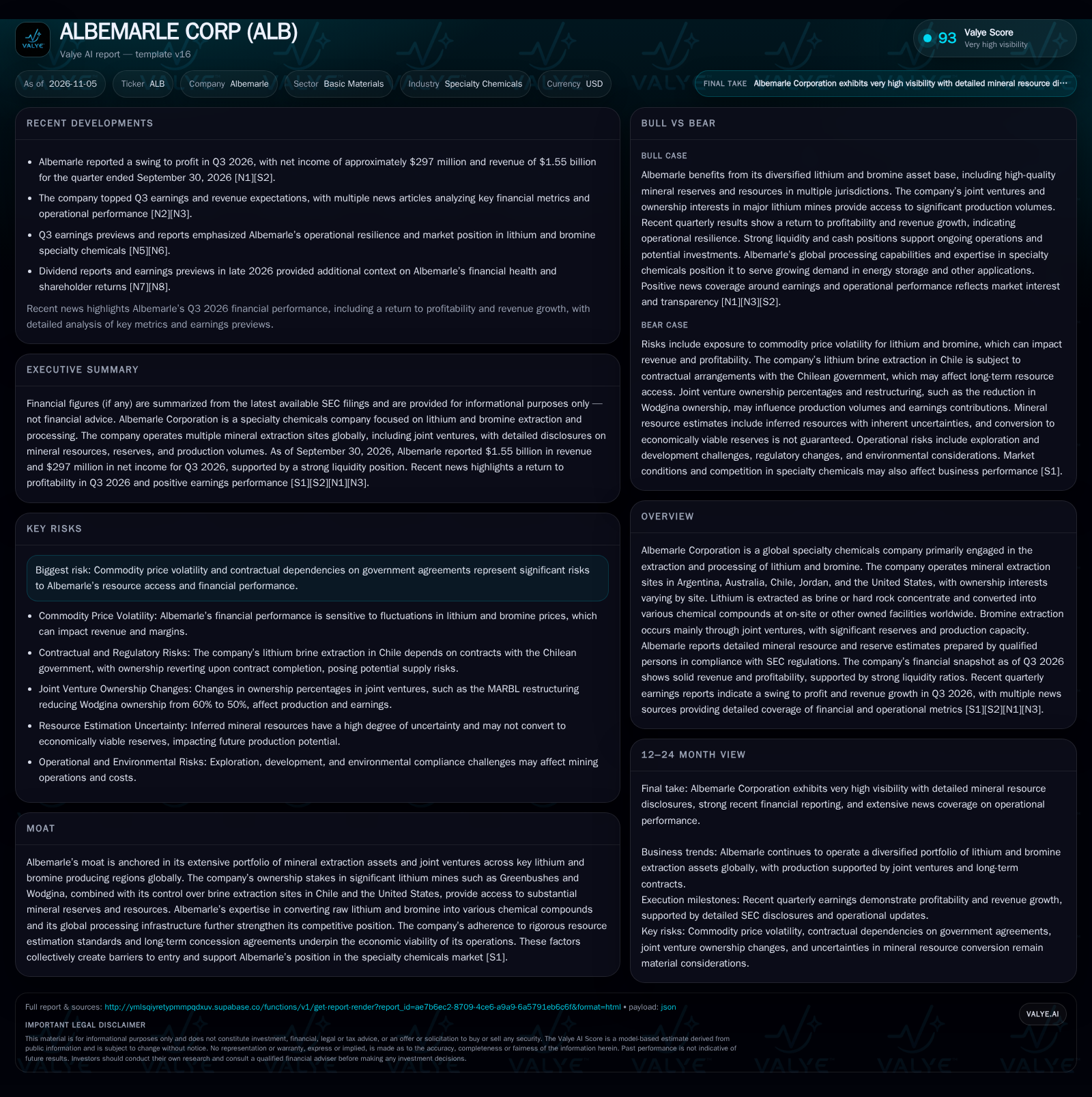
Albemarle reported net income of approximately $297 million and revenue of $1.55 billion for Q3 2026, reversing prior period losses and surpassing expectations according to multiple news sources [N1] [N3] [S2]. This profitability rebound is notable given recent industry volatility and highlights Albemarle’s ability to leverage its diversified asset portfolio. The company’s operational footprint includes significant lithium and bromine production capacity: in 2025, attributable lithium metal output was about 42,000 metric tonnes from Australia, Chile, and the United States, while bromine production stood at 126,000 metric tonnes from facilities in Jordan and the U.S. [S1].
As of September 30, 2026, Albemarle held $1.85 billion in cash and reported liquidity-ratio trends of 2.34, positioning the company with a reported liquidity position buffer [S2]. However, the company’s lithium brine extraction in Chile is subject to government contracts, with resource ownership reverting to the state at contract end—a structural exposure that could affect long-term supply security [S1]. These facts set the stage for Albemarle’s current financial strength, but also underscore its dependency on external factors beyond immediate operational control.
How Albemarle’s Value Chain and Earnings Engine Actually Work
Albemarle’s economics are fundamentally tied to the extraction, processing, and sale of specialty chemicals—primarily lithium and bromine. The company’s revenue mix is heavily weighted toward lithium, driven by global demand for batteries, energy storage, and electric vehicles. Pricing in these markets can be highly volatile, translating directly into revenue swings since sales are often indexed to prevailing commodity prices or negotiated via medium-term contracts. Bromine, though less volatile, is used in flame retardants and industrial applications, providing some diversification.
Operating leverage in this model is significant: fixed costs are high due to the capital intensity of mining and processing infrastructure, but incremental production generally carries high contribution margins if capacity is well utilized. This means that volume growth or price increases can drive outsized earnings gains, as seen in the Q3 2026 results. Conversely, a downturn in lithium prices or production hiccups can compress margins rapidly.
Capital requirements for Albemarle remain substantial, as resource development, exploration, and capacity expansions are ongoing necessities to maintain or grow output. Joint ventures help mitigate some capital intensity and risk, but also share economics with partners. Importantly, the company’s ability to convert mineral resources into proven and probable reserves—subject to technical, regulatory, and environmental hurdles—will determine the sustainability of its production and earnings over time.
What Anchors Albemarle’s Position—and What Could Undermine It?
Albemarle’s competitive position is underpinned by its global portfolio of mineral assets and joint ventures in key resource geographies. Controlling or co-owning interests in world-class lithium deposits like Greenbushes (Australia) and Salar de Atacama (Chile) provides volume scale and some insulation from supply shocks. The company’s expertise in chemical processing and vertical integration—from resource extraction to compound conversion—creates operational synergies and cost efficiencies that are difficult for new entrants to replicate.
However, Albemarle faces meaningful counterforces. First, it is exposed to competition from other multinational specialty chemical firms and emerging lithium producers, especially as new projects come online in South America, Australia, and Africa. Second, technology risk looms: advances in battery chemistry or alternative materials could dampen lithium demand growth or shift pricing power. Third, regulatory risk is acute—especially in Chile, where government policies and contract terms can reshape cost structures and resource access. Finally, the joint venture model, while risk-sharing, also means Albemarle does not retain full upside from production increases at its largest mines.
If Lithium Demand Stays Strong and Contractual Access Holds, What Could Go Right?
The most favorable scenario for Albemarle is a sustained or accelerating demand environment for lithium, driven by robust EV and energy storage adoption, coupled with stable or rising lithium prices. In this world, Albemarle’s integrated asset base and processing capacity could deliver outsized earnings growth as incremental volume and price gains flow through to the bottom line. If bromine markets remain steady, they would provide additional margin stability.
Confirmation of this scenario would require evidence of continued high utilization at major extraction sites, expansion of proven and probable reserves (especially as inferred resources are converted), and maintenance or extension of favorable government contracts—particularly in Chile. Successful execution on expansion projects, stable joint venture relationships, and a lack of major regulatory or environmental disruptions would further bolster the case.
Falsification would come from signs of contract renegotiation risk, unexpected production shortfalls, or a rapid decline in lithium pricing outpacing cost flexibility.
Sustainable Earnings with Cyclical Swings: The Most Likely Trajectory
The most plausible path for Albemarle is one of continued profitability but with earnings cycling alongside lithium and bromine price fluctuations. Demand for lithium is likely to remain structurally elevated, but price volatility may persist as new supply enters the market and as battery technology evolves. Albemarle’s diversified asset base and joint venture structure should enable it to weather moderate price and volume swings, provided operational discipline is maintained.
Key confirming evidence would include steady production volumes, conversion of mineral resources into reserves to offset depletion, and ongoing compliance with environmental and regulatory requirements. The renewal or extension of key contracts (especially in Chile) without materially adverse terms would also support the base case. Conversely, a sustained drop in lithium prices, resource conversion disappointments, or step-changes in government policy impacting resource access would signal downside risk.
Resource Access and Price Shocks: How Albemarle Could Lose Momentum
The adverse scenario for Albemarle centers on a combination of lithium price declines and disruptions to resource access—most notably, unfavorable changes to government contracts in Chile or technical obstacles in converting mineral resources into economic reserves. In this event, revenue and margins would contract sharply, and the fixed-cost structure could drive disproportionate earnings declines.
Additional downside triggers could include delays or cost overruns in expansion projects, environmental or regulatory sanctions, or a breakdown in key joint venture relationships leading to lower attributable production. Evidence confirming this scenario would be announcements of contract disputes, downward revisions to reserve estimates, or significant shortfalls in quarterly production and earnings relative to expectations.
Developments That Will Test Albemarle’s Earnings Durability
Quarterly reported production volumes for lithium and bromine, with site-level granularity if disclosed, to gauge operational continuity and capacity utilization.
Updates on the conversion rate of measured and indicated resources into proven and probable reserves, particularly at flagship sites.
Announcements regarding renewal, renegotiation, or expiration of key government contracts, especially for Chilean lithium brine extraction.
Trends in average realized selling prices for lithium and bromine—whether indexed to spot, fixed, or negotiated contracts, if disclosed.
Capital expenditure guidance and project updates on new extraction or processing capacity, including joint venture developments.
Any regulatory, environmental, or legal actions impacting major production sites or reserve access.
Changes in joint venture structures or ownership percentages that could alter Albemarle’s share of production or economics.
Quarterly cash flow from operations and capex outflows, to assess whether reported liquidity position persists through commodity cycles.
Disclaimer: This is research-only, informational analysis and not investment advice. It may include AI-generated interpretation and general industry context. Always verify important details using primary sources.

Comments