
Brand Licensing Expansion Meets Regional Divergence in Interparfums’ Fragrance Model
Interparfums Inc. leverages exclusive licensing deals with high-profile brands to drive global fragrance sales, but its recent results highlight the importance of geographic balance and ongoing portfolio renewal. The company’s operational transparency, recent brand additions, and reported balance sheet position underpin its position, yet reliance on licensing and regional volatility remain core strategic variables.
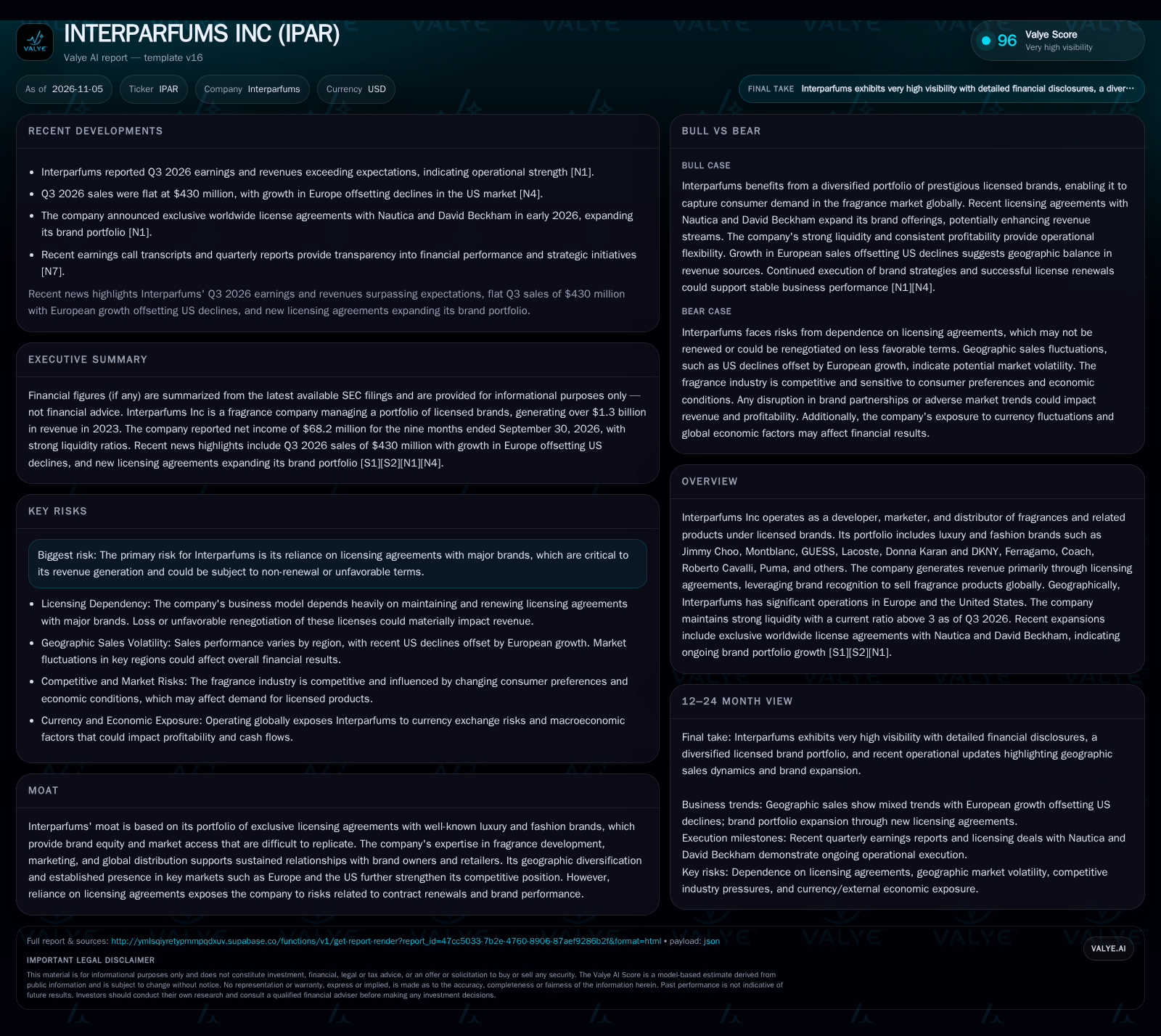
Interparfums’ Q3 2026 results and recent license wins with Nautica and David Beckham underscore its growth-through-portfolio strategy and operational discipline. While European sales growth offset US declines, geographic divergence and licensing dependency continue to shape risk and opportunity. [S2] [N1] [N4]
Interparfums Inc. is navigating a complex landscape where the strength of its luxury and fashion brand portfolio is both its engine for growth and a source of vulnerability. With Q3 2026 results showing European momentum counterbalancing US softness and new licensing agreements with Nautica and David Beckham, the company’s growth formula remains intact. However, its heavy reliance on licensing, exposure to regional market swings, and the need for continuous brand renewal are central to both its upside potential and risk profile as it seeks to maintain global relevance in the fragrance sector. [S2] [N1] [N4]
Recent Results Highlight European Resilience and Licensing Momentum
Interparfums reported flat Q3 2026 sales at $430 million, with growth in Europe offsetting declines in the US, spotlighting ongoing regional divergence in consumer demand [N4]. This geographic split is material given the company’s reliance on both markets for scale and stability.
Net income for the nine months ended September 30, 2026, reached $68.2 million, with EPS of $2.13, signaling sustained profitability even amid mixed top-line trends [S2].
The company expanded its portfolio through exclusive worldwide license agreements with Nautica and David Beckham in early 2026, reinforcing its strategy of growth through new brand partnerships [N1].
The company reported cash and liquidity metrics for the period; these figures do not by themselves establish operating runway, investment capacity, financial flexibility, or financing capacity.
How Interparfums Converts Brand Equity Into Revenue Streams
Interparfums’ economic engine centers on licensing agreements with globally recognized fashion and luxury brands, granting the company exclusive rights to create, market, and distribute branded fragrances. The company pays royalties and minimum guarantees to licensors, with gross margins shaped by the mix of brand, geographic channel, and the terms of each agreement.
Pricing power is typically tied to the prestige of the underlying brand and the perceived value of the fragrance portfolio. Volume is influenced by the reach of global distribution networks and the ability to activate brands through launches, line extensions, and targeted marketing campaigns.
Variable costs are largely driven by production, royalties, and promotional investments, while fixed costs include R&D, corporate overhead, and minimum royalty commitments. Operating leverage can materialize when new launches or incremental sales flow through a largely fixed cost base, but this leverage is partly constrained by the ongoing need to invest in marketing and maintain brand cachet.
The business requires ongoing capital to fund working capital cycles—especially around major launches—and to secure new licenses, which sometimes involve upfront payments or minimum royalty guarantees.
Brand Portfolio as Both Moat and Exposure in a Crowded Fragrance Landscape
Interparfums’ primary competitive advantage comes from its portfolio of exclusive licensing agreements with established luxury and fashion brands. These relationships provide access to consumer mindshare and retail channels that are difficult for smaller or unlicensed competitors to replicate.
However, this moat is inherently fragile: licenses are time-bound and subject to renewal or renegotiation, and licensors may demand higher royalties or choose different partners if performance lags. The company competes against both independent fragrance houses and vertically integrated luxury conglomerates, many of which have greater scale or direct brand ownership.
Switching frictions for licensors are moderate: while there are costs and risks in moving to a new fragrance partner, high-performing brands have options. For Interparfums, the ability to consistently execute launches, manage brand equity, and deliver on minimum guarantees is critical to retaining and renewing licenses.
Technology substitution risk is low in this sector, but the company faces ongoing pressure from evolving consumer preferences, new entrants, and the marketing muscle of larger rivals. The breadth and renewal cadence of its brand portfolio are thus key to maintaining relevance and negotiating power.
Portfolio Expansion and Geographic Recovery Drive Outperformance
A favorable outcome for Interparfums would see the successful integration and activation of new licenses—such as Nautica and David Beckham—translating into incremental sales and improved operating leverage. If European growth persists and US sales stabilize or rebound, the company could achieve high-single-digit revenue growth and margin expansion as new launches scale through existing distribution.
Confirmation of this scenario would include accelerating sales from recently acquired brands, visible growth in US market data, and upward EPS revisions in subsequent quarters. Renewals or extensions of major licenses on favorable terms, combined with continued geographic diversification, would further validate the thesis.
Falsification would involve weak early performance from new brands, persistent US declines, or evidence of margin compression due to higher royalty burdens or promotional costs.
Mixed Regional Trends and Ongoing License Churn Shape Steady-State Outcomes
The most plausible near-term trajectory for Interparfums is moderate top-line growth, with European sales providing a buffer against slower or declining performance in the US. The company is likely to continue layering in new brands, offsetting natural churn in its licensing portfolio.
Operating margins could remain stable if the company manages royalty and promotional expenses, but there is limited room for significant margin expansion without a US recovery. The brand renewal cycle will remain a constant, with periodic renegotiations introducing both opportunity and risk.
This scenario would be confirmed by flat-to-modest sales growth, stable net income, and regular announcements of new or renewed licensing agreements. Evidence of persistent geographic divergence or a failure to materially move the needle with recent brand additions would reinforce the base case.
License Disruption and Regional Weakness Erode Franchise Value
The primary risk to Interparfums is the loss or unfavorable renegotiation of key licenses, resulting in the loss of high-margin revenue streams and diminished negotiating leverage with retailers and distributors. A scenario where US declines intensify, European growth stalls, and new brands underperform could drive both top-line and margin contraction.
Currency volatility and macroeconomic shocks could further squeeze profitability, especially if minimum royalty guarantees become burdensome in a weaker sales environment. The company could be forced to increase promotional spending or accept less favorable licensing terms to retain brands.
This scenario would be confirmed by a decline in the number or quality of major licenses, rising royalty expense ratios, negative operating leverage, or a deterioration in liquidity as the company seeks to bridge performance gaps.
Milestones That Will Test Interparfums’ Brand Strategy and Regional Execution
Sales growth and mix by geography—especially whether US declines can be reversed or European gains sustained—will be a leading indicator of demand resilience.
Revenue and margin contribution from new licenses such as Nautica and David Beckham, if disclosed, would clarify the impact of portfolio expansion.
Renewal or extension of major licensing agreements, as well as the terms secured, will signal brand-owner confidence and the sustainability of the company’s model.
Gross margin trends, particularly around major launches and in the context of royalty and promotional expense, would help test the thesis.
Changes in working capital needs or minimum guarantee commitments, if disclosed, could highlight financial strain or operational flexibility.
Currency impact disclosures and hedging effectiveness, if provided, would be relevant given the company’s global footprint.
Quarterly earnings call commentary on competitive dynamics, consumer preference shifts, or channel performance would provide qualitative signals.
Disclaimer: This is research-only, informational analysis and not investment advice. It may include AI-generated interpretation and general industry context. Always verify important details using primary sources.

Comments