
Cushman & Wakefield: Recurring Revenue Shield, Transactional Exposure, and the Stakes of Global Scale
As Cushman & Wakefield retires debt and surpasses Q3 2026 expectations, the company’s stability increasingly hinges on recurring service contracts, differentiated technology investment, and talent depth—while its transactional segments remain vulnerable to market cyclicality and shifting client priorities.
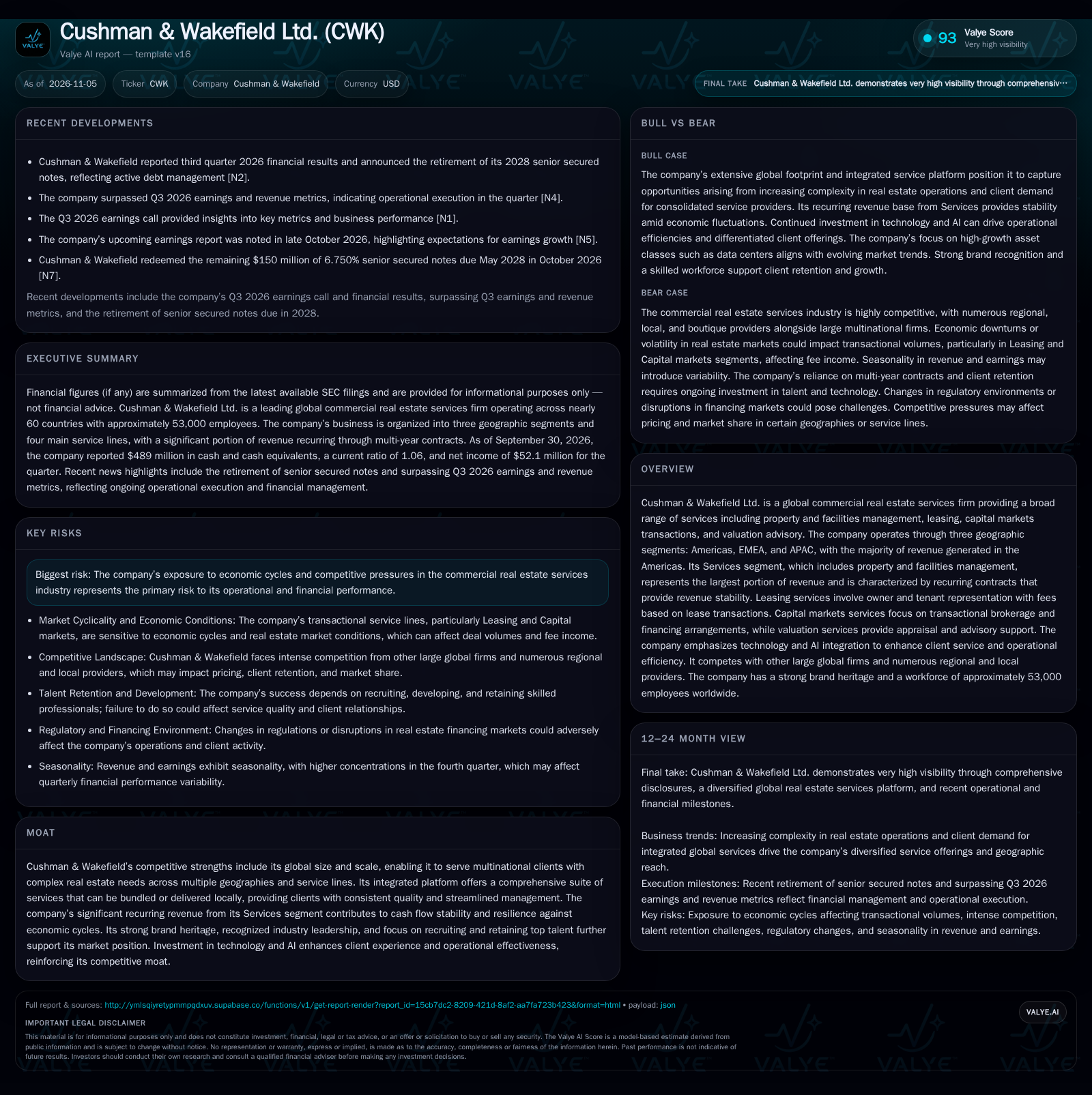
Cushman & Wakefield’s Q3 2026 results highlight the firm’s operational execution and active debt management, with net income of $52.1 million and a strengthened balance sheet after redeeming $150 million in senior notes. The firm’s Services segment, driven by multi-year contracts, provides a recurring revenue base that helps buffer against real estate market volatility. However, the Leasing and Capital markets lines remain cyclical, exposing the company to variable fee income tied to transaction volumes. Competitive dynamics and ongoing investments in technology and talent will shape future margin and growth outcomes. Monitoring the mix of recurring versus transactional revenue, talent retention, and evidence of technology-driven differentiation will be central to evaluating the durability of Cushman & Wakefield’s global platform. [S2] [N2] [N4] [N7]
Cushman & Wakefield, one of the world’s largest commercial real estate services firms, is navigating a complex landscape shaped by global scale, a large recurring-revenue base, and exposure to cyclical transactional markets. The firm’s Q3 2026 results—marked by net income growth and the retirement of $150 million in senior notes—underscore disciplined financial management and operational execution. However, the real test for investors lies in how the company balances the stability of its Services segment against the volatility inherent in Leasing and Capital markets, all while leveraging technology and talent to sustain competitive advantage. The next phase will hinge on whether recurring revenues can offset transactional swings and whether strategic investments translate into tangible client and margin gains. [S2] [N2] [N4] [N7]
Recent Financial Moves Signal Stability but Highlight Persistent Cyclical Exposure
Cushman & Wakefield reported net income of $52.1 million for Q3 2026, with basic and diluted EPS of $0.22 per share, reflecting an uptick in operational performance. The company also redeemed the remaining $150 million of its 6.750% senior secured notes due May 2028, demonstrating active debt management and a reduction in future interest obligations. The balance sheet as of September 30, 2026, shows $489 million in cash and a current ratio of 1.06, indicating broadly neutral short-term liquidity. The firm’s Services segment—anchored by multi-year, recurring contracts—now constitutes 66% of 2025 revenue, while Leasing and Capital markets, both more sensitive to market cycles, together make up 29%. These facts set the stage for a business model that is increasingly defensive but not immune to cyclical shocks. [S2] [N2] [N4] [N7]
Recurring Revenue Anchors, Transactional Volatility, and Margin Leverage Dynamics
Cushman & Wakefield’s economic engine is powered by a mix of recurring and transaction-driven activities. The Services segment—covering property management, facilities management, and related services—generates predictable, multi-year revenues and provides baseline cash flow stability. These contracts are often structured with annual escalators or service add-ons, which can modestly enhance margins and provide some inflation pass-through, although price sensitivity and client renegotiation are ongoing risks.
In contrast, Leasing and Capital markets revenues are inherently variable, tied directly to transaction volume and market sentiment. Fees in Leasing are typically calculated as a percentage of rent over the lease term, while Capital markets fees are based on transaction value and paid at deal close. This introduces significant operating leverage: when transaction volumes rise, incremental revenue often flows at high margin due to relatively fixed operating costs in these segments. However, in downturns, operating leverage works in reverse, compressing margins and exposing the business to rapid profit swings.
Capital intensity is moderate, as the firm’s largest investments are in talent, technology, and client relationship management rather than physical assets. Ongoing investment in AI and digital platforms could yield cost efficiencies or new service lines, but the near-term impact is mostly on productivity and client stickiness rather than on headline margins. Seasonality is a structural feature: Q4 is historically strongest for Leasing and Capital markets, whereas Services revenue is steadier year-round. [S1]
Global Scale, Integrated Platform, and the Battle for Talent and Technology
Cushman & Wakefield is one of the top three global commercial real estate services providers by revenue and workforce, leveraging its geographic footprint—53,000 employees in over 350 offices across nearly 60 countries—to serve multinational clients with complex needs. This scale enables bundled, cross-border service delivery, appealing to large occupiers and investors seeking one-stop solutions. The company’s ability to provide a full suite of services (from property management to capital markets) underpins client retention and upsell opportunities.
However, the competitive landscape is intense. Large global peers (such as Jones Lang LaSalle, CBRE Group, and Colliers International) compete on breadth, technology, and brand, while regional and boutique providers often offer price flexibility and local expertise. Barriers to entry in core service lines are moderate, as client relationships, regulatory knowledge, and data scale matter—but switching costs are not prohibitive if service or pricing falters. Sustained differentiation will depend on Cushman & Wakefield’s success in talent retention (particularly top brokers and advisors) and the ability to turn technology and AI investments into visible client and operational advantages. [S1]
When Recurring Services and Digital Differentiation Offset Transactional Headwinds
The most favorable scenario sees Cushman & Wakefield’s recurring Services revenue base continuing to expand, further insulating the firm from cyclical downturns in Leasing and Capital markets. If technology and AI investments materially improve client experience or operational efficiency—resulting in higher client retention, new service offerings, or margin expansion—the company could outpace peers in both growth and profitability. A continued focus on high-growth asset classes (e.g., data centers, logistics, life sciences) may also diversify revenue streams and reduce reliance on traditional office leasing.
Confirmation of this scenario would come from: (a) rising share of Services in overall revenue and gross margin, (b) evidence of client wins or retention linked to digital capabilities, (c) sustained expansion into emerging asset classes, and (d) visible margin improvement or cost efficiencies attributed to technology. Conversely, if Services revenue growth stalls or technology investments fail to deliver operational leverage or client stickiness, the upside would be limited. [S1]
Integrated Service Model Provides Stability, but Transactional Revenue Remains a Swing Factor
The most plausible path forward is that Cushman & Wakefield continues to generate stable, recurring cash flows from its Services segment, offsetting some but not all volatility in Leasing and Capital markets. Transactional revenue will remain cyclical, with macroeconomic conditions and real estate market sentiment driving quarter-to-quarter swings. Technology and AI investments incrementally improve efficiency and client retention, but margin gains are gradual and largely offset by ongoing competitive and wage pressures.
This scenario would be confirmed by steady Services revenue growth, relatively stable gross margins, and transactional revenue that tracks broader market cycles without significant loss of share to competitors. Falsification would come from material erosion of Services contract renewals, sustained margin compression, or evidence that Cushman & Wakefield is losing major talent or clients to more nimble or digitally advanced peers. [S1]
Cyclical Downturns and Attrition Overwhelm Recurring Revenue Defenses
A negative scenario could unfold if a pronounced downturn in commercial real estate activity leads to sharp declines in Leasing and Capital markets volumes, overwhelming the stabilizing effect of recurring Services revenue. Intensifying competition—especially from digitally native or aggressively priced regional firms—could erode both pricing and client retention. Failure to demonstrate tangible returns on technology investments may further compress margins and weaken client loyalty.
Evidence for this downside would include: (a) sequential or year-over-year declines in total revenue and net income, (b) shrinking Services contract backlog or renewal rates (if disclosed), (c) visible loss of major clients or rainmaker personnel, and (d) margin contraction outpacing peers, particularly in cyclical segments. Extended periods of weak transaction volumes would stress both profitability and the value proposition of Cushman & Wakefield’s integrated platform. [S1]
What Will Truly Test Cushman & Wakefield’s Resilience and Differentiation?
The proportion of total revenue and gross margin derived from recurring Services contracts—especially its trend over time—would help test the thesis that Services can offset transactional volatility.
Year-over-year and sequential revenue swings in Leasing and Capital markets, as a proxy for cyclical sensitivity and relative share performance.
Client retention and renewal rates for multi-year Services contracts (if disclosed), or qualitative commentary on contract win/loss trends.
Margin progression at both the segment and consolidated level, particularly evidence of operational leverage or cost savings attributed to technology and AI investments.
Talent metrics—such as broker retention, productivity, or compensation trends—which would illuminate the firm's ability to sustain its human capital advantage.
The rate of client wins in high-growth asset classes (e.g., data centers, logistics, life sciences), and evidence of cross-selling or bundled service penetration.
Any strategic commentary around competitive wins or losses, particularly against digitally advanced or regional competitors.
Disclosure of backlog, pipeline visibility, or forward-looking contract commitments in Services and transactional lines, if available.
Disclaimer: This is research-only, informational analysis and not investment advice. It may include AI-generated interpretation and general industry context. Always verify important details using primary sources.

Comments