
MBIA Inc.: Installment Premium Dependency, Capital Preservation, and the Stakes of Recurring Revenue Erosion
MBIA’s focus on capital preservation and claims-paying strength is underpinned by recurring installment premiums, but persistent net losses and operational risks raise questions about the durability of its economic model and future revenue resilience.
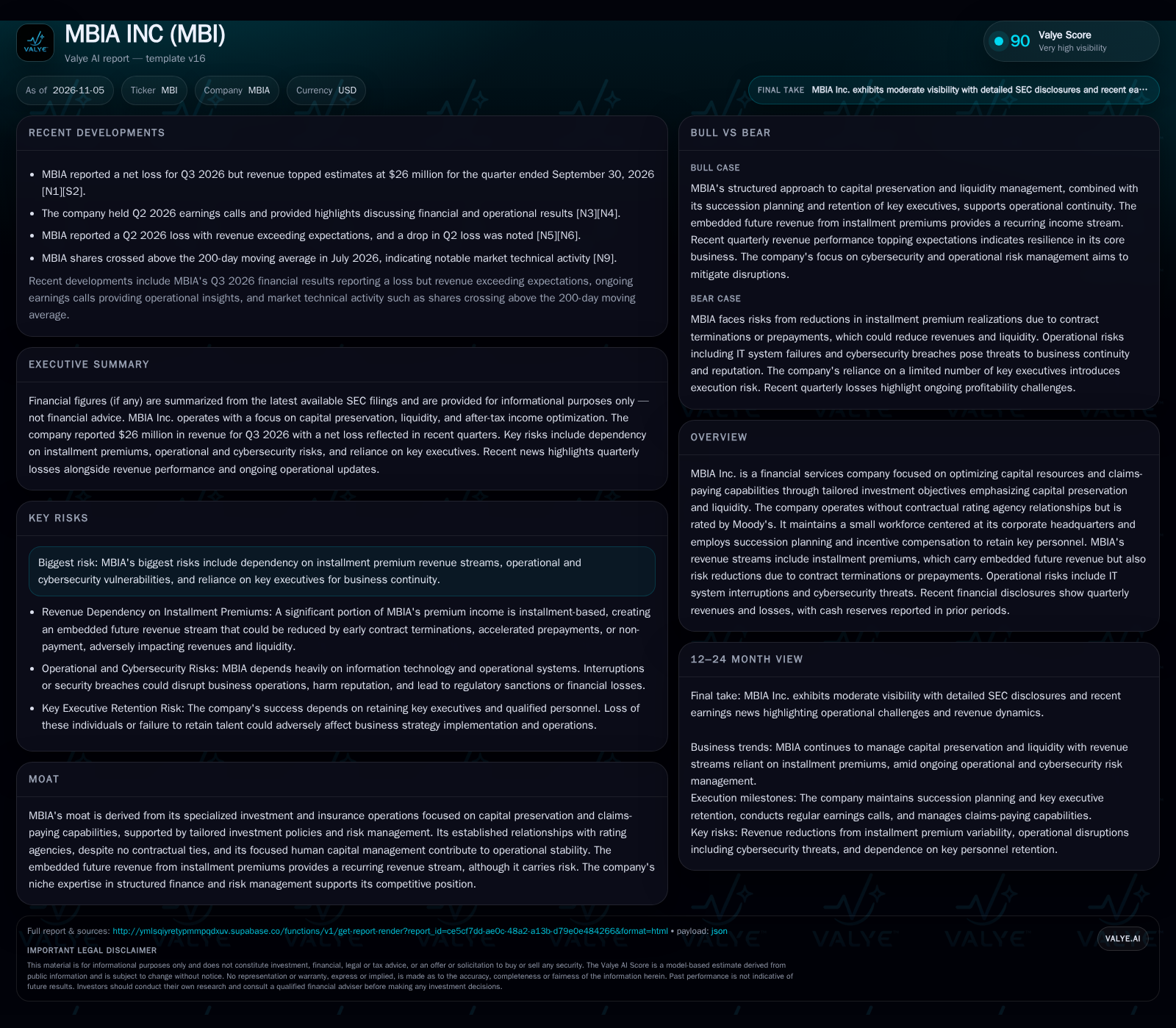
MBIA reported $26 million in Q3 2026 revenue—above estimates—but continued to post quarterly net losses. The company’s reliance on installment premiums creates embedded future revenue but exposes it to contract terminations and prepayments. Ongoing operational and cybersecurity risks, along with a concentrated executive team, present challenges to stability and execution. Monitoring premium retention, expense control, and risk management will be critical to determining whether MBIA can stabilize or faces further contraction.
MBIA Inc. sits at a crossroads defined by persistent net losses, a shrinking workforce, and a business model reliant on recurring installment premiums. While Q3 2026 revenue of $26 million exceeded expectations, profitability remains elusive and revenue streams are vulnerable to external shocks, such as early contract terminations. The company’s capital preservation focus and claims-paying orientation are tested by operational risks and a lean organizational structure. The question for investors is whether MBIA’s embedded premium income can offset ongoing losses and risk exposures, or if the headwinds will erode its core economic engine over time.
Recent Performance: Revenue Beats, Losses Persist, and Embedded Risks
MBIA reported $26 million in revenue for Q3 2026, surpassing analyst expectations, but continued to post net losses, including a negative $40 million net income in Q1 2026 [N1] [S2]. The company’s core revenue stream—installment premiums—provides a recurring income base, yet is exposed to reductions if contracts are terminated early or prepaid [S1]. MBIA is not contractually tied to major rating agencies and currently lacks a capital facility, factors that may affect market perception and access to capital [S1]. Operational risk, particularly from IT and cybersecurity threats, continues to loom over day-to-day continuity and reputation [S1]. These facts collectively highlight a business model with embedded future revenue but real vulnerability to both internal and external shocks.
Installment Premiums and the Economics of Claims-Paying Capital
MBIA’s economics are rooted in the insurance and structured finance model, where recurring installment premiums represent an embedded stream of future income. This structure provides revenue visibility, but the actual cash flows are contingent on the sustained health of underlying insured obligations. If contracts are prepaid, terminated, or defaulted upon, the future revenue stream can decline abruptly, jeopardizing both liquidity and claims-paying capacity. The company’s focus on capital preservation and after-tax income optimization suggests a conservative investment stance, likely prioritizing high-grade, liquid assets over yield-seeking strategies. This limits upside in favorable markets but may provide downside protection.
Operating leverage in this model is limited: while a lean workforce (57 employees as of late 2025 [S1]) and centralized operations constrain fixed costs, the main expense drivers—claims, loss reserves, and risk management—are variable and driven by external events. Without a capital facility, MBIA may be more exposed to liquidity crunches in adverse scenarios, unable to quickly shore up claims-paying resources. The company reported cash and cash equivalents of $151 million for the period. [S2]
The installment premium model inherently embeds a trade-off between revenue predictability and exposure to counterparty behavior. While these premiums provide a forward-looking income stream, their sensitivity to contract modifications means that MBIA's revenue base is not fully insulated from credit market dynamics or borrower incentives. For instance, in a declining interest rate environment, borrowers may be incentivized to refinance or prepay, accelerating premium runoff. Conversely, in stressed credit conditions, increased defaults could simultaneously reduce premium inflows and increase claims payouts, compounding liquidity pressures. Thus, MBIA's financial resilience depends on its ability to anticipate and manage these behavioral and credit risks through dynamic underwriting and portfolio monitoring.
Capital preservation strategies in such a model must also account for the timing mismatch between premium inflows and potential claim outflows. Given that premiums are received in installments over contract life, whereas claims can occur unpredictably and sometimes in large lump sums, MBIA faces liquidity management challenges. The absence of a committed capital facility heightens this risk, as the company cannot rapidly access external funds to meet unexpected claims. This structural liquidity risk necessitates conservative asset-liability matching and stress testing under various adverse scenarios. The company's investment portfolio composition and duration management thus play a critical role in buffering against sudden liquidity demands while maintaining regulatory capital adequacy.
Specialization in Structured Finance: Niche Strengths and Market Pressures
MBIA’s competitive edge historically derives from its expertise in structured finance, municipal bond insurance, and risk management. The company’s tailored investment policies and focus on claims-paying capabilities distinguish it from more diversified financial insurers. However, the lack of contractual relationships with rating agencies and the absence of a capital facility could place MBIA at a disadvantage relative to peers with stronger market access or broader product sets [S1].
The core threat comes from alternative risk transfer mechanisms, evolving capital markets, and the potential for direct municipal or corporate issuance without insurance. Additionally, the market for financial guaranty products has been shrinking, and pricing power is constrained by intense competition and the commoditization of credit enhancement. MBIA’s recurring revenue stream is valuable, but if market participants increasingly bypass insurance or if credit cycles deteriorate, the company could face both volume and margin pressure.
If Installment Premiums Hold and Operational Risks Are Contained, Margin Recovery Is Possible
A favorable scenario for MBIA would see the company’s book of installment premium contracts holding steady, with minimal terminations or prepayments. This would sustain embedded revenue and support gradual margin improvement, especially if claims activity remains below historical averages. The company’s conservative investment approach could preserve capital during market volatility, while effective risk management—particularly in IT and cybersecurity—would prevent costly disruptions.
Confirmation of this scenario would require evidence of stable or rising installment premium balances, a decline in claims or loss reserves, and sequential improvement in net income or operating margins. Regular reporting of premium retention rates and explicit management commentary on risk exposures would further bolster confidence. Conversely, a spike in contract terminations, claims, or major operational incidents would quickly falsify the upside case.
Embedded Revenue Is Eroded Gradually by Contract Attrition and Persistent Cost Pressures
The most plausible trajectory is one where MBIA’s installment premium base slowly declines due to natural contract runoff, occasional prepayments, and modest competitive attrition. Revenue remains visible in the near term, but ongoing net losses persist as premium inflows fail to fully offset claims, expenses, and the lack of new growth avenues. Operational and cybersecurity risks are managed but not eliminated, resulting in occasional disruptions that add to cost pressures.
This scenario would be confirmed by a slow but steady reduction in installment premium balances, continued quarterly net losses, and muted management guidance. If the company is unable to grow new business or access additional capital facilities, the long-term viability of the current economic model could come into question. A stabilization or reversal in premium attrition, or new product introductions, would challenge the base scenario.
Accelerated Premium Run-Off or Operational Shock Triggers Liquidity and Reputation Crisis
In an adverse scenario, MBIA could face a sudden wave of contract terminations or prepayments, leading to a sharp drop in installment premiums and an immediate hit to revenue and liquidity. This could be triggered by credit market dislocations, counterparty distress, or a loss of confidence in MBIA’s claims-paying ability. Alternatively, a major operational or cybersecurity incident could disrupt business, incur regulatory or legal costs, and damage the company’s reputation, resulting in client attrition.
Evidence supporting this scenario would include a precipitous decline in reported premium balances, a spike in claims or loss reserves, and urgent liquidity measures such as asset sales or emergency financing. Public disclosures of system breaches, regulatory investigations, or client losses would further corroborate a downside trajectory.
What Will Reveal the True Durability of MBIA’s Embedded Revenue Model?
Reported balances of installment premiums—if disclosed—would directly signal whether embedded revenue is stable or eroding.
Quarterly trends in net income, operating margin, and claims expense will clarify whether MBIA can approach break-even or continues to burn capital.
Explicit commentary or metrics on contract terminations, prepayments, or premium retention rates would help test the core revenue thesis.
Updates on operational risk events, including IT interruptions or cybersecurity breaches, would show whether management is effectively containing these threats.
Management succession events or turnover among key executives could disrupt continuity and strategic execution.
Evidence of new business origination, product expansion, or entry into new markets would signal an attempt to offset runoff and diversify revenue.
Disclaimer: This is research-only, informational analysis and not investment advice. It may include AI-generated interpretation and general industry context. Always verify important details using primary sources.

Comments