
Tenaya Therapeutics: Cardiac Gene Therapy Pipeline Progress Meets the Realities of Clinical and Capital Demands
Tenaya Therapeutics’ gene therapy programs for inherited cardiac conditions have demonstrated clinical progress and attracted strategic partnerships, but ongoing net losses and the inherent risks of biotech development keep the company’s long-term trajectory highly dependent on successful trial outcomes, regulatory approvals, and prudent capital management.
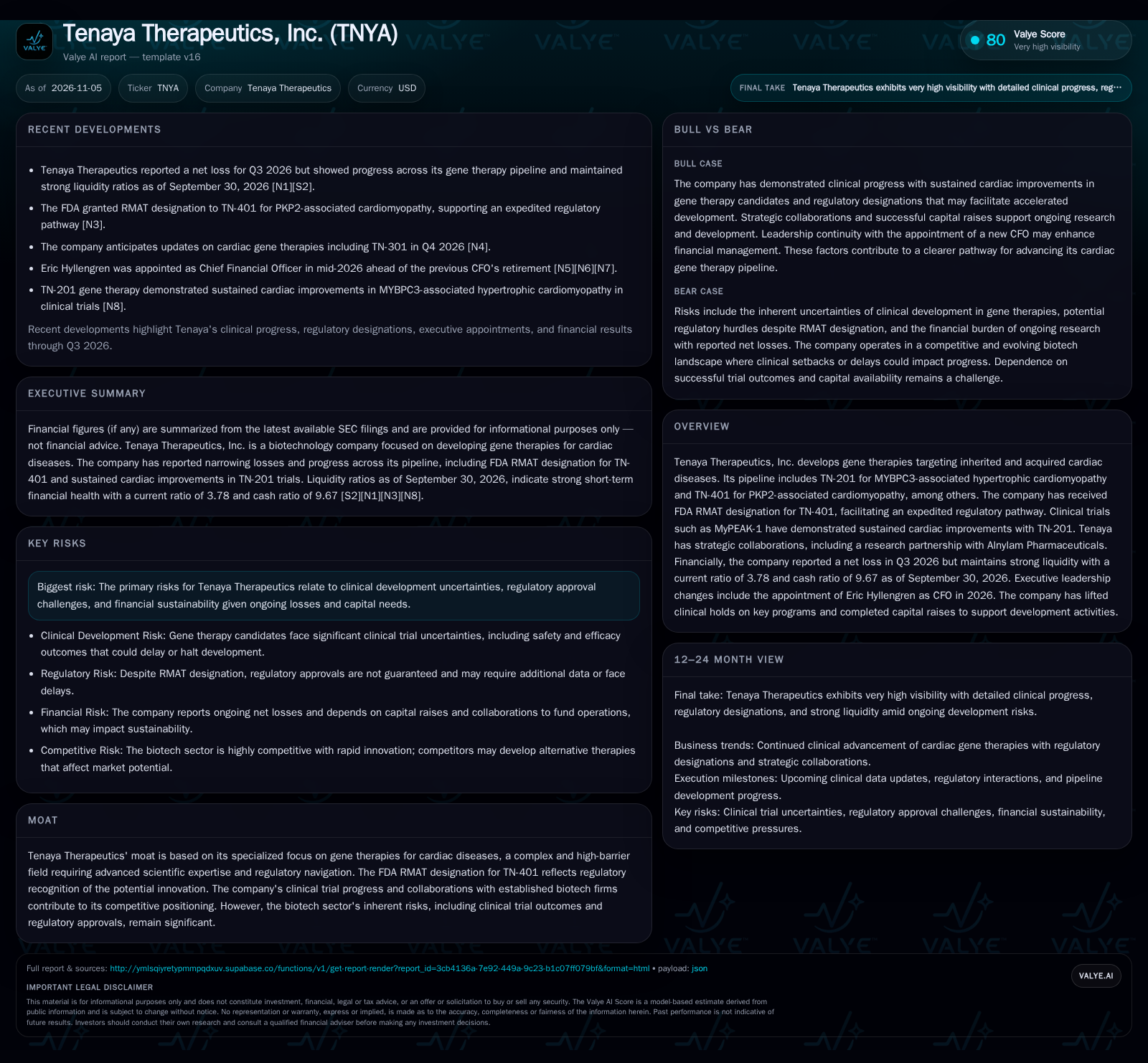
Tenaya Therapeutics is advancing gene therapies for cardiac diseases, with clinical progress in its TN-201 and TN-401 programs and reported liquidity position as of Q3 2026. Continued narrowing of losses and a new CFO appointment reflect operational focus, but the business remains reliant on successful trials, regulatory milestones, and access to capital in a competitive biotech landscape. The company’s future hinges on translating pipeline momentum into regulatory approvals and eventually, commercial success. [S2] [N1] [N4] [N8]
Tenaya Therapeutics is pushing the frontiers of cardiac gene therapy with a pipeline targeting inherited heart diseases, including programs that have already shown early clinical promise. As of Q3 2026, the company maintains a reported liquidity position cushion and has secured strategic partnerships, but its business model remains deeply exposed to the binary outcomes of clinical trials and regulatory decisions. While narrowing losses and a new CFO appointment signal operational discipline, the company’s long-term value proposition will be determined by its ability to convert scientific progress into regulatory approval and, ultimately, commercial adoption.
Pipeline Momentum, Clinical Data, and Financial Position: The Current State of Play
Tenaya Therapeutics’ Q3 2026 results underscore a company at a critical juncture: it reported a net loss of $18.9 million, but continues to maintain reported liquidity position with $66.8 million in cash and cash equivalents and a current ratio of 3.78 as of September 30, 2026. This financial cushion is notable given the capital-intensive nature of gene therapy development. Clinically, Tenaya’s TN-201 program for MYBPC3-associated hypertrophic cardiomyopathy has demonstrated sustained cardiac improvements in ongoing trials, marking a meaningful step forward in a notoriously difficult indication. The TN-401 program, targeting PKP2-associated cardiomyopathy, has also advanced, receiving Regenerative Medicine Advanced Therapy (RMAT) designation. Leadership transition is underway, with Eric Hyllengren appointed CFO in mid-2026, reflecting a continued focus on operational and financial stewardship. [S2] [N1] [N3] [N4] [N5] [N6] [N7] [N8]
Gene Therapy Economics: High-Risk R&D for Potentially Transformative Rewards
Tenaya’s business model is predicated on successfully developing and commercializing gene therapies for cardiac diseases—a segment with high unmet need but also high barriers to entry. The economics of gene therapy are shaped by enormous upfront R&D costs, lengthy clinical timelines, and binary regulatory outcomes. Once approved, gene therapies can command premium pricing due to their potential for disease modification or even cure, but payer adoption and pricing negotiations can be complex, especially for rare diseases.
Tenaya’s financials reflect the typical biotech profile: ongoing net losses as pipeline investments outpace revenue generation. The company’s Q3 2026 net loss of $18.9 million and narrowing losses in recent quarters point to a disciplined approach, but the path to profitability requires not just one, but likely multiple, successful program approvals. The upfront payment from the Alnylam collaboration (up to $10 million) provides non-dilutive capital, but Tenaya remains reliant on external funding—either through partnerships, equity, or debt—to sustain its pipeline through late-stage trials and, eventually, commercialization. [S2] [N1]
Operating leverage may materialize if lead programs progress to market, as fixed R&D costs are amortized over a potentially large patient base. However, the capital needs to reach this inflection point are significant, and any clinical or regulatory setback could force strategic pivots or additional financings.
Differentiation in a Crowded Cardiac Gene Therapy Race
Tenaya’s competitive position hinges on its ability to deliver clinically meaningful, safe, and durable outcomes in cardiac gene therapy—a field attracting significant investment and innovation. While the company’s TN-201 and TN-401 programs address genetically defined subpopulations (MYBPC3- and PKP2-associated cardiomyopathies), other biotechnology and pharmaceutical companies are also pursuing gene editing, RNA therapies, and small molecules for similar indications.
Tenaya’s strategic collaborations, such as the partnership with Alnylam Pharmaceuticals, provide both validation and access to additional scientific and financial resources. However, the ultimate moat in gene therapy will be built on clinical efficacy, safety, regulatory designations, and the ability to scale manufacturing and distribution. The RMAT designation for TN-401 offers potential for expedited regulatory review, but similar designations are increasingly common in the sector, reducing their exclusivity as a differentiator.
Switching costs in rare cardiac diseases can be high once a therapy is approved and integrated into clinical practice, but reaching that point requires overcoming substantial clinical, regulatory, and commercial hurdles. Fast followers, alternative modalities (such as RNAi or gene editing), and evolving standards of care represent ongoing competitive threats.
What Could Unlock Transformational Value: Positive Data and Regulatory Catalysts
A favorable scenario for Tenaya would see pivotal clinical trials for TN-201 and TN-401 demonstrate robust, durable efficacy and safety, leading to regulatory approvals in the U.S. and other major markets. This would position Tenaya as a first- or best-in-class provider of gene therapies for specific cardiac conditions, enabling premium pricing and potentially rapid uptake among eligible patients.
Validation from regulators—such as RMAT or breakthrough therapy designations—could accelerate timelines and attract further partnership interest or non-dilutive funding. Successful execution on upcoming milestones, including the anticipated Q4 2026 clinical updates for TN-301, would further de-risk the pipeline and potentially broaden the addressable market. [N4]
Evidence that would confirm this scenario includes positive late-stage clinical data, regulatory filings or approvals, new partnership announcements, and the initiation of commercial infrastructure investments. Material increases in non-dilutive funding or strategic collaborations would also support this trajectory.
Pipeline Progress Offset by the Realities of Long Development Timelines and Funding Cycles
The most plausible outcome is that Tenaya continues to advance its lead programs through clinical development, with incremental data updates and regulatory interactions in 2026 and beyond.
In this scenario, the company may see modest de-risking of its pipeline as more clinical data accumulates, but the business remains fundamentally pre-revenue and exposed to the timing and outcomes of clinical and regulatory milestones. Strategic collaborations and prudent cost management could help extend the runway, but dilution or partnering trade-offs are probable.
Confirmation of this scenario would be ongoing net losses with narrowing quarterly deficits, continued progress in clinical trials without major setbacks, and regular announcements of funding or partnership activity. Falsification would involve a significant clinical failure, regulatory setback, or an inability to secure necessary capital.
Adverse Clinical Outcomes or Funding Gaps Could Trigger Severe Strategic Reassessment
A negative trajectory would be driven by failure of one or more lead programs—such as TN-201 or TN-401—to demonstrate efficacy or safety in pivotal trials, resulting in trial holds, program discontinuation, or regulatory rejections. Such outcomes would erode investor and partner confidence, potentially constraining Tenaya’s ability to raise additional capital on favorable terms.
Given the capital intensity of gene therapy development, a clinical or regulatory setback could force Tenaya to reprioritize its pipeline, delay programs, or pursue asset sales or strategic alternatives. The company’s liquidity, while strong as of Q3 2026, is finite and could be quickly depleted in the absence of new funding or a major partnership.
Downside confirmation would include negative clinical data, regulatory holds or rejections, material increases in quarterly losses, or announcements of workforce reductions, pipeline reprioritization, or distressed financings. A useful falsification would be rapid recovery or pivot following a setback, supported by new partnerships or capital raises.
Milestones That Will Define Tenaya’s Path from Clinic to Commercialization
Clinical trial readouts for TN-201, TN-401, and TN-301—positive or negative—will be pivotal in determining the company’s future trajectory.
Updates on regulatory interactions, including acceptance of filings, designations (such as RMAT or breakthrough therapy), and feedback from agencies, will help clarify approval timelines.
Progress and terms of new or expanded strategic partnerships, especially those providing non-dilutive capital or commercial infrastructure, would support pipeline advancement.
Quarterly cash burn and net loss trends—if disclosed—will reveal whether operational discipline is being maintained and how long the current liquidity can support active programs.
Announcements of capital raises, debt financing, or milestone payments will indicate the company’s ability to sustain development through late-stage trials.
Manufacturing scale-up plans and related investments, if disclosed, would suggest preparation for eventual commercial launch.
Any signals of payer engagement, pricing discussions, or early access programs would help gauge the market adoption potential for Tenaya’s lead assets.
Leadership stability and further management changes, particularly in R&D and commercial functions, could impact execution risk and strategic direction.
Disclaimer: This is research-only, informational analysis and not investment advice. It may include AI-generated interpretation and general industry context. Always verify important details using primary sources.

Comments