
Motorola Solutions: Revenue Resilience, Margin Pressures, and the Stakes of Mission-Critical Communications
Motorola Solutions continues to post strong revenue and earnings results in its core segments, but a recent profit decline highlights the cost and execution challenges inherent in complex, contract-driven markets. As the company raises its full-year outlook, the interplay between debt obligations, contract management, and evolving customer needs will shape its trajectory in the mission-critical communications sector.
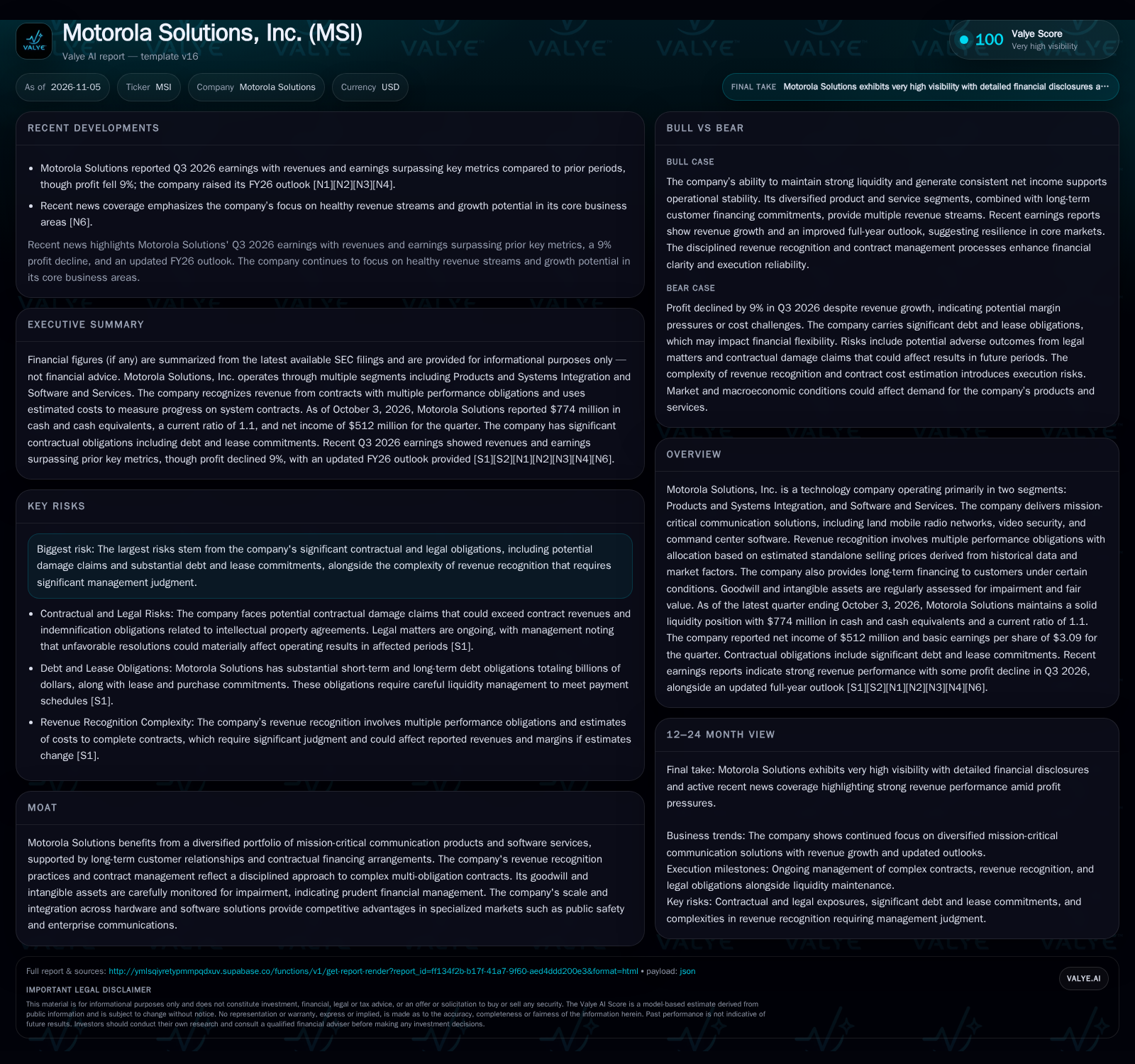
Motorola Solutions delivered higher revenues and earnings in Q3 2026, but experienced a 9% drop in profit amid ongoing margin pressures. The company raised its full-year outlook, signaling confidence in demand across core products and services. However, substantial debt, complex contract structures, and legal exposures present ongoing risks as the company navigates the evolving public safety and enterprise communications landscape. [S1] [S2] [N1] [N2] [N3] [N4] [N6]
Motorola Solutions, a major provider of mission-critical communications and software, continues to demonstrate revenue and earnings growth—even as profit margins face new headwinds. In Q3 2026, the company reported higher revenues and earnings versus prior periods, but profit declined by 9%, raising questions about cost structures and contract execution in a complex operating environment. With an updated full-year outlook and a strategic emphasis on core markets, Motorola Solutions’ ability to balance growth, debt obligations, and the realities of contract-driven revenue will be central to its performance in the coming cycles. [S1] [S2] [N1] [N2] [N3] [N4] [N6]
Recent Profit Decline and Upbeat Outlook: Parsing Q3 2026 Results
Motorola Solutions reported Q3 2026 revenues and earnings that exceeded prior periods, but profit fell 9% year-over-year. Despite this margin compression, management raised its full-year 2026 outlook, suggesting confidence in demand and pipeline execution [N1] [N2] [N3] [N4]. The company’s liquidity snapshot as of October 3, 2026, showed $774 million in cash and cash equivalents, a current ratio of 1.1, and a cash ratio of 0.13 [S2]. Meanwhile, Motorola Solutions faces $750 million in short-term debt and $8.476 billion in long-term debt, highlighting a substantial leverage profile [S1] [S2]. These facts frame a business experiencing ongoing revenue momentum and market relevance, but with cost and capital structure issues rising in prominence.
The Economics of Mission-Critical Solutions: Revenue Streams and Cost Dynamics
Motorola Solutions generates revenue through two primary segments: Products and Systems Integration (hardware, infrastructure, and implementation) and Software and Services (recurring support, command center software, and managed services) [S1]. Revenue is often derived from contracts with multiple performance obligations, requiring allocation based on estimated standalone selling prices. This complexity means that a significant portion of revenue recognition depends on management’s judgment of progress and cost-to-complete, especially for large-scale system deployments.
The business model combines upfront hardware and integration revenue with ongoing software and maintenance streams. This hybrid structure may provide some revenue resilience—especially where long-term contracts or customer financing are in place—but can also mask underlying margin pressures if costs overrun or if new project wins require aggressive pricing. Fixed costs are meaningful in R&D, support infrastructure, and sales, while variable costs are tied to hardware components and service delivery. Operating leverage is present, but the risk is that margin erosion can occur quickly if project costs escalate or software/service growth does not offset hardware commoditization.
Capital needs are non-trivial: the company’s substantial debt load and customer financing commitments ($179 million outstanding as of December 2025) [S1] require ongoing cash generation and prudent working capital management. The interplay between contract-driven receivables, project delivery timelines, and debt servicing creates an environment where missteps in execution or shifts in customer payment patterns could pressure liquidity and potential financial flexibility.
Defending Share in Public Safety and Enterprise: Advantages and Emerging Threats
Motorola Solutions’ core advantage lies in its deep integration across mission-critical hardware, software, and managed services, particularly in public safety and enterprise communications. Long-standing customer relationships, technical certifications, and entrenched installed bases in land mobile radio (LMR) systems and command center software create high switching frictions for government and large enterprise customers. The company’s ability to bundle financing with multi-year contracts can further cement customer loyalty and provide revenue visibility.
However, counterforces are mounting. Competitive categories include traditional LMR and video security peers, as well as cloud-native software entrants and large IT vendors targeting public safety digital transformation. The gradual migration from hardware-centric to cloud-first, software-defined communications could erode Motorola’s historical advantages unless its own software and managed services portfolio scales rapidly. Price competition in hardware, especially as commoditization increases, may pressure margins. Additionally, procurement cycles and public-sector budget constraints can delay or disrupt large projects, amplifying execution risk.
Substitution risk is rising as next-generation broadband (e.g., LTE, 5G) gains traction in public safety, and as enterprise buyers increasingly demand open, interoperable solutions. The question is whether Motorola Solutions can maintain its relevance and pricing power as the market pivots toward software-centric and cloud-enabled platforms.
If Software and Services Outpace Hardware: A Margin Expansion Thesis
A favorable outcome for Motorola Solutions would see accelerated growth in software and managed services, tilting the revenue mix away from lower-margin hardware toward higher-margin, recurring contracts. If the company’s command center software, video analytics, and managed communications offerings gain traction—especially through multi-year government and enterprise deals—operating leverage could improve as fixed R&D and support costs are spread over a larger, more predictable revenue base.
Evidence that would confirm this scenario includes: a sustained increase in software/services revenue as a percentage of total sales (if disclosed); rising gross and operating margins quarter-over-quarter; and commentary or disclosures about major new software platform wins or renewals. Additional validation would come from a decline in profit volatility, improved cash conversion cycles, and reductions in customer financing needs as recurring revenue grows. Continued positive updates to full-year outlooks, especially tied to software/services backlog, would further support the thesis.
Revenue Growth Balanced by Execution Risks and Debt Service
The most plausible trajectory is that Motorola Solutions will continue to grow revenues in both core segments, but margin improvement will be slow and uneven due to cost pressures, complex contract delivery, and the need to service substantial debt. Hardware and integration projects will deliver lumpier results, while software and services provide a more stable backdrop—but not enough to fully offset execution risks in large-scale deployments.
Confirmation of this base case would come from continued revenue and earnings growth, but with quarterly profit fluctuations tied to contract mix and delivery timing. Margins may stabilize or improve modestly, but debt and lease obligations will remain a significant drag on free cash flow. Evidence against this scenario would be either a sharp, sustained margin recovery (implying a successful pivot to higher-value software/services) or a pronounced deterioration in profit and cash flow, potentially linked to contract overruns or unexpected legal/contractual liabilities.
Margin Compression and Contract Disputes: How the Model Could Falter
The adverse scenario would see continued or accelerating margin compression—potentially from cost overruns on complex integration projects, aggressive pricing to win new business, or slower-than-expected adoption of higher-margin software and services. If customer financing needs rise or large projects are delayed, working capital could tighten, increasing reliance on debt or forcing asset sales.
A key risk is the potential for contractual disputes or legal claims that exceed anticipated revenues or indemnification limits, as flagged in SEC filings [S1]. An unfavorable resolution in a major legal matter or a spike in damage claims could materially impact results in the affected period, compounding financial strain. Evidence confirming this scenario would include further profit declines, negative revisions to the full-year outlook, rising legal reserves, or disclosures of major contract disputes or payment delays.
What Will Determine Motorola Solutions’ Next Phase in Mission-Critical Communications?
Quarterly gross and operating margin trends—especially the direction and stability of margins as the revenue mix evolves.
Disclosures or commentary on the share of software and managed services in total revenue, which would clarify the pace of business model transition (if disclosed).
Updates on major contract wins or renewals—particularly multi-year government or enterprise deals that could drive visibility and backlog.
Any changes in customer financing commitments or working capital metrics, which would signal shifts in project risk or cash flow needs.
Legal disclosures regarding contractual disputes, damage claims, or indemnification issues, given their potential impact on near-term results.
Trends in debt service costs and refinancing activity, as the company manages its substantial leverage profile.
Evidence of customer migration to next-generation broadband or cloud-based solutions, which could accelerate substitution risk.
Disclaimer: This is research-only, informational analysis and not investment advice. It may include AI-generated interpretation and general industry context. Always verify important details using primary sources.

Comments