
MGT Capital Investments: Strategic Limbo, Asset Redeployment, and the High Stakes of Reinvention
After exiting Bitcoin mining and disposing of its main facility, MGT Capital Investments is left with legacy mining equipment, a constrained balance sheet, and no revenue-generating operations. The company's future now hinges on its ability to secure capital and identify viable new business directions—amid extreme dilution risk, volatile crypto economics, and dependence on a single executive.
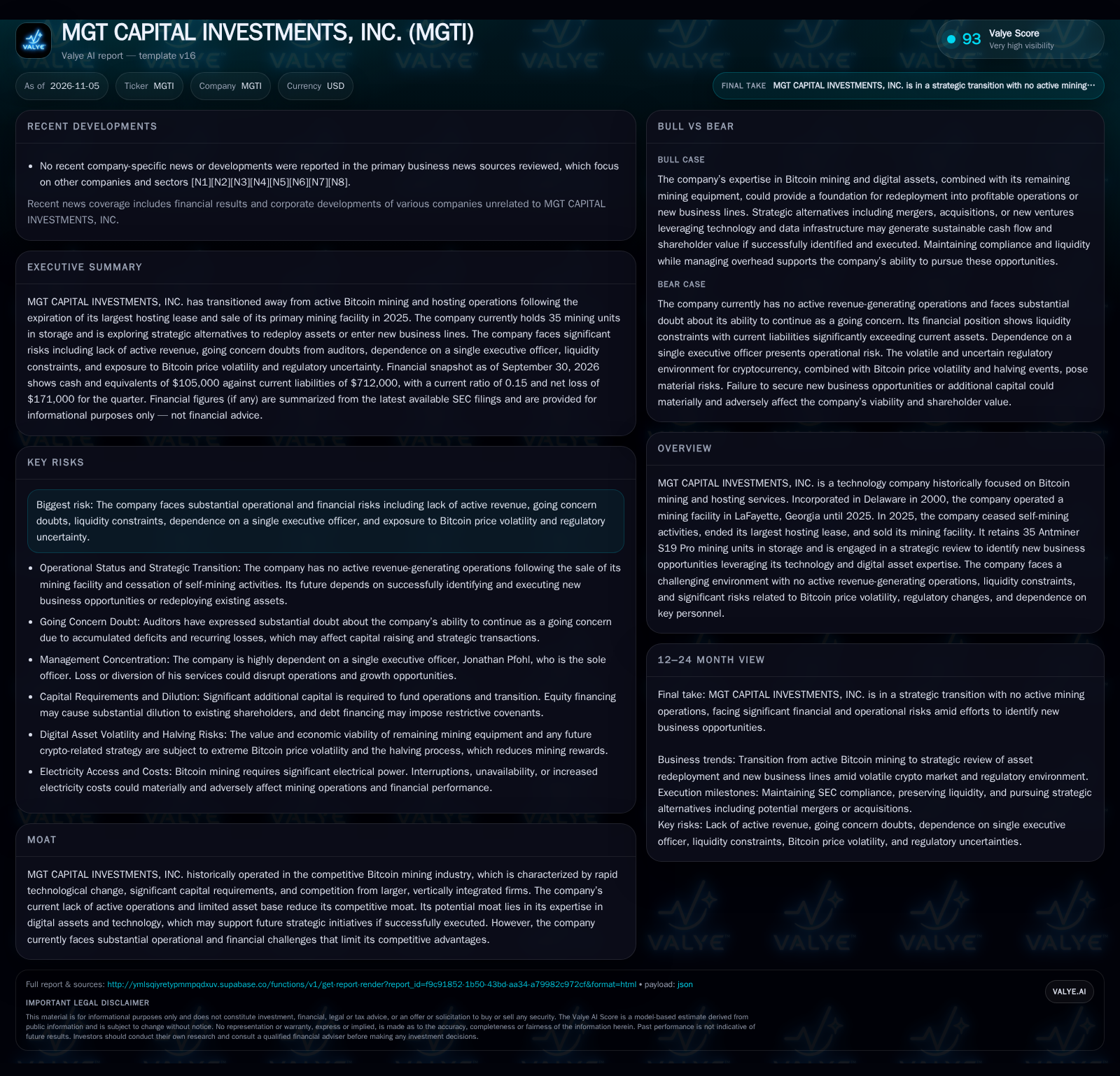
MGT Capital Investments has ceased all Bitcoin mining and hosting activities, liquidated its primary operating facility, and now holds only a small inventory of inactive mining equipment. Dilution, asset redeployment, and crypto market volatility are central risks.
MGT Capital Investments, once a participant in the competitive Bitcoin mining sector, now faces a pivotal crossroads. Having exited all active operations and sold its primary mining facility, the company is left with a modest trove of mining equipment and a sharply constrained balance sheet. The business must now reinvent itself or risk dissolution, with its future hinging on strategic asset redeployment, new capital infusions, or transformative M&A.
After the Exit: Where MGTI Stands Following the Mining Wind-Down
The most consequential recent facts for MGT Capital Investments are its full exit from Bitcoin mining and the subsequent sale of its LaFayette, Georgia facility in May 2025 for $1,350. The company now retains only 35 Antminer S19 Pro units in storage, representing roughly 3 Ph/s of potential hash power, but these units are not currently operational or deployed [S2]. As of September 30, 2026, MGTI reported $105,000 in cash and $712,000 in current liabilities, yielding a current ratio of just 0.15 and a net loss of $171,000 for the quarter, with no active revenue streams [S2]. Auditors have flagged substantial doubt about the company's ability to continue as a going concern due to a $426.7 million accumulated deficit and recurring losses [S2]. These facts underscore a business in stasis, with both operational and financial uncertainty dominating the outlook.
Mining Economics Abandoned: Pivoting from Fixed-Cost Intensity to Uncertain New Models
Historically, MGTI’s economics were dictated by the capital- and energy-intensive nature of Bitcoin mining, where profitability hinged on electricity costs, mining difficulty, and Bitcoin price. With the cessation of active mining and hosting operations, the company has eliminated most fixed operating costs associated with facility management and power procurement. However, it has also lost all recurring revenue and the operating leverage that came with scale mining.
Currently, MGTI’s economics are defined by negative cash flow, a reported cash balance, and the absence of any revenue-generating assets. The remaining Antminer S19 Pro units could, in theory, be redeployed if power access and capital were secured, but their economic viability is highly sensitive to Bitcoin’s price, the recent halving (which reduced block rewards to 3.125 BTC per block), and the efficiency gap versus next-generation mining hardware.
The core business challenge is funding: with only $105,000 in cash and a growing deficit, any new operational initiative or acquisition would require substantial outside capital. This likely means equity issuance, which could be highly dilutive given the company’s penny-stock status and weak balance sheet, or partnership/M&A structures that do not require immediate cash outlay. The company’s future economics may depend on identifying a new business line—potentially in technology, digital assets, or data infrastructure—where it can leverage legacy expertise but with a more scalable, asset-light, or recurring-revenue model. Execution risk and funding constraints are paramount.
From Miner to Market Laggard: Structural Disadvantages and the Search for a New Niche
MGTI’s previous competitive landscape was dominated by well-capitalized, vertically integrated Bitcoin miners who benefited from scale, proprietary technology, and favorable power contracts. As a subscale player, MGTI faced eroding margins, rising mining difficulty, and severe capital constraints. The April 2024 Bitcoin halving further intensified these pressures by cutting block rewards and compressing industry profitability.
Post-exit, MGTI effectively has no competitive position in the mining sector: its remaining hardware is technologically dated and idle, and it lacks the infrastructure, capital, and power arrangements to compete with leading miners. In the broader technology or digital asset space, the company’s only potential moat is its legacy expertise in mining operations, data center management, and digital asset security. However, this expertise is not a sustainable advantage without capital and a platform for execution.
Any future competitive position will depend entirely on the success of a new business model or strategic transaction. The company’s small scale, liquidity constraints, and penny-stock status are structural disadvantages relative to peers in both crypto and tech-adjacent industries. Moreover, evolving regulatory frameworks and rapid technological change create persistent barriers to re-entry or repositioning.
What Would a Successful Reinvention Look Like?
The most favorable scenario for MGTI involves the successful identification and execution of a new business line or strategic transaction that leverages its technology and digital asset expertise. This could take the form of a merger with a better-capitalized technology firm, acquisition of a promising startup, or a pivot to an adjacent market such as blockchain infrastructure services, digital asset security, or hosting for emerging compute-intensive applications.
For this scenario to materialize, the company would need to secure enough capital—either through a strategic investor, creative deal structuring, or a non-dilutive partnership—to fund the transition without destroying existing shareholder value. Successful redeployment of the remaining mining equipment (either via sale, lease, or integration into a new operation) would provide modest incremental capital, but would not be transformative on its own.
Confirmation of this scenario would come from a public announcement of a concrete new business initiative, the closing of a strategic transaction, or the securing of a meaningful capital raise that supports operational ramp-up. Early signs could include new executive hires, board changes, or the launch of pilot projects in adjacent technology fields.
Strategic Drift and Dilution: The Most Probable Trajectory
Absent a near-term breakthrough on asset redeployment or strategic transactions, the most plausible outcome is a period of continued strategic drift, marked by ongoing operating losses, incremental asset sales, and efforts to maintain regulatory compliance.
In this scenario, the remaining mining equipment is either sold at a loss or remains idle, contributing little to balance sheet repair. The company’s single executive officer is forced to juggle operational overhead with the demands of strategic review, hampered by the lack of both resources and a diversified management team. Shareholder value is gradually eroded by dilution and persistent losses.
Evidence confirming this scenario would include repeated small-scale capital raises, continued operating losses, lack of a clear new business launch, and ongoing references to strategic review without concrete progress. Falsification would require a decisive pivot or major transaction that fundamentally alters the company’s business model or financial profile.
Terminal Decline: When Strategic Options and Capital Run Out
The downside scenario for MGTI is a gradual or abrupt move toward insolvency and potential dissolution. If the company is unable to secure new capital or identify a viable business line, its limited cash will be consumed by recurring overhead and legacy liabilities. The remaining mining equipment, if not monetized soon, may lose residual value as technology advances and market conditions evolve.
The company’s penny-stock status and lack of operating assets make it an unattractive target for acquisition or rescue, while ongoing regulatory and reporting obligations consume the dwindling cash balance. In this scenario, the loss of the sole executive officer or further adverse regulatory developments could accelerate the demise. Delisting, bankruptcy, or a formal wind-down become increasingly likely as liquidity evaporates.
Confirmation would come from further auditor going concern warnings, missed SEC filings, inability to raise capital, or announcements regarding asset liquidation and dissolution. A reversal would require a last-minute capital infusion or the emergence of an unexpected acquirer.
Milestones and Developments That Will Decide MGTI’s Next Act
Announcements of any new business line, strategic partnership, merger, or acquisition—especially deals that leverage the company’s digital asset or technology expertise.
Disclosure of a significant capital raise, including the terms, sources, and potential dilution impact; a useful metric would be the effective post-money valuation and share count if disclosed.
Updates on the disposition or redeployment of the 35 Antminer S19 Pro units, including sale price, lease terms, or integration into a new operational context.
Changes in executive leadership, board composition, or the addition of new strategic advisors—signals of a shift in strategy or new capabilities.
Evidence of recurring revenue generation from any new initiative, such as signed contracts, customer onboarding, or early-stage pilot deployments.
Further auditor commentary on going concern status, or any missed or late SEC filings, which would indicate escalating financial distress.
Developments in the regulatory landscape for crypto assets or OTC-listed companies that materially affect MGTI’s strategic options or compliance costs.
Insider transaction activity was reported in the cited source; this activity does not by itself establish insider confidence.
Disclaimer: This is research-only, informational analysis and not investment advice. It may include AI-generated interpretation and general industry context. Always verify important details using primary sources.

Comments