
Belpointe PREP: Opportunity Zone Real Estate Ambition Meets Execution and Economic Headwinds
Belpointe PREP, LLC is pursuing a differentiated strategy by leveraging opportunity zone incentives to attract capital for commercial and multifamily developments, but persistent operating losses and challenging market conditions put the company’s ability to deliver long-term value to the test.
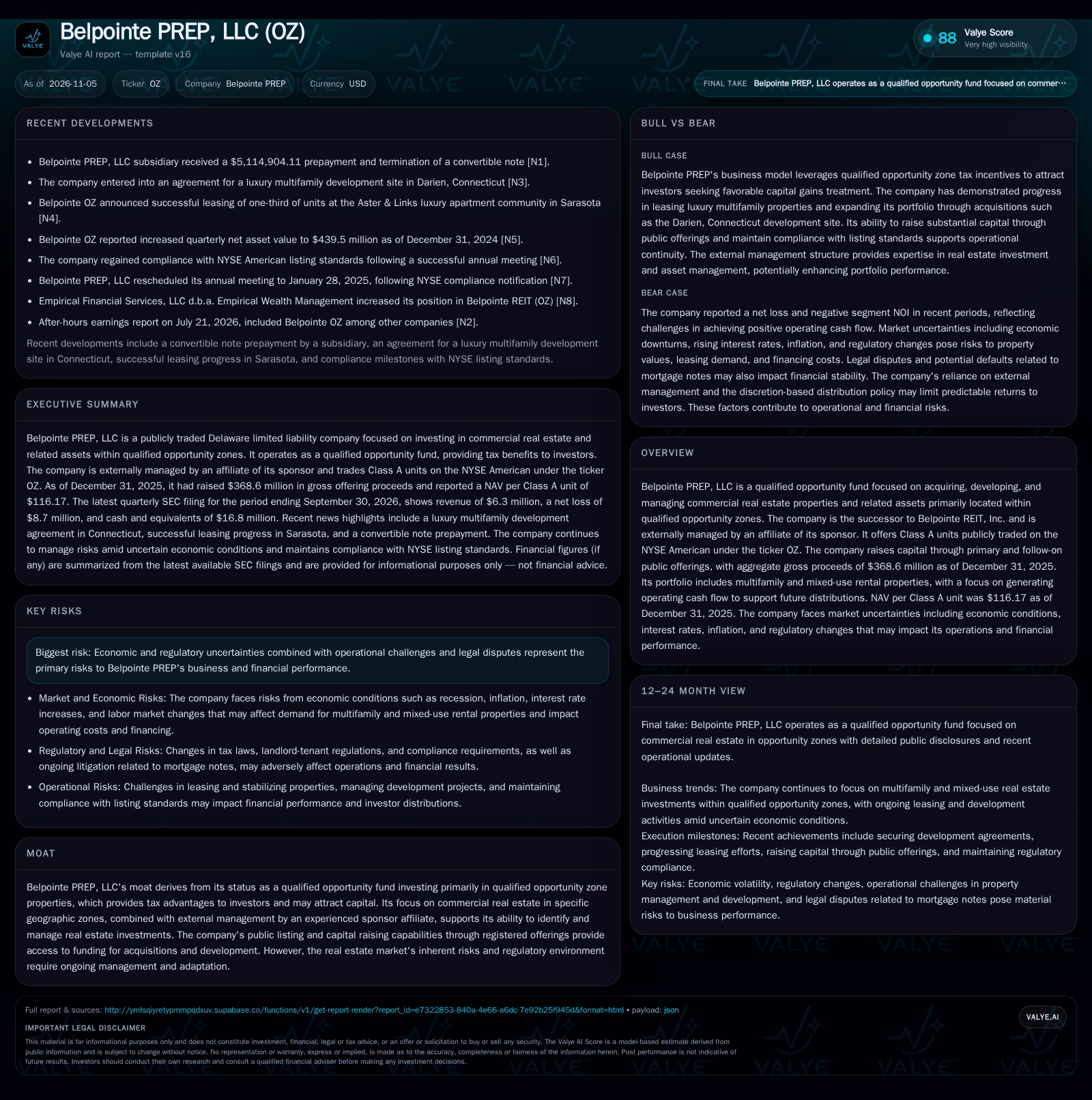
Belpointe PREP, LLC operates as a qualified opportunity fund, investing in and managing commercial and multifamily real estate within opportunity zones. Recent milestones include new development deals, successful leasing progress, and continued capital raising. However, the company reported a net loss and negative segment NOI, highlighting the economic and operational hurdles it faces. The interplay between tax-advantaged capital, real estate execution, and market volatility will determine whether Belpointe PREP can turn its unique structure into sustainable returns. [S1] [S2] [N3] [N4]
Belpointe PREP, LLC stands at the intersection of real estate investing and federal tax policy, aiming to generate returns by acquiring, developing, and managing properties in qualified opportunity zones. With over $368 million raised since inception, a growing portfolio of multifamily and mixed-use projects, and a public listing on NYSE American, Belpointe PREP has established itself as a notable player in this niche. Yet, the company’s most recent results—showing continued net losses and negative net operating income—underscore the challenges of executing large-scale real estate development amid economic and market headwinds. Investors must weigh the appeal of tax-advantaged structures against the operational realities and financial risks inherent in the business. [S1] [S2]
Recent Results Spotlight Execution Progress and Persistent Losses
Belpointe PREP reported revenue of $6.3 million and a net loss of $8.7 million for the quarter ended September 30, 2026, with basic and diluted EPS of -$2.20 per share. Cash and cash equivalents stood at $16.8 million at quarter-end. Segment data for the year ended December 31, 2025, revealed a negative NOI of $2.47 million from its commercial and mixed-use properties. These results reflect the ongoing difficulty of achieving profitable operations despite a sizable capital base. [S2] [S1]
The company continues to expand its portfolio, entering into an agreement for a luxury multifamily development site in Darien, Connecticut, and reporting successful leasing of one-third of units at its Aster & Links project in Sarasota. These milestones suggest some traction in property development and leasing, which are critical to realizing the company’s value proposition. [N3] [N4]
Aggregate gross offering proceeds reached $368.6 million as of December 31, 2025, indicating sustained investor interest. However, the company’s NAV per Class A unit was $116.17 as of the same date, and its ability to translate capital into distributable cash flow remains unproven at scale. [S1]
How Opportunity Zone Incentives and Real Estate Cycles Shape the Bottom Line
Belpointe PREP’s business model relies on raising capital from investors seeking to defer or reduce capital gains taxes by placing funds in qualified opportunity zones. The company then deploys this capital into acquiring, developing, and managing commercial and multifamily properties, with the intent to generate rental income and eventual appreciation.
Revenue is primarily driven by rental income from stabilized properties and, potentially, gains on asset sales. However, the development cycle for new projects is long, and upfront expenditures on land, construction, and leasing mean that positive net operating income can take years to materialize. Negative NOI and net losses, as recently reported, are typical of early-stage real estate development but become more concerning if they persist as the portfolio matures. [S1] [S2]
Fixed costs include management fees paid to the external manager, debt service (if applicable), and property-level operating expenses. Variable costs scale with the number and size of projects. As more properties are stabilized and leasing ramps up, operating leverage should improve—rental revenue can outpace incremental expenses, driving margin expansion. However, the extent of this leverage is highly sensitive to occupancy rates, rental pricing, construction costs, and prevailing cap rates.
The company’s capital needs are substantial, given the size and ambition of its development pipeline. Public offerings have provided significant funding, but persistent operating losses highlight the risk that further external capital could be needed if cash flows from operations do not ramp quickly.
Tax-Advantaged Capital Draws Investors, But Execution and Market Forces Define Moat Depth
Belpointe PREP’s core advantage is its status as a qualified opportunity fund, which enables it to attract capital from investors seeking to capture capital gains tax benefits unavailable from standard real estate vehicles. This structure can provide a lower cost of capital and a broader investor base, particularly among high-net-worth individuals and family offices. [S1]
In terms of real estate execution, the company competes with other opportunity funds, traditional REITs, private equity real estate funds, and local developers. The external management model may provide specialized expertise, but it can also introduce agency costs and fee leakage compared to internally managed peers.
The main competitive counterforces are market supply and demand for multifamily and mixed-use properties, the availability and cost of development sites, and the evolving landscape of regulatory and tax policy. Rising interest rates, construction inflation, and local market saturation can all compress returns, regardless of tax advantages.
Switching frictions for investors are moderate—while the tax incentive is unique to opportunity zone funds, real estate investors can choose among many vehicles, and actual realized returns will be driven by property-level performance and distribution policy.
If Development Execution and Leasing Outpace Headwinds, Value Creation Could Accelerate
The most favorable scenario sees Belpointe PREP successfully developing and leasing up its new projects, particularly the luxury multifamily sites in Darien and Sarasota. As more units are leased at market rates, segment NOI would turn positive, supporting both NAV growth and potential cash distributions to investors. If stabilized occupancy reaches high levels and rental rates exceed underwriting assumptions, operating leverage could drive a sharp improvement in profitability.
Tax-advantaged capital raising could remain robust if IRS opportunity zone guidelines remain favorable and the macro environment encourages reinvestment of capital gains. This could fuel further acquisitions and development, compounding the company’s growth.
Evidence that would confirm this scenario includes sustained increases in segment NOI, positive operating cash flow, high leasing velocity for new projects, and the initiation or increase of distributions to unit holders. Upward revisions to NAV and positive net income would further validate the bull case.
Realistic Trajectory: Gradual Portfolio Maturation Amid Economic and Regulatory Uncertainty
The most plausible path is a gradual stabilization of Belpointe PREP’s existing and in-development properties, with leasing progress continuing at a moderate pace. Operating losses may narrow as more projects reach completion and occupancy rises, but profitability may remain elusive if rental rates or occupancy fall short of projections or if cost pressures persist.
External capital raising could continue, but perhaps at a slower pace if macroeconomic volatility or higher interest rates dampen investor appetite for real estate or opportunity zone funds. Management’s ability to optimize financing and manage risk will be tested if capital markets tighten or if development timelines are extended.
Confirmation of this scenario would come from incremental improvements in NOI, modest NAV growth, and a reduction in quarterly net losses. However, a lack of consistent positive operating cash flow or delays in new project stabilization would suggest the company remains in a prolonged ramp-up phase.
Prolonged Losses, Market Dislocation, and Regulatory Shifts Could Undermine the Model
Should economic conditions deteriorate—through a recession, rising interest rates, or a sharp pullback in real estate valuations—Belpointe PREP could face continued negative NOI, cash burn, and difficulty raising additional capital. If leasing demand weakens or construction costs escalate, projects may fail to achieve stabilization, impairing NAV and forcing asset sales at unfavorable prices.
Regulatory risk is also material: adverse changes to opportunity zone tax treatment or local property regulations could reduce the attractiveness of the fund to investors or increase compliance costs. The external management structure could amplify losses if fees remain high while performance lags.
This scenario would be confirmed by persistent or worsening net losses, declining NAV, negative operating cash flow, missed leasing targets, or forced asset dispositions. Inability to raise new capital or meet debt obligations would further validate the bear case.
Signals That Will Reveal Whether Belpointe PREP Can Deliver on Its Opportunity Zone Promise
Quarterly segment NOI trends—improvement toward positive territory would indicate operational momentum; persistent losses would signal structural challenges. [S1] [S2]
Leasing velocity and occupancy rates at major projects, especially Aster & Links (Sarasota) and Darien (if disclosed), as these directly impact cash flow ramp.
Changes in NAV per Class A unit, which reflect both property valuations and the effectiveness of capital deployment. [S1]
Cash flow from operations—sustained positive figures would support distribution potential and reduce reliance on external capital. [S2]
Updates on development timelines, cost overruns, or delays for major projects, as these affect both return on investment and capital needs.
Any changes in opportunity zone tax policy or regulatory environment that could affect the attractiveness of the fund structure.
Capital raising activity—continued ability to attract new funds at favorable terms would support growth; a slowdown could pressure development plans.
Management fee disclosures and cost structure details (if disclosed), as external management fees can erode returns and affect alignment with investors.
Disclaimer: This is research-only, informational analysis and not investment advice. It may include AI-generated interpretation and general industry context. Always verify important details using primary sources.

Comments