
CrossAmerica Partners: Distribution Stability, Fuel Volume Challenges, and the Real Estate Lever
CrossAmerica Partners LP juggles the imperatives of stable cash distributions, fuel volume headwinds, and asset-driven economics in a consolidating and margin-sensitive fuel distribution landscape. With a diversified business model spanning wholesale, retail, and real estate, the company's future hinges on its ability to renew contracts, manage liquidity, and adapt to evolving competitive and regulatory pressures.
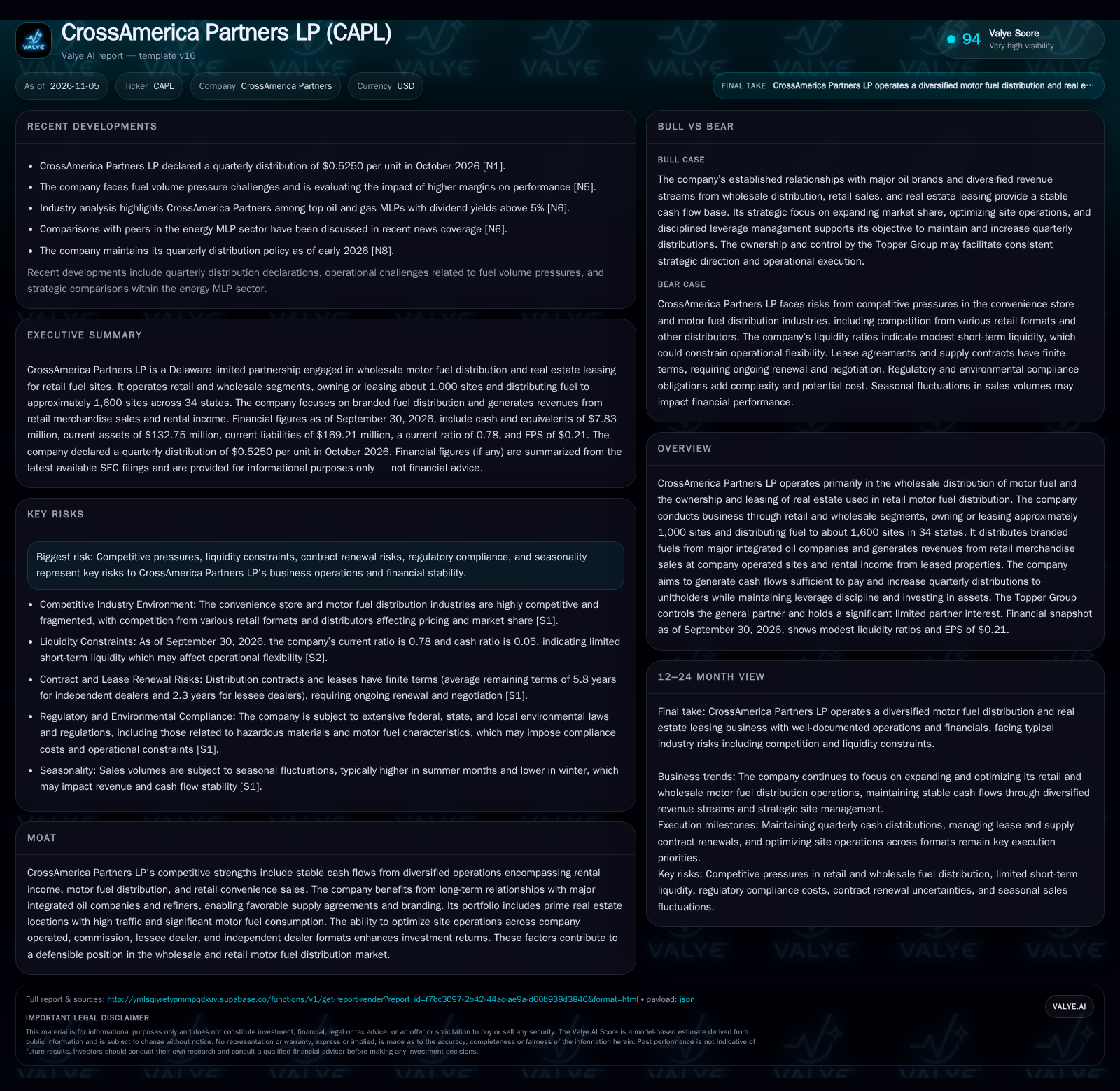
CrossAmerica Partners LP operates a diversified fuel distribution and real estate business, distributing branded fuels to about 1,600 sites across 34 states and deriving rental income from its property portfolio. The company is maintaining quarterly distributions despite modest short-term liquidity, but faces fuel volume pressures and must continually renew supply and lease contracts to sustain cash flow. Its competitive position relies on long-standing oil major partnerships, real estate ownership, and multi-format site operations, but the path forward depends on margin management, contract renewals, and response to industry consolidation and regulatory demands. [S1] [S2] [N1] [N5]
CrossAmerica Partners LP stands at a crossroads shaped by the interplay of stable distribution priorities, tightening fuel volumes, and the economics of property ownership in an evolving motor fuel value chain. The next phase will test management’s ability to optimize site operations, secure contract renewals, and extract value from its real estate portfolio while meeting the expectations of income-focused unitholders.
Distribution Commitment Amid Fuel Volume Headwinds
CrossAmerica Partners LP continues to prioritize quarterly distributions, declaring $0.5250 per unit in October 2026 despite a current ratio of 0.78 and cash on hand of $7.83 million as of September 30, 2026. This reflects the company's longstanding objective to generate distributable cash flow, even as it contends with fuel volume pressure—an industry-wide trend that may signal reduced throughput or heightened competition at the forecourt. The company’s real estate portfolio, with 1,000 owned or leased sites and rental income of $62.5 million from 212 sites in 2025, remains a core earnings pillar, while the renewal cycle for distribution and lease contracts (average remaining terms of 5.8 years for independent dealers and 2.3 years for lessee dealers) introduces recurring negotiation risk and potential volatility in future cash flows. [S1] [S2] [N1] [N5]
How Asset Mix and Margin Management Shape Cash Generation
CrossAmerica Partners derives revenue from three primary streams: wholesale fuel distribution, retail merchandise and fuel sales at company-operated sites, and rental income from its real estate footprint. The core economic engine is the wholesale segment, distributing predominantly branded fuel (about 95% in 2025) from major oil companies. Margins in wholesale fuel distribution are typically thin, making volume critical; however, fuel volume pressures have led the company to evaluate margin expansion as a compensatory lever. In retail, company-operated sites provide higher per-site revenue potential but expose the company to operating cost variability and retail competition.
The real estate component—owning or leasing about 1,000 sites and generating $62.5 million in rental income from 212 sites—introduces a relatively stable, asset-backed cash flow, with 56% of properties owned outright. This asset-heavy model provides optionality for sale-leasebacks or leveraging property value, but also requires ongoing capital for site maintenance and compliance. Operating leverage is mixed: while certain fixed costs are absorbed by scale, the need for continual investment in site upgrades, compliance, and contract renewals keeps capital intensity elevated. [S1] [S2]
Strategic Partnerships, Real Estate, and the Challenge of Industry Fragmentation
CrossAmerica Partners benefits from exclusive long-term supply contracts with major branded fuel suppliers (ExxonMobil, BP, Marathon, Shell, Valero, Phillips 66), which support volume commitments and pricing stability, but also tie the company’s fate to the economics of these brands. The real estate portfolio, particularly the ownership of 56% of properties, provides a moat through location control and recurring rental income, deterring entry by less capitalized competitors.
However, the broader market is highly fragmented, with competition from large national chains, regional operators, and alternative retail formats (e.g., warehouse clubs, grocery fuel centers). Industry consolidation and the rise of integrated convenience/retail platforms create pricing pressure and threaten share for mid-sized operators. Substitution risk is rising as electric vehicle adoption and low-emission mandates gather pace, although the timeline for material impact remains uncertain. The company’s multi-format approach (company-operated, commission agent, lessee, and independent dealer sites) adds operational flexibility but can dilute focus and complicate margin management.
Margin Gains and Real Estate Optimization Drive Distribution Growth
A favorable outcome for CrossAmerica Partners would involve successfully offsetting fuel volume pressure through sustained margin improvement—potentially via renegotiated supply terms, expanded higher-margin retail offerings, or operational efficiencies at company-operated sites. The company could also realize incremental value from its real estate portfolio, either by increasing rental rates, monetizing non-core assets, or executing sale-leaseback transactions to fund growth or reduce leverage.
Confirmation of this scenario would include evidence of higher per-gallon gross margins, rising rental income per site, successful lease and supply contract renewals at favorable terms, and continued or increased quarterly distributions. Additional signs would be stable or improving liquidity metrics despite ongoing distributions, and announcements of asset optimization strategies or accretive tuck-in acquisitions.
Navigating Contract Churn and Margin Pressures in a Flat Volume Environment
The most plausible near-term trajectory is one of stable to modestly declining fuel volumes, with the company working to preserve cash flow through incremental margin improvements and disciplined expense management. Distribution and lease contract renewals would proceed at a steady cadence, with occasional renegotiation friction but no systemic loss of major relationships. Rental income from the real estate portfolio would remain steady, and the company would maintain its distribution policy, barring a significant external shock.
This outcome would be confirmed by flat to slightly declining reported volumes, stable gross margins per gallon, regular quarterly distribution declarations, and periodic contract renewal disclosures. Falsification would come from sharp volume declines, contract losses to competitors, or a reduction in the quarterly distribution rate driven by liquidity or covenant constraints.
Contract Attrition and Liquidity Squeeze Undermine Distribution Stability
An adverse scenario would see CrossAmerica Partners lose key distribution or lease contracts—either through competitive displacement or unfavorable renegotiation—resulting in declining site count, lower fuel throughput, and reduced rental income. If margin expansion efforts fail to offset volume losses, cash flow could fall below distribution requirements, forcing a reduction or suspension of quarterly distributions.
Early warning signs would include reported contract non-renewals, sharp drops in distributed volumes, declining rental income, and a deterioration in current or cash ratios. A cut to the quarterly distribution would be a clear signal that downside pressures are materializing.
Testing the Resilience of CrossAmerica’s Distribution Model: What Will Move the Needle?
Quarterly disclosed fuel volumes by segment—declining throughput would pressure both wholesale and retail economics.
Gross margin per gallon trends—sustained improvement would validate margin management as a viable offset to volume headwinds.
Rental income per site and total property count—shifts here would signal success or weakness in real estate monetization and retention.
Contract renewal/displacement disclosures and average remaining term—shortening weighted average duration or increased churn would raise medium-term risk.
Quarterly distribution declarations and any changes to payout policy—a reduction or suspension would directly challenge the income thesis.
Evidence of asset sales, sale-leasebacks, or refinancing events—these would reveal management’s approach to capital structure under pressure.
Announcements related to electric vehicle infrastructure partnerships or alternative fuel initiatives—could signal adaptation to long-term demand shifts.
Disclaimer: This is research-only, informational analysis and not investment advice. It may include AI-generated interpretation and general industry context. Always verify important details using primary sources.

Comments