
BGSF Refocuses on Property Management Staffing: Narrower Scope, Sharper Execution, and the Stakes of Specialization
BGSF, Inc. has transformed into a pure-play property management staffing provider after divesting non-core segments, betting on scale, technology investment, and a specialized workforce model to defend margins in an intensely competitive, cyclical market. The question is whether its focused approach and operational discipline can offset customer churn, pricing pressure, and sector volatility.
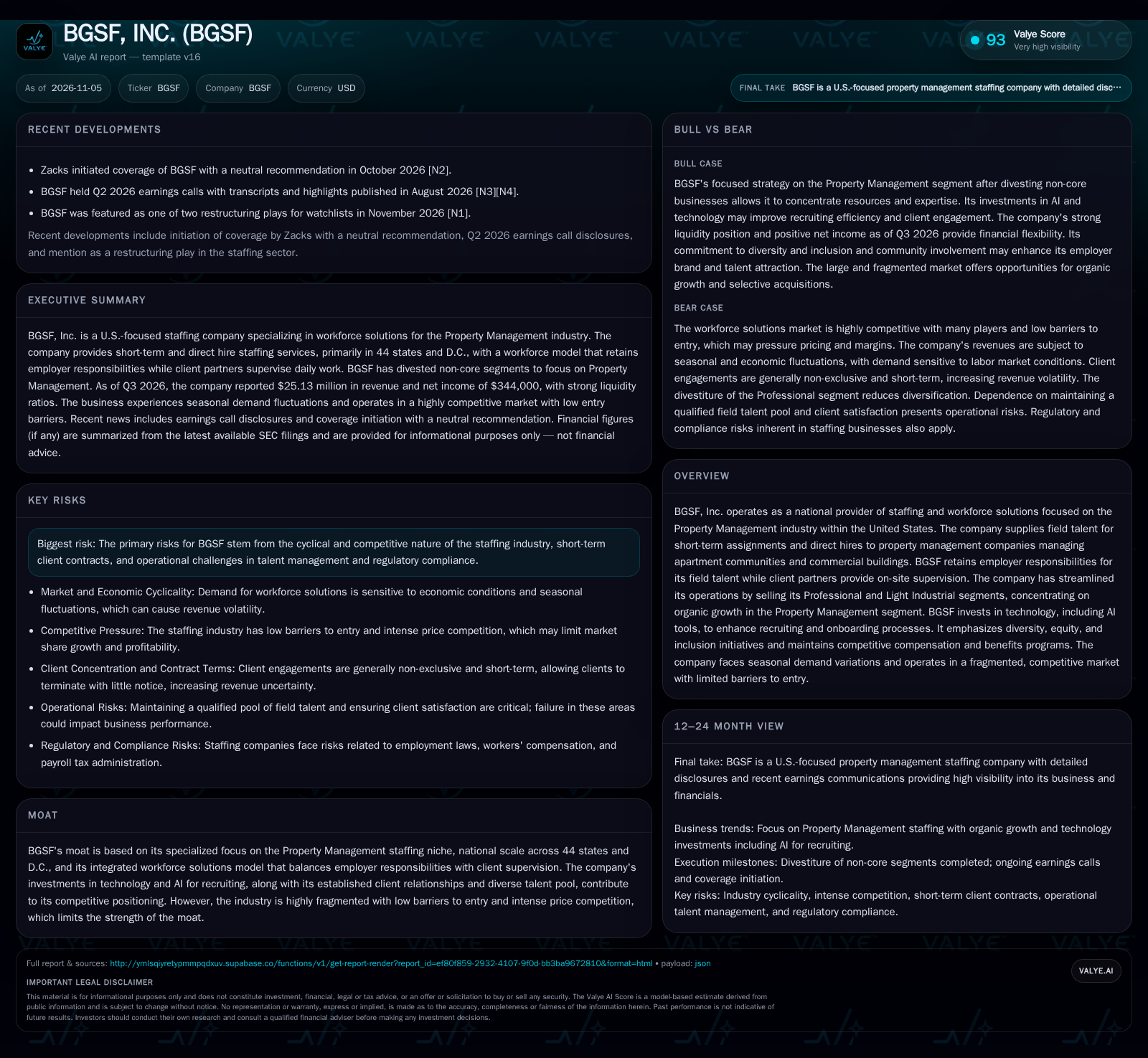
BGSF, Inc. now operates solely within property management staffing after selling off its Professional and Light Industrial segments. The company reported $25.13 million in Q3 2026 revenue, net income of $344,000, and maintains a reported current ratio of 5.06. Its business model, emphasizing on-demand and direct hire field talent, is supported by investments in AI-driven recruiting and diversity initiatives. However, the company faces seasonal swings, short-term client relationships, and intense industry competition, raising questions about the durability of its niche strategy and ability to sustain organic growth and profitability in a fragmented market. [S1] [S2]
BGSF, Inc. has undergone a significant transformation, shedding its Professional and Light Industrial divisions to become a focused provider of staffing and workforce solutions for the U.S. property management sector. By narrowing its scope, BGSF is betting that operational focus, technology-driven recruiting, and a scalable field talent model can carve out defensible economics in a market notorious for price competition and cyclicality.
BGSF’s Strategic Pivot and Financial Position: Where the Company Stands Now
BGSF, Inc. now operates as a pure-play staffing and workforce solutions provider exclusively serving the U.S. property management sector, following the sale of its Professional segment in September 2025 and its Light Industrial segment in March 2022. This strategic focus means all company resources and management attention are now dedicated to property management clients, which span 44 states and D.C. [S1]
The company reported Q3 2026 revenue of $25.13 million and net income of $344,000, with a basic EPS of $0.03. As of the end of the quarter, BGSF reported $9.3 million in cash, $8.6 million in short-term investments, and a current ratio of 5.06. The company reported cash and liquidity metrics for the period; these figures do not by themselves establish operating runway, investment capacity, financial flexibility, or financing capacity. [S2]
BGSF’s workforce model places roughly 9,600 field talent in client positions annually, with 92% of its total workforce classified as field talent. This structure allows clients to flex labor costs while BGSF retains employer responsibilities for wages, benefits, and payroll taxes. [S1]
Recent analyst coverage from Zacks was neutral, indicating market skepticism about the company’s ability to overcome sector headwinds and maintain its earnings trajectory. [N2]
How BGSF’s Workforce Model Shapes Its Revenue, Costs, and Margin Dynamics
BGSF generates revenue by placing field talent with property management clients, earning fees for both on-demand/short-term assignments and direct hires. The company’s value proposition rests on allowing property managers to convert fixed personnel costs into variable expenses, which can be compelling in an industry marked by unpredictable tenant turnover and maintenance demands.
BGSF’s cost structure is heavily variable: the largest expense is direct compensation and benefits for field talent, which scales with placement volume. The company maintains employer-of-record responsibilities, absorbing payroll tax and benefits costs, while clients provide on-site supervision. This model limits fixed overhead but exposes margins to wage inflation, benefit cost increases, and any mismatch between bill rates and pay rates.
Seasonality is pronounced, with Q2 and Q3 historically stronger due to higher multifamily unit turnover in summer. This means revenue and margin visibility are limited, and operating leverage is only modest outside of peak periods.
Technology investments—including AI tools for recruiting and onboarding—are designed to improve placement efficiency and retention, potentially reducing sourcing costs and turnover. If these tools can lower time-to-fill or increase candidate quality, BGSF could see improved gross margin, but this effect remains to be quantified in financial results.
Specialization vs. Scale: BGSF’s Place in a Fragmented, Low-Barrier Market
BGSF operates in a highly fragmented workforce solutions sector, with numerous regional and national staffing firms vying for property management placements. The industry’s low barriers to entry—few licensing requirements, limited capital needs, and non-exclusive client relationships—fuel intense price and service competition.
BGSF’s primary differentiation comes from its exclusive focus on property management staffing, national scale, and investments in AI-driven recruiting and onboarding. This specialization could provide a reputation and network advantage with property managers, but such advantages are inherently fragile absent long-term contracts or proprietary candidate pools.
Competitive threats come from both large generalist staffing firms with broader resources and smaller local agencies with lower cost structures and deep community ties. Technology-enabled disruptors, including online staffing platforms and gig-economy models, represent additional substitution risk, particularly for short-term assignments.
Retention of qualified field talent and responsiveness to client needs are critical; failure in either area can quickly erode market share given the short-term, non-exclusive nature of most staffing agreements. The company’s diversity, equity, and inclusion programs may help attract a broader talent pool, but do not insulate BGSF from wage competition or client churn. [S1]
If Tech-Driven Recruiting and Niche Focus Drive Sustainable Growth
The bull case for BGSF rests on its ability to leverage AI and technology investments to create a more efficient, effective recruiting and onboarding engine, resulting in faster placements, lower sourcing costs, and improved field talent retention. If these gains translate into higher fill rates, better candidate quality, and lower turnover, BGSF could command a reputation premium and see improved client retention.
A focused property management strategy could allow BGSF to deepen relationships with large multifamily and commercial property managers, potentially winning preferred vendor status or multi-property engagements. If the company can demonstrate consistent service delivery and compliance expertise, clients may be more willing to engage on recurring or longer-term arrangements, increasing revenue visibility and margin stability.
Evidence supporting this scenario would include: sustained organic revenue growth above industry averages, rising gross margins attributable to technology-enabled efficiencies, increased average assignment duration, and evidence of new or expanded client relationships with national property management firms. Disclosures of multi-year contracts or preferred vendor status would help confirm this trajectory.
Core Dynamics Likely to Persist: Modest Growth, Margin Pressure, and Volatility
The most plausible path for BGSF is continued organic growth in the property management segment, offset by persistent margin pressure and revenue volatility driven by seasonality, economic cycles, and competitive pricing. The company’s specialized focus and technology investments may yield incremental gains in efficiency or client engagement, but these are likely to be gradual and contested by rivals adopting similar tools.
Client engagements will remain mostly short-term and non-exclusive, limiting revenue visibility and making the business sensitive to local labor market dynamics and client staffing decisions. Wage inflation and benefits costs could outpace bill rate growth, particularly if competition for qualified field talent intensifies.
Evidence supporting this scenario would include: stable but modest annual revenue growth, relatively flat gross margins, continued concentration in short-term assignments, and little change in the mix or duration of client contracts.
What Happens If Pricing Power Erodes and Labor Markets Tighten?
The bear case centers on a combination of intensifying competition, client price sensitivity, and tight labor markets that make it difficult for BGSF to recruit and retain enough qualified field talent without sacrificing margin. If large generalist firms or tech-enabled disruptors undercut pricing or offer more flexible arrangements, BGSF could see client attrition and margin compression.
Economic downturns or sector-specific shocks (e.g., a significant decline in multifamily construction or property management budgets) could sharply reduce demand for temporary and direct hire staffing. Because most client engagements are short-term and non-exclusive, revenue could drop quickly with little contractual cushion.
Operational missteps—such as compliance failures, payroll errors, or inability to deliver quality talent—could further erode reputation and client trust, amplifying losses.
Evidence of this scenario would include: declining revenue and gross margin, increased turnover among field talent, negative client feedback or lost accounts, and a shift in coverage from neutral to negative by industry analysts.
Milestones and Metrics That Will Clarify BGSF’s Strategic Payoff
Quarterly organic revenue growth in the Property Management segment, particularly relative to overall industry trends and competitors, would indicate whether the focused strategy is gaining traction.
Gross margin trends, especially any improvement attributable to technology investments or shifts in assignment mix, will help test the impact of AI and efficiency initiatives.
Average duration and type of client engagements—short-term vs. recurring or multi-year—would clarify revenue visibility and relationship depth.
Field talent turnover rates and fill times for open assignments would provide insight into recruiting effectiveness and talent pool stability.
Client concentration metrics (e.g., top 10 clients as a percentage of revenue) and any announcements of new multi-property or preferred vendor relationships would test the thesis of deepening client partnerships.
Updates on technology adoption rates among recruiters and any quantifiable impact on placement speed or quality would signal whether investments are yielding operational leverage.
Disclosures of regulatory or compliance incidents, or any material increases in wage or benefits costs, could act as early warnings for margin or operational risk.
Disclaimer: This is research-only, informational analysis and not investment advice. It may include AI-generated interpretation and general industry context. Always verify important details using primary sources.

Comments