
Addus HomeCare: Scaling Through Acquisition, Margin Pressures, and the Stakes of Service Integration
Addus HomeCare’s latest results highlight robust revenue growth and positive earnings, but the company’s ongoing acquisition strategy—exemplified by the AccentCare personal care division purchase—raises integration and margin questions amid persistent regulatory and reimbursement headwinds.
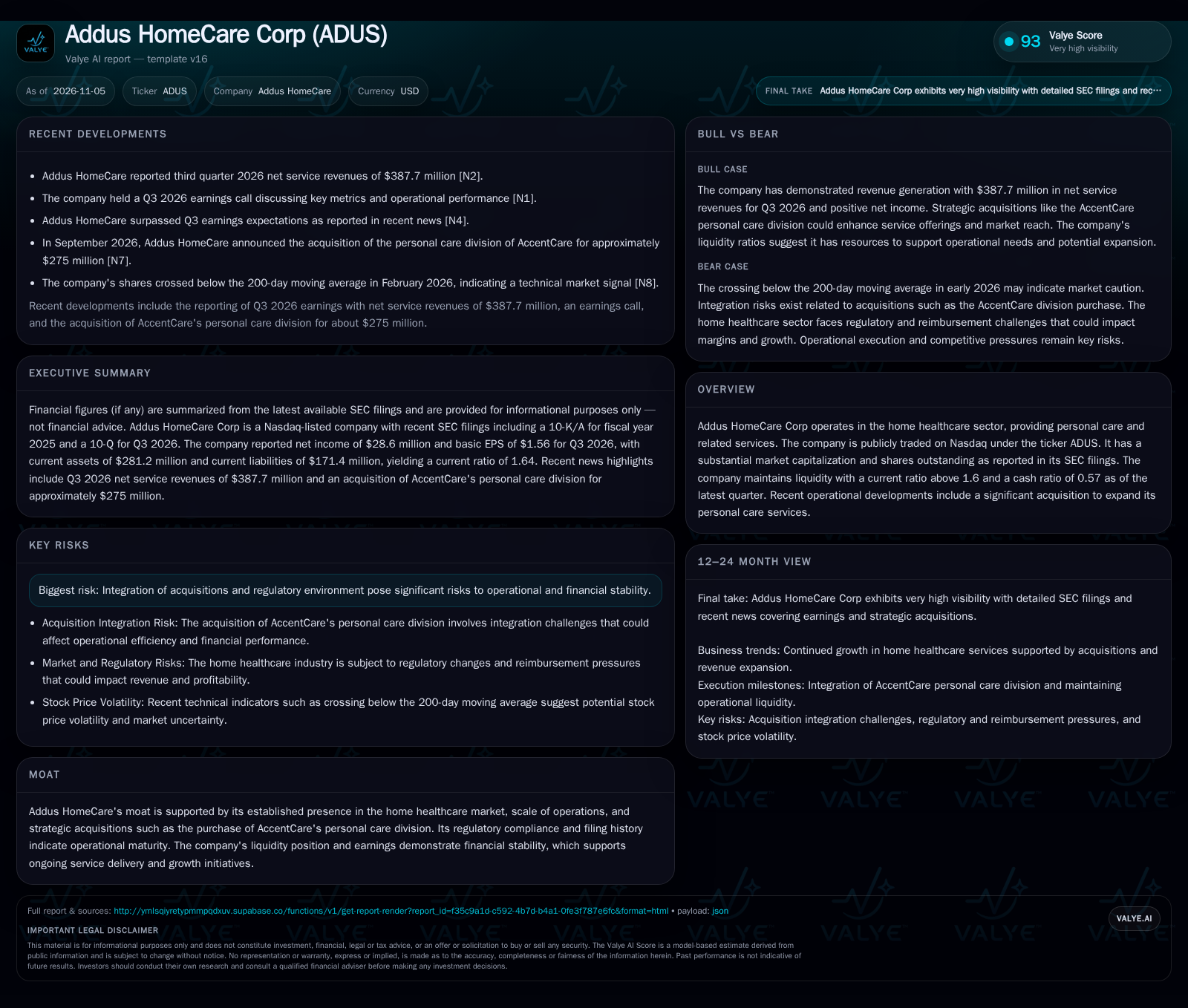
Addus HomeCare reported Q3 2026 net service revenues of $387.7 million and net income of $28.6 million, reflecting continued growth and profitability. The company’s acquisition of the AccentCare personal care division signals a push for greater scale and service breadth, but integration risks and sector-wide regulatory pressures remain central to its outlook. Liquidity metrics show operational stability, while market caution is evident from recent technical signals. The key question is whether Addus can sustain margin and growth momentum as the home healthcare landscape evolves. [S2] [N2] [N7] [N8]
Addus HomeCare’s recent quarterly results underscore the complex trade-offs facing home healthcare operators scaling through acquisition. With Q3 2026 net service revenues of $387.7 million and positive earnings, Addus is executing on a strategy of expanding its service portfolio and geographic reach, most notably through the acquisition of AccentCare’s personal care division for approximately $275 million. While liquidity metrics remain solid, the company operates in a sector where regulatory and reimbursement trends can rapidly alter unit economics. As Addus integrates new assets and faces evolving payment models, the sustainability of its growth and profitability will hinge on its ability to manage cost pressures and realize synergies.
Recent Performance and Strategic Actions Define Addus’s 2026 Position
Addus HomeCare reported net service revenues of $387.7 million for Q3 2026, with net income of $28.6 million and basic EPS of $1.56, reflecting continued operational profitability [S2] [N2]. The company’s acquisition of the AccentCare personal care division for approximately $275 million marks a significant expansion in service capacity and market reach [N7]. [S2] Market sentiment has been mixed, as seen in the shares crossing below the 200-day moving average in early 2026 [N8]. Together, these facts frame a company balancing growth initiatives with the challenge of integrating new operations and navigating sector volatility.
How Addus Monetizes Home Healthcare: Volume, Mix, and Margin Dynamics
Addus HomeCare generates revenue primarily through personal care, hospice, and home health services, with reimbursement coming from a blend of Medicaid, Medicare, and managed care payers. Revenue growth is typically volume-driven, hinging on the ability to recruit and retain care providers, expand geographic presence, and win contracts with payers and referral sources. The acquisition of AccentCare’s personal care division likely adds substantial volume and the potential for cross-selling broader service lines.
The economics of home healthcare are characterized by relatively low fixed costs at the branch level but high labor intensity, as direct care staff represent the bulk of expenses. Operating leverage can materialize if Addus achieves higher client density in existing markets or streamlines administrative overhead through scale, though this is counterbalanced by persistent wage inflation and the need to maintain compliance infrastructure.
Margins are especially sensitive to reimbursement rate changes, mix shifts between Medicaid and Medicare, and the effectiveness of utilization management. Acquisitions can improve bargaining power with payers and suppliers, yet integration costs and potential cultural mismatches may temporarily dampen profitability. Capital requirements remain moderate, focused on working capital, selective M&A, and technology upgrades—rather than heavy asset investment.
Assessing Addus’s Edge in a Crowded, Regulated Market
Addus operates in a fragmented industry populated by regional players, national chains, and vertically integrated managed care organizations. Its scale—enhanced by acquisitions like AccentCare’s personal care division—may confer advantages in payer negotiations, compliance, and recruitment, but these strengths are not unassailable. The sector’s low barriers to entry for basic personal care services mean local competitors can often undercut on price or flexibility, especially in states with less restrictive licensing.
Regulatory requirements, accreditation, and payer relationships do create switching frictions for both clients and referral sources, but these are rarely absolute. Addus’s competitive position could be reinforced if it demonstrates superior care quality, technology-enabled service coordination, or more efficient integration of acquired assets. However, managed care organizations and hospital-at-home initiatives represent potential substitutes that could pressure traditional home care providers if payment models shift or if hospital systems seek to internalize more post-acute care.
The company’s ability to differentiate may ultimately rest on its capacity to deliver consistent outcomes at scale, manage compliance costs, and adapt to evolving reimbursement schemes faster than smaller peers.
Synergy Realization and Regulatory Tailwinds Could Accelerate Profitable Growth
If Addus successfully integrates the AccentCare personal care division, achieving operational synergies and expanding its referral network, the company could see accelerated revenue growth and improved margins. A favorable reimbursement environment—such as Medicaid rate increases or expanded home-based care waivers—would further enhance profitability. Evidence for this scenario would include above-trend revenue growth in newly acquired markets, a rising EBITDA margin, and positive commentary from management on cost savings and referral expansion.
This upside would be supported by stable or increasing reimbursement rates, minimal attrition among acquired staff, and the ability to leverage technology to improve scheduling, billing, and compliance. Confirmation would come from future quarters showing revenue and margin expansion outpacing sector averages, rapid integration of acquired branches, and new payer contracts or expanded service lines in core geographies.
Incremental Growth Amid Margin Pressures and Ongoing Integration
The most plausible path for Addus is continued mid-single-digit revenue growth, driven by both organic expansion and the partial contribution from recent acquisitions. Integration of the AccentCare personal care division may proceed steadily, but with typical transitional costs and some temporary margin compression. Reimbursement rates are likely to remain flat to modestly up, with occasional state-level adjustments and ongoing pressure from managed care payers.
Margins may stay stable or contract slightly due to wage inflation and integration expenses, partially offset by incremental operating leverage. Confirmation of this scenario would include revenue in line with recent quarters, gross and operating margins within historical ranges, and management commentary focused on integration milestones and steady payer relationships. Evidence against this scenario would be either rapid margin improvement (suggesting upside) or a marked deterioration in financials or integration execution (suggesting downside).
Integration Stumbles and Adverse Policy Shifts Could Undermine Profitability
The primary risk for Addus is that integration of the AccentCare personal care division proves more costly or disruptive than anticipated, leading to operational inefficiencies, client attrition, or unanticipated regulatory hurdles. Simultaneously, if state or federal reimbursement rates are cut or payment models change unfavorably (e.g., increased prior authorization requirements or managed care carve-outs), revenue and margins could decline.
Negative evidence would include missed synergy targets, higher-than-expected turnover among acquired staff, increased compliance or IT costs, and a decline in branch-level profitability. Material contract losses, adverse regulatory developments, or a failure to absorb new markets efficiently would signal a more severe downside. A sharp drop in liquidity or a need for unexpected external financing to cover integration shortfalls would also confirm this scenario.
What Will Reveal Addus’s Acquisition Payoff and Margin Trajectory?
Quarterly revenue and EBITDA margin trends, especially in the quarters following the AccentCare integration, will clarify whether synergies are being captured or if costs are rising.
Attrition rates among staff in newly acquired branches—if disclosed—would help test cultural fit and operational continuity.
Updates on payer contract renewals, new contract wins, or reimbursement rate changes will indicate Addus’s negotiating leverage and revenue visibility.
Any commentary or quantitative disclosure on cost savings or integration milestones following the AccentCare division acquisition.
Branch-level profitability metrics—if provided—would show whether scale is translating into local market strength or being offset by wage/overhead pressures.
Changes in the mix of Medicaid vs. managed care vs. private pay revenue could signal shifts in reimbursement risk.
Disclaimer: This is research-only, informational analysis and not investment advice. It may include AI-generated interpretation and general industry context. Always verify important details using primary sources.

Comments