
Murphy Oil: Operational Leverage, Regulatory Exposure, and the Stakes of Capital Discipline in E&P
Murphy Oil’s latest quarter illustrates both the earnings power and inherent fragility of today’s independent E&P business model.
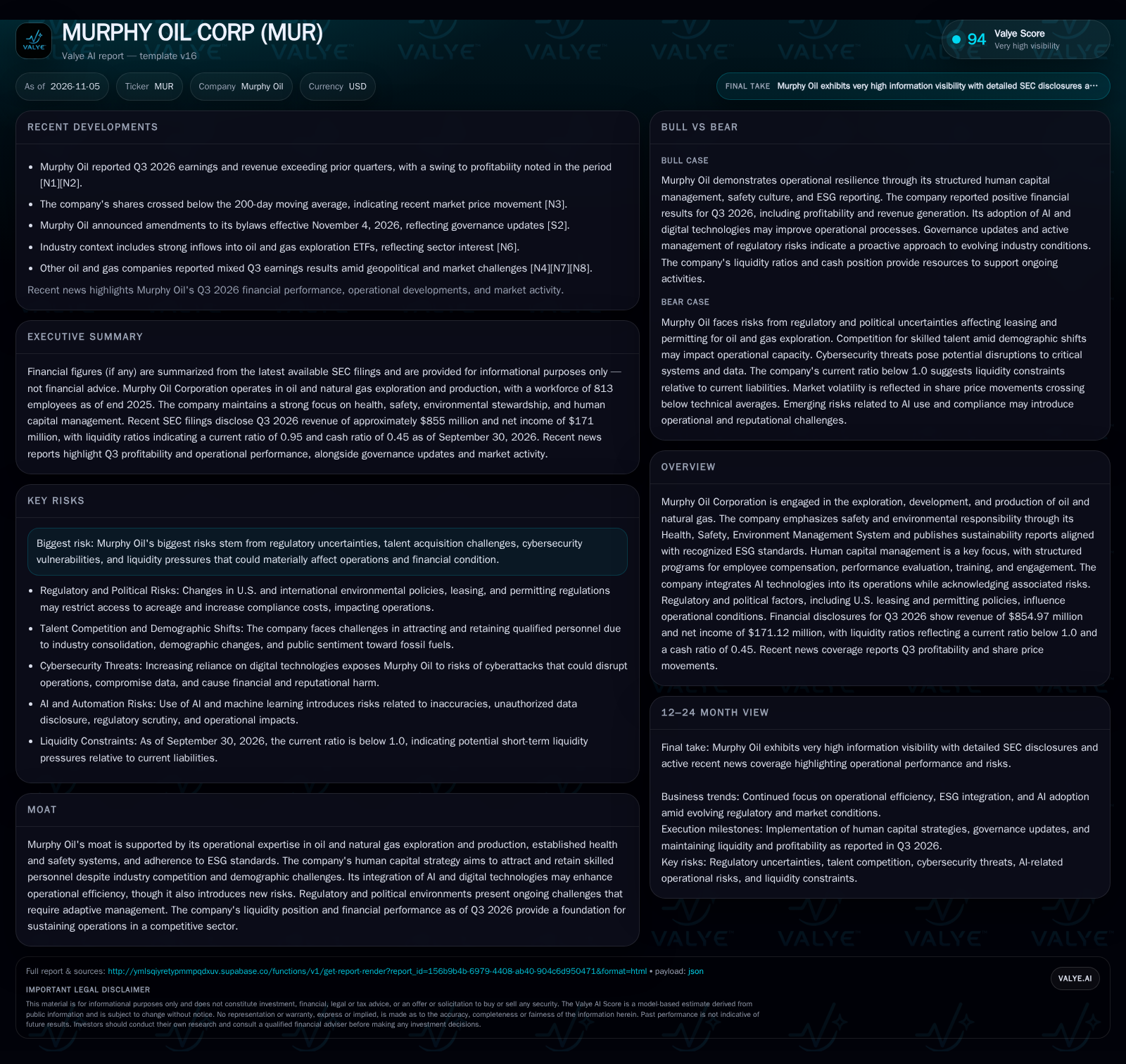
Murphy Oil posted a strong Q3 2026 profit and revenue rebound, but its liquidity ratios remain below comfort thresholds, highlighting sector volatility and capital intensity. The company’s focus on ESG, digitalization, and human capital management aims to build resilience, yet regulatory and talent risks persist. Investors should watch for sustained profitability, liquidity improvements, and the impact of policy or market shocks on future performance.
Murphy Oil’s latest quarter illustrates both the earnings power and inherent fragility of today’s independent E&P business model. While the company delivered strong Q3 2026 financials, including a swing to net profit and solid revenue growth, its liquidity ratios remain below typical comfort thresholds, highlighting the capital intensity and volatility of the sector. Strategic priorities—spanning ESG, AI-enabled operations, and human capital management—are geared toward operational resilience, but regulatory and talent headwinds persist. The central question for investors is whether Murphy can sustain profitability and investment discipline against a backdrop of commodity price swings, evolving environmental policy, and a tightening labor pool [S2] [S1] [N1] [N2].
Earnings Rebound and Liquidity Tension Define Murphy Oil’s Near-Term Position
Murphy Oil reported Q3 2026 revenue of approximately $855 million and net income of $171 million, marking a clear improvement over prior quarters and indicating the company’s ability to capture value during periods of favorable commodity pricing [S2] [N1] [N2]. The company reported cash and liquidity metrics for the period; these figures do not by themselves establish operating runway, investment capacity, financial flexibility, or financing capacity. [S2] The company’s shares recently crossed below the 200-day moving average, reflecting shifting investor sentiment and possibly heightened concerns about the durability of recent financial gains or sector headwinds [N3]. Governance updates, including amended bylaws, signal ongoing attention to corporate oversight in a dynamic operating environment [S2].
How Murphy Oil’s Cash Flow Engine Responds to Commodity Cycles and Cost Pressures
Murphy Oil’s economic model is fundamentally shaped by the volatile dynamics of oil and gas commodity pricing, with revenue and profitability highly sensitive to realized prices and production volumes. Upstream E&P operations like Murphy’s typically feature high fixed costs (leasehold, drilling, production infrastructure) and variable input costs (labor, services, consumables), resulting in strong operating leverage—margins expand rapidly as prices rise, but contract sharply in downturns. The company’s Q3 swing to profitability likely reflects a combination of price tailwinds and operational execution, though the lack of disclosed hedging instruments as of September 30, 2026, leaves the business fully exposed to future price swings [S2].
Sustained investment is required to replace reserves and maintain production rates, so the company’s ability to internally fund capex—or access external financing on reasonable terms—remains a critical variable. ESG investments, digitalization (including AI integration), and human capital initiatives add to the cost base but may also drive long-term efficiency gains and risk mitigation if executed well [S1].
Operational Discipline, ESG Alignment, and the Battle for Talent in a Consolidating Sector
Murphy Oil’s competitive stance is shaped by its operational expertise in exploration and production, adherence to health and safety norms, and proactive ESG reporting. These factors offer some insulation from regulatory and reputational risks, but the company operates in a sector marked by intense competition from larger integrated oil companies, other independents, and, increasingly, non-fossil fuel substitutes. The integration of AI and machine learning in operations may provide incremental efficiency and decision-quality advantages, though such gains are not exclusive and can be rapidly replicated by peers with similar technology adoption ambitions.
A growing challenge is talent acquisition and retention, as industry consolidation and demographic shifts tighten the pool of skilled professionals. Murphy’s structured human capital management is intended to mitigate these pressures, but larger competitors may offer more attractive compensation or career prospects. Regulatory risk—particularly shifting U.S. and international policies on leasing, permitting, and emissions—remains a sector-wide threat, with Murphy’s asset portfolio and future growth prospects directly exposed to policy changes [S1].
If Commodity Prices Hold and Murphy Accelerates Operational Efficiency Gains
In a favorable scenario, global oil and gas prices remain elevated or stable, allowing Murphy Oil to sustain or expand its revenue and margin base. Continued cost discipline, successful deployment of AI-driven operational improvements, and effective talent management could further enhance cash flow conversion and lower the break-even threshold for new projects.
Additional validation could include public disclosure of major efficiency milestones, new low-cost production brought online, or successful navigation of regulatory hurdles for new projects.
Managing Volatility: Murphy Oil’s Most Likely Course in a Mixed Macro and Policy Environment
The most plausible path for Murphy Oil is continued profitability, but with earnings and cash flow subject to quarter-to-quarter swings driven by commodity prices, regulatory developments, and operational execution. The company is likely to focus on steady production, incremental efficiency gains, and careful capital allocation, with a persistent eye on liquidity management due to its sub-1.0 current ratio. ESG and digital initiatives will continue, but their full impact on margins and risk mitigation may take time to materialize.
This scenario would be confirmed by relatively stable revenue and net income trends, maintenance of production levels, and moderate improvements in liquidity metrics over time. Further evidence would include successful navigation of regulatory filings, absence of major operational disruptions, and incremental progress in human capital and digital transformation disclosures. A deviation from this path—such as a significant regulatory setback, operational incident, or worsening liquidity—would shift the outlook toward the downside.
What Happens If Regulatory, Talent, or Liquidity Shocks Hit Simultaneously?
A negative scenario would unfold if Murphy Oil faces a convergence of adverse events: a sharp drop in oil and gas prices, regulatory delays or restrictions limiting new development (especially in U.S. federal acreage), and intensified competition for skilled workers, leading to operational bottlenecks or cost inflation. In this context, the company’s liquidity constraints could become acute, potentially forcing asset sales, capital expenditure cuts, or new debt issuance at unfavorable terms.
This scenario would be confirmed by declining revenue and net income, deterioration in the current and cash ratios, increased leverage, or a reduction in production and reserves. Additional red flags would include negative revisions to forward guidance, management commentary on cost or regulatory pressures, or external signals such as credit rating downgrades. A material cyber or operational incident could further amplify the downside risk profile.
Milestones and Metrics That Will Clarify Murphy Oil’s Resilience and Strategic Trajectory
Quarterly production and reserve replacement rates: If disclosed, these would reveal whether Murphy is offsetting natural decline and supporting future revenue.
Updates on regulatory approvals and permitting for new exploration or development projects: Delays or denials would be early warning signs for growth constraints.
Disclosures on realized commodity prices and hedging activity: These would clarify the degree of exposure to market swings.
Progress in implementing AI and digital efficiency initiatives: Concrete operational or cost milestones would test whether technology adoption is translating to financial impact.
Workforce retention and recruitment data: If disclosed, these would help assess the effectiveness of human capital strategies amid industry-wide talent shortages.
Incidence of cybersecurity or operational disruptions: Any material events here could signal vulnerability and impact both cost structure and reputation.
Changes in capital expenditure plans or asset divestitures: Shifts here would indicate management’s response to liquidity and market conditions.
Disclaimer: This is research-only, informational analysis and not investment advice. It may include AI-generated interpretation and general industry context. Always verify important details using primary sources.

Comments