
Mineralys Therapeutics: Lorundrostat’s Pivotal Moment, Capital Structure, and the Stakes of Cardiorenal Innovation
With full IP control over lorundrostat and a substantial liquidity reserve, Mineralys Therapeutics approaches a critical inflection in its quest to commercialize a novel aldosterone synthase inhibitor for hypertension and related diseases. The company’s future now hinges on regulatory outcomes, the ability to differentiate in a crowded antihypertensive market, and the management of new debt obligations.
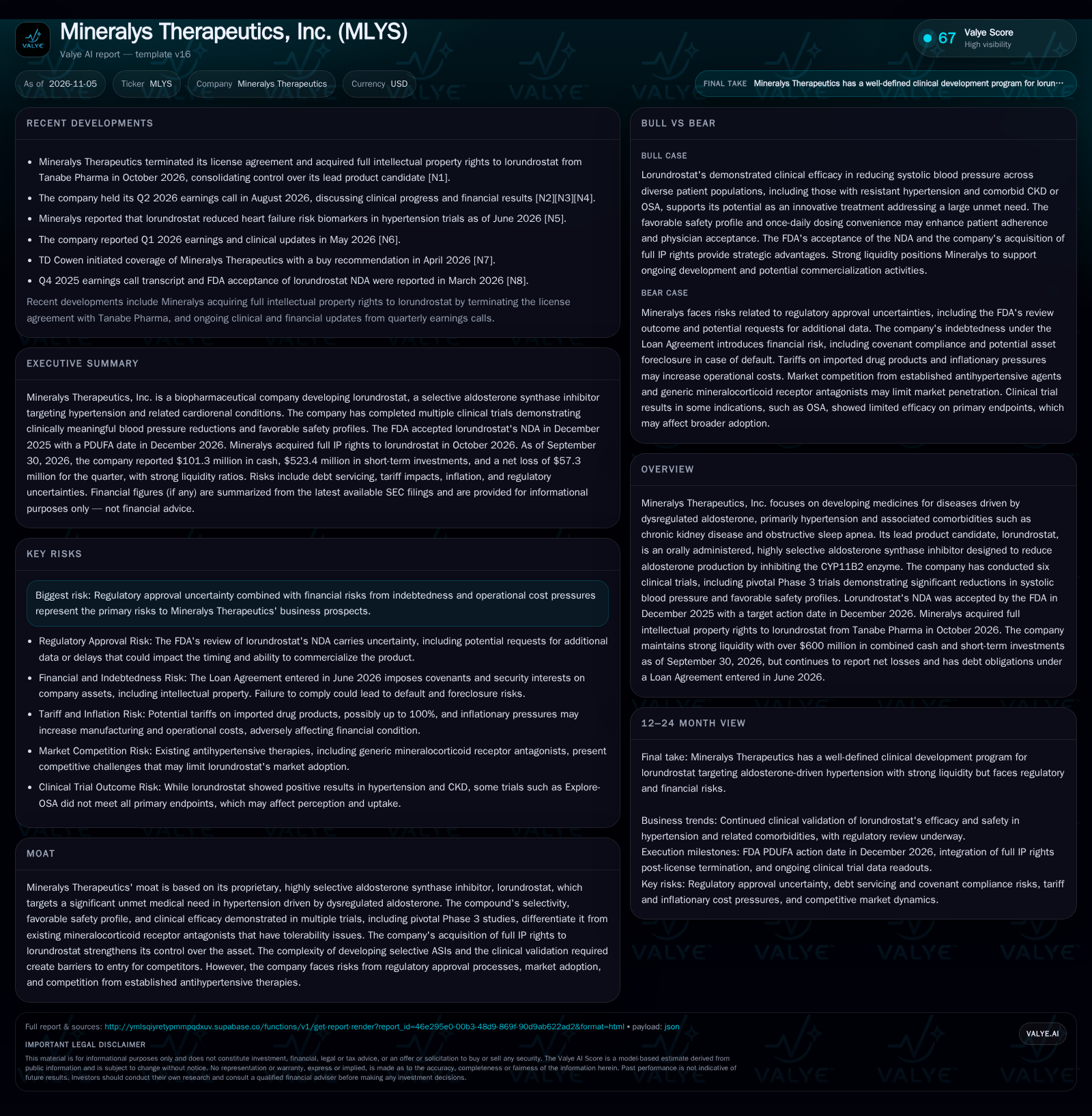
Mineralys Therapeutics has consolidated global rights to lorundrostat—its selective aldosterone synthase inhibitor—following the termination of its Tanabe Pharma license, and holds over $600 million in liquidity as of September 2026. While late-stage trials have shown significant blood pressure reductions and favorable safety, the company faces regulatory, financial, and competitive risks as it transitions from clinical development to potential commercialization. Debt incurred in June 2026 and outstanding regulatory approvals will be pivotal to its future trajectory. [S2] [N1] [N5]
Mineralys Therapeutics stands at a critical juncture following its acquisition of full global rights to lorundrostat, a highly selective aldosterone synthase inhibitor targeting hypertension and cardiorenal conditions. Backed by substantial liquidity but also new debt, the company is preparing for a potential transition from a clinical-stage biotech to a commercial enterprise. The next phase will test not only the clinical promise of lorundrostat, but also Mineralys’ ability to carve out a durable market position amid entrenched competition and heightened regulatory scrutiny. The coming quarters will reveal whether its strategic moves translate into sustainable value or expose it to the familiar pitfalls of late-stage drug development. [N1] [S2]
Gaining Full Control: Recent IP Consolidation and Financial Position
The most significant recent development for Mineralys Therapeutics is its October 2026 acquisition of full intellectual property rights to lorundrostat, ending its license agreement with Tanabe Pharma and consolidating global control over its flagship asset. This move removes a layer of dependency and potential royalty leakage, positioning Mineralys for greater strategic and economic flexibility in commercialization or partnership negotiations. The company reported cash and liquidity metrics for the period; these figures do not by themselves establish operating runway, investment capacity, financial flexibility, or financing capacity. Lorundrostat has demonstrated significant reductions in systolic blood pressure in pivotal Phase 3 trials and showed reduced heart failure biomarkers in hypertension cohorts, but efficacy in obstructive sleep apnea was less robust. These facts set the stage for a high-stakes regulatory and commercial transition. [N1] [S2] [N5]
Beyond the immediate financial and IP consolidation benefits, gaining full control over lorundrostat also enhances Mineralys’ strategic options for lifecycle management. With unencumbered rights, the company can pursue label expansions, combination therapy trials, or formulation improvements without the need for partner negotiation, thereby accelerating decision-making and potentially capturing incremental value. This autonomy also allows Mineralys to tailor its intellectual property strategy to evolving competitive threats, such as filing new patents on uses or formulations to extend exclusivity. However, this increased control brings the full burden of commercialization risk, requiring robust internal capabilities or carefully selected partnerships to navigate market entry complexities effectively.
From Pipeline to P&L: Economics of a First-in-Class Hypertension Drug
Mineralys’ revenue model, if lorundrostat is approved, would hinge on pricing power as a novel, differentiated therapy targeting aldosterone-driven hypertension and cardiorenal comorbidities. U.S. antihypertensive drug pricing typically reflects the degree of clinical differentiation, payer willingness, and competitive intensity; innovative therapies can command premiums if they demonstrate superior efficacy or safety, especially in resistant populations. However, generic mineralocorticoid receptor antagonists and entrenched antihypertensive agents constrain pricing headroom and necessitate robust health-economic evidence for formulary access.
The company’s cost structure is currently dominated by R&D and clinical trial expenses, but commercialization would shift the mix toward manufacturing, sales, and post-marketing surveillance. The oral, once-daily dosing of lorundrostat may support scalable, margin-accretive distribution if adoption is strong. Operating leverage could be significant if fixed SG&A and manufacturing costs are spread over a large patient base, but initial uptake may be gated by payer negotiations, physician education, and guideline inclusion. The June 2026 debt introduces recurring interest and potential covenant compliance costs, raising the bar for rapid revenue ramp and margin expansion.
The economics of launching a first-in-class hypertension drug like lorundrostat depend heavily on demonstrating value not just through clinical efficacy but also via health economics and outcomes research (HEOR). Payers increasingly demand evidence that new therapies reduce total cost of care, such as by lowering hospitalization rates or delaying progression of comorbidities. Mineralys’ ability to generate and communicate such data will be critical to justify premium pricing and favorable formulary placement. Moreover, the company must anticipate payer strategies such as step edits or prior authorization that could delay patient access. Strategically, investing in robust real-world evidence generation post-launch could mitigate these risks and support broader adoption over time.
Therapeutic Differentiation and the Challenge of Entrenched Alternatives
Mineralys’ potential competitive edge lies in lorundrostat’s mechanism as a highly selective aldosterone synthase inhibitor, which—if fully validated—could offer efficacy and tolerability advantages over existing mineralocorticoid receptor antagonists (MRAs) that are often limited by side effects such as hyperkalemia. The company’s moat is anchored in clinical trial data showing meaningful blood pressure reductions and a favorable safety profile, as well as its now-unencumbered IP position.
However, the antihypertensive market is crowded: generic MRAs, ACE inhibitors, ARBs, calcium channel blockers, and beta-blockers are well established, inexpensive, and supported by decades of outcomes data. For lorundrostat to win share, it must either address populations inadequately served by current therapies (e.g., resistant hypertension, CKD) or demonstrate compelling advantages recognized by prescribers and payers. The complexity of developing selective ASIs creates some technical barrier to direct competition, but the real battleground will be in physician adoption, payer access, and real-world outcomes.
While lorundrostat’s selective inhibition mechanism offers a mechanistic differentiation, its commercial success will depend on translating this into meaningful clinical and economic benefits recognized by stakeholders. Physicians may be hesitant to switch stable patients from established therapies unless the new drug demonstrates clear advantages in tolerability, adherence, or outcomes. Mineralys will need to invest in education and real-world evidence to shift prescribing behavior. Additionally, payers’ willingness to cover a novel agent in the face of cheaper generics may hinge on the drug’s impact on downstream costs, such as reducing cardiovascular events or hospitalizations. Competitive dynamics could also evolve if other companies develop rival selective aldosterone synthase inhibitors or alternative modalities targeting similar pathways, underscoring the importance of speed and differentiation in market entry.
How a Clean Regulatory Win Could Unlock a Cardiorenal Blockbuster
If lorundrostat secures FDA approval without major label restrictions and is rapidly adopted by hypertension specialists and primary care providers—particularly for patients with resistant hypertension or CKD—Mineralys could see accelerated revenue growth and operating leverage.
Confirmation of this scenario would come from a positive regulatory decision, favorable guideline inclusion, rapid payer coverage determinations, and early prescription trends in key target populations. Evidence of expanding clinical utility (e.g., in heart failure or CKD) and strong safety/tolerability signals in real-world data would further reinforce the upside. Conversely, delays in approval, restrictive labeling, or slow physician uptake would falsify this path.
Navigating Approval, Debt, and Gradual Uptake in a Conservative Market
The most plausible near-term outcome is that lorundrostat receives regulatory approval for a subset of hypertensive patients, but faces a measured adoption curve due to conservative prescribing habits, payer step therapy requirements, and the need for long-term outcomes data. Mineralys would likely launch with a focused specialty salesforce, targeting high-risk or treatment-resistant patients where the unmet need is greatest.
Revenue ramp may be modest initially, with operating losses persisting until broader clinical adoption and payer access are achieved. Missed milestones, reimbursement headwinds, or safety signals could push the trajectory toward the downside.
Regulatory Setbacks, Debt Strain, and the Risk of Strategic Contraction
A material downside scenario would involve regulatory delays, requests for additional data, or approval with restrictive labeling that limits lorundrostat’s addressable market. In this case, Mineralys could face prolonged operating losses, heightened covenant and foreclosure risk under its debt agreement, and the need to curtail commercial or pipeline investments.
Competitive headwinds from generics and lackluster payer adoption could further compress revenue potential, while inflation and tariffs may erode gross margins. Evidence confirming this scenario would include negative regulatory news, missed loan covenants, asset sales, or restructuring actions. Failure to achieve meaningful differentiation in real-world practice would also reinforce the bear case.
Milestones and External Forces That Will Define Mineralys’ Next Chapter
FDA regulatory review outcomes and label scope for lorundrostat—any delay, request for additional studies, or restrictive indication would materially alter commercialization prospects.
Early prescription and launch uptake data, if disclosed, particularly among resistant hypertension and CKD populations.
Payer coverage decisions, including formulary tiering, step therapy requirements, and any exclusion by major insurers.
Progress on guideline inclusion by hypertension societies, which would drive physician awareness and adoption.
Debt covenant compliance and liquidity trends, as persistent net losses or missed milestones could trigger asset risks.
Real-world safety and tolerability outcomes, especially regarding hyperkalemia and off-target effects.
Expansion into related indications (e.g., heart failure, CKD) or initiation of pivotal trials in adjacent cardiorenal populations.
Any announced commercial partnership, co-promotion, or out-licensing deal that clarifies go-to-market strategy and economics.
Disclaimer: This is research-only, informational analysis and not investment advice. It may include AI-generated interpretation and general industry context. Always verify important details using primary sources.

Comments